



Australian electricity costs are now two to three times higher than our global rivals.
BHP’s Mike Henry dropped that bombshell last month, warning we’re losing the energy investment race.
Sandfire Resources’ CEO piled on, noting others are delivering carbon-free power while we’re still debating how to get there.
The diagnosis is harsh, but everyone has a different prescription.
I’m not here to offer my own fix for the energy crisis. Everyone brings their own bias.
But while the debate rages over renewables versus nuclear or gas, one part of the solution is unavoidable: transmission lines and grid equipment.
Australia’s transmission network is old and stretched. No matter the energy source, the grid will need replacing.
To fix this, Australia has earmarked tens of billions in new transmission infrastructure by 2050.
Think about it. Whatever energy source eventually wins — solar, wind, nuclear, or hamsters on wheels — it all needs wires to reach your home.
And supporting those wires and services will become Australia’s next infrastructure opportunity.
The Grid That Wasn’t Built for This
The reality is that our transmission grid is having an identity crisis.
Built for one-way traffic from big coal plants to cities, it’s now being asked to juggle electricity flowing in every direction.
With one in three Aussie homes sporting rooftop solar, the grid has become a two-way street that wasn’t designed for traffic.
The infrastructure is also ancient. Much of our transmission network is over 40 years old and creaking under record use.
These bottlenecks are already costing billions as renewable projects wait up to two years for connection in Queensland and Victoria.
The problem isn’t unique to renewables, or to Australia.
In the US, new gas projects face similar delays: Three years for gas turbines. Four years for transformers. High-voltage cables and substations are also backlogged.
Supply simply can’t keep up with demand, and it’s about to get worse.
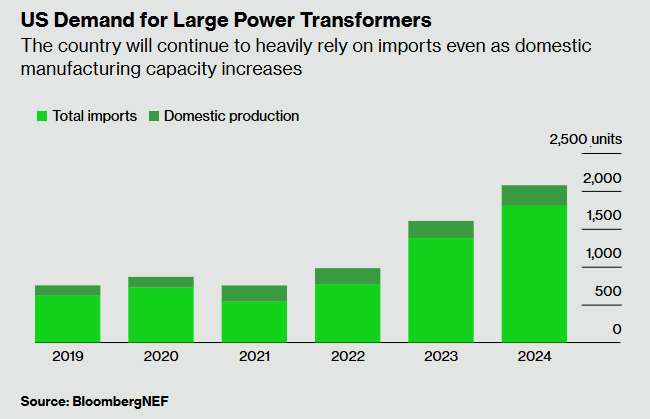
Source: Bloomberg
In May, Australia’s Energy Market Operator (AEMO) revealed that cost estimates for major transmission lines have jumped 25–55% in real terms since 2023, with some components nearly doubling after inflation.
These problems will likely worsen as data centres continue to expand their footprint.
The Great Replacement
Australia’s grid spans 918,000 kilometres — enough to circle Earth 23 times — but much of it is due for replacement.
In South Australia, 40% of towers and 30% of conductors are already past their asset life.
NSW’s Transgrid and Victoria’s AusNet are already rolling out major upgrade programs worth hundreds of millions.
Add to that the estimated 4,581 km of new transmission lines needed to meet 2030 targets, and you’re talking about serious cash flowing down to construction, parts, servicing, and all the rest.
Here’s AEMO’s latest conceptual map to give you an idea of the floated transmission plans.

Source: AEMO Draft Report, May 25
[Click to open in a new window]
Playing the theme
Australia’s electricity networks represent $123.2 billion in regulated assets.
In the past year alone, capital investment reached $7.4 billion, the highest since 2014.
So how do you invest to capture this trend?
Most infrastructure is state or foreign-owned. However, APA Group [ASX:APA] owns key infrastructure, including Basslink and the Pilbara gas pipeline system. It trades at a premium 11.8 times EBITDA but offers a 6.6% yield.
Builders like Genusplus Group [ASX:GNP] and Ventia [ASX:VNT] are winning construction and service contracts. Ventia landed a $500 million Transgrid service deal back in April.
While Genusplus has seen revenue climb 36% from FY24, and has a nearly $2 billion order book from the infrastructure rollouts.
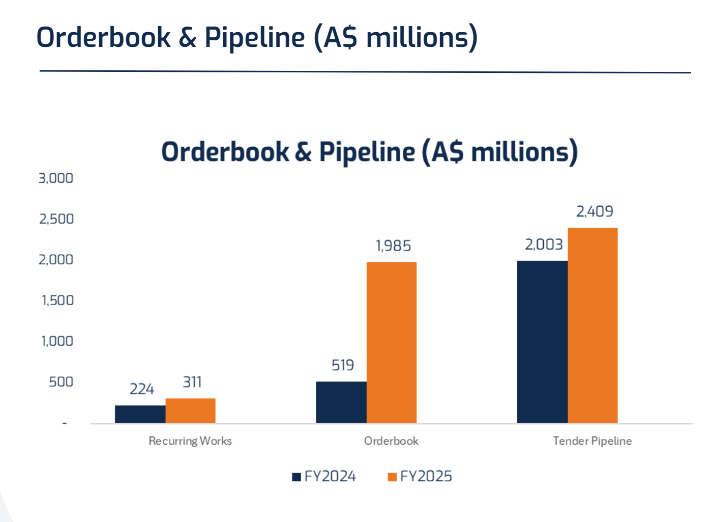
Source: Genusplus FY25 Report
Don’t forget technology providers. Every transmission line needs smart monitoring and control systems.
Foreign companies like Schneider Electric and ABB are selling the equipment that runs these systems.
Meanwhile, IPD Group [ASX:IPG] has been minting cash as a distribution hub for these electrical vendors while supporting data centre buildouts.
Got to pay the toll
Of course, nothing in infrastructure comes cheap.
Project costs are rising — for example, the 900km EnergyConnect link between SA, Victoria, and NSW has doubled to $4.1 billion.
As data centres grow, the old model where consumers shoulder costs through electricity bills is breaking down. The US is already seeing this, and Australia likely will too.
Still, one truth remains: we need more (and cheaper) power
I’m not here arguing what the future energy mix should be. The reality is probably going to be somewhere between what both sides want.
Here’s my bottom line: transmission infrastructure is this decade’s toll road.
When Sydney built its motorway network in the 1990s, smart investors bought the toll roads, not the car companies. They understood that regardless of whether people drove Toyotas or Teslas, they’d pay to use the road.
Same logic here. Whether our future energy comes from solar farms, wind turbines, or nuclear reactors, it still travels through transmission lines. The builders and owners get paid either way.
While everyone else debates which energy technology wins, you can invest in the roads they’ll all travel on.
In a world obsessed with the next big thing, sometimes the smartest investment is the boring infrastructure that makes the next big thing possible.
Australia’s about to spend billions proving that point.
Regards,

Charlie Ormond,
ATLAS and Altucher’s Investment Network Australia




Comments