




About three months ago, I told our gold expert Brian Chu to shut up shop and become a roughneck instead. His Australian Gold Fund should be closed down and replaced by an Australian Oil Fund, I said.
Why?
The gold to oil price ratio was screaming it loud and clear. It had hit extremes not seen since COIVD.
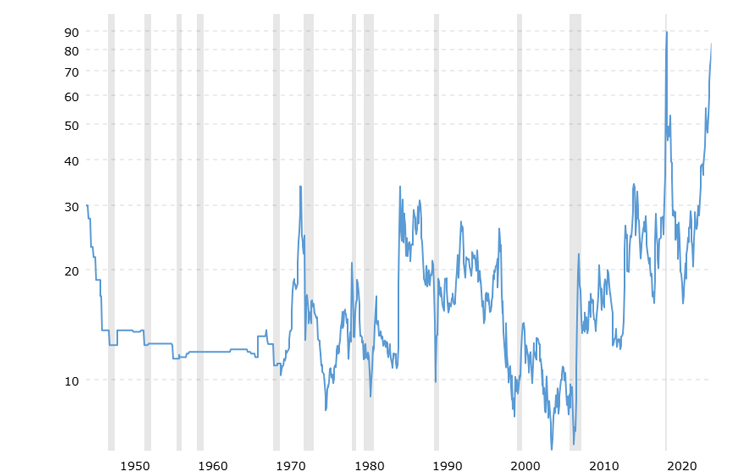
Source: Macro Trends
[Click to open in a new window]
This extreme overvaluation of gold relative to oil would not last, I told Brian. Oil prices were going to outperform gold in coming years. Investors should dump their gold stocks and wade into oil companies instead.
Luckily for all concerned, Brian didn’t take the suggestion seriously. He just politely smiled and nodded. He stuck with gold, and gold has soared since, while oil kept selling off…
Brian’s gold stock investing subscribers have been raking in the gains like nobody else. Despite his careful risk management ensuring profits get taken along the way.
However, the gold to oil price ratio has only grown more absurd with the continuing divergence. The last time it was at these levels, the oil price was outright negative.
I better clarify that. There are many different types of oil prices. They vary by location, quality, type and delivery dates.
The negative oil price only occurred in a segment of the oil market because of a lack of short-term storage in particular locations. So it’s a bit misleading to say oil prices were negative.
But the point is that we were in a lockdown the last time an ounce of gold bought you this much oil. The government was printing money hand over fist. And nobody was flying anywhere.
I believe the gold to oil price ratio must return to more normal levels eventually. It’s a matter of physics. I call it…
Investing’s Law of Relativity
It’s not as ironbound as the version you’ll find in physics. But it does hold true over time.
Investing’s Law of Relativity is quite simple. The relative price of assets cannot get too far out of kilter.
What’s a relative price?
How much oil an ounce of gold will buy you.
How much gas a barrel of oil will buy you.
How much silver an ounce of gold will buy you.
It’s about measuring the price of real stuff in terms of other real stuff. As opposed to using money as a measure.
These relative prices are measured in ratios. And the ratios mean revert.
But why focus on relative prices?
I recently heard an analyst say that gold is now a risky investment because ‘nothing can go up forever.’
This is wrong, because the value of money steadily declines each year. That’s the Reserve Bank’s stated policy goal. So the price of gold really does increase over the time period of ‘forever.’ Alongside the price of everything else, for that matter.
But this observation also makes the point I call ‘Investing’s Law of Relativity.’ The gold price can’t outperform other prices forever. Even if it never falls, expect other assets to rise faster at some point to bring back balance to their relative value.
The steady devaluation of currency over time thanks to inflation raises a problem that our Investing Law of Relativity fixes. Unlike in physics, there is no constant measure in finance. Everything is always fluctuating in value, especially because we measure it in dollar terms, which itself fluctuates.
Imagine conducting physics where gravity kept changing or the amount of millimetres in a centimetre grew. That’s what investors are dealing with.
The only meaningful measures in finance are relative measures. Hence the law of relativity.
The gold price to silver price ratio is a good example. Or the gold price to oil price ratio. Or the gas to oil price ratio.
These relationships are bound by physics. Their supply in the earth’s crust. Their cost of mining and transportation. And their usefulness. The amount of energy in a barrel of oil per British Thermal Unit of gas, for example.
It’s easy to understand why the price of oil and gas cannot diverge continuously over time. They are substitutes, to an extent. If one gets cheaper, more people buy it, which bids it back up. So there are limits to how cheap one can get relative to the other.
But relative pricing also extends to less tangible assets…
For example, consider stocks and bonds. The more stock prices go up, the more attractive bonds become in relative terms. If only when you compare the dividend yield to the bond coupon returns.
As a result, the relative prices oscillate around each other. One performs well…then the other catches up.
This creates oscillations in relative prices.
Oscillations tell you what to
buy and what to sell
Oscillations in relative prices define investors’ returns.
You must invest in something, even if it means just holding cash. But whether your portfolio outperforms depends on the oscillations between relative prices, not just your percentage gains.
After all, your aim is to outpace inflation after tax. And investors are usually judged by whether they outperformed an index like the ASX200. Again, only relative prices matter, not absolute.
So, how do you use Investing’s Law of Relativity to outperform?
Investors can buy what’s performed poorly and avoid what’s outperformed. Then wait for the laws of physics to kick in. The mean reversion must occur eventually.
It’s been that way for gold and silver prices lately. Not to mention the past 400 years, at least. Each time the gold or silver price surges ahead, it’s a signal that the other one is about to catch up. One cannot outperform the other indefinitely.
To be fair, it took a long time for silver to wake up. But the point still stands.
The same applies for the stock market. Sure, certain sectors can outperform the others, for a while. But doing so indefinitely would be a violation of investing’s Law of Relativity. At some point, the oscillation must kick in.
If you agree with all this, what
does it mean for investing today?
Right now, oil is cheap relative to other assets. That’s what the gold to oil ratio tells us.
We don’t know when. And we don’t know how absurdly out of line the relative values will get. But reversion to the mean means the oscillation will arrive and send oil higher eventually.
That’s why, right now is the best time to buy energy stocks in decades. Presuming you’re going to hold on for a few years, of course.
Which stocks fit the bill? More on that soon.
But oil isn’t the only undervalued sector. And since Brian isn’t going to set up shop outside of gold, let me recommend you this instead. It has begun its oscillation higher already.
Regards,

Nick Hubble,
Strategic Intelligence Australia



Comments