



All eyes are on the AI buildout.
But what if I told you that its success could be the end for hyperscales?
This seems counterintuitive, but it comes from a recent paper from Stanford.
And if its implications are true, then the Magnificent 7 companies are digging their own grave.
Well, except for one.
Maybe the most boring Mag 7 company has the solution.
Apple. A company that once held cult status among consumers and investors has drifted into the background in this AI era.
But maybe its conservative approach could pay dividends as AI intelligence blossoms.
First, let’s examine that intelligence, and then explore why Apple could be well positioned to profit.
Foothills of the singularity
Our AI tests and benchmarks are breaking down. We’ve had this issue for some time, but it’s hit a local zenith.
Many benchmarks face ‘saturation’, with AI scores over 90% and answers absorbed into the latest training. Still, a few are worth watching.
One, ominously titled ‘Humanity’s Last Exam’, has top AI scoring 55%.
This test is constructed from a rotating set of 2,500 expert questions contributed by thousands of professors and researchers at over 500 institutions.

Source: agi.safe.ai
[Click to open in a new window]
It’s an interesting test for gauging how broad AI’s knowledge base is. But for this argument, another test is more useful.
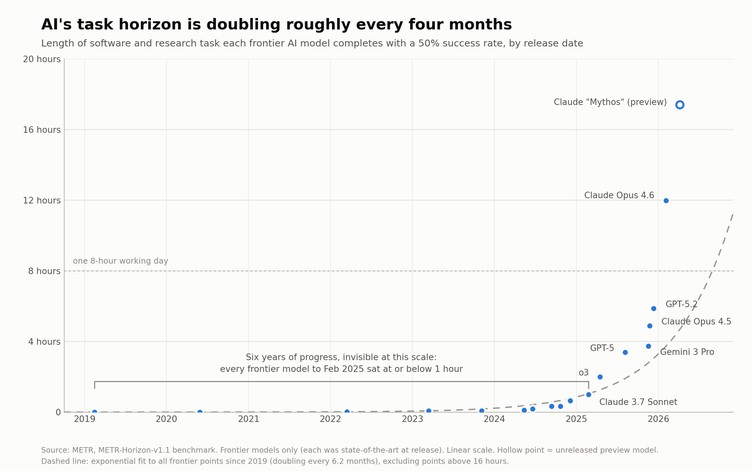
METR measures the difficulty of software tasks AI can complete, using the time those tasks take human experts as its yardstick.
At the 50% success threshold, an eight-hour task means the AI is expected to succeed half the time on tasks that take an expert roughly eight hours.
It doesn’t mean the AI runs for eight hours straight. And it certainly doesn’t mean you can hand it someone’s job and walk away.
Even with those qualifications, the progress is striking. Exponential.
You can think of this as ‘AI Moore’s Law’. The time it takes to double the duration used to be roughly 7-months (grey line).
Source: METR
[Click to open in a new window]
If we include the latest AI, those trends have accelerated to doubling every four months.
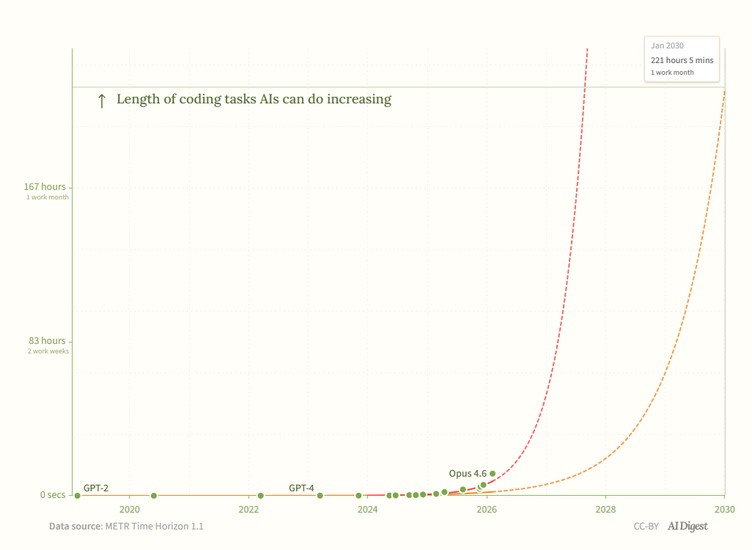
Here’s what those two trend lines look like if we zoom out. Our older 7-month trend in orange, and the latest 4-month doubling in red.
Source: AI Digest
[Click to open in a new window]
So right now, AI can complete coding tasks that would take around 14–18 hours of work.
Even conservatively, that could soon jump to many dozens of hours. From there, it’s days’ worth of work by 2027. Before long, that will be months.
This might even be too slow. Increasingly capable AI systems could even trigger a flywheel effect, further accelerating these trends.
Even on a conservative track, we have to consider AI capable of multiple decades’ worth of work by mid-2030’s.
I’ve written in the past about the problem with exponentials and the difficulty of grasping exponential takeoff.
Sir Demis Hassabis, founder of DeepMind, recently described this moment as ‘the foothills of the singularity’.
It’s a head-spinning reality ahead of us. But we don’t need to project decades of human work onto a chart to see the investment problem ahead of us today.
The risk is around committing capital on today’s assumptions about what tomorrow’s AI will need.
So, heading back to the beginning, why could rapidly improving AI make life harder for the companies building it?
Your email isn’t getting harder
Because while, yes, AI will open new frontiers, most of the tasks that you and I want help with aren’t getting exponentially harder.
An email still needs tidying. A document summarising. And a sentence translating. But on the scale we’re talking about, there’s a limit.
Tomorrow’s model might be exponentially more capable, but your shopping list probably won’t be. That means, as AI capabilities increase, a class of AI is being completely overlooked.
So-called ‘Small Language Models’ (SLMs). These are the tiny AI models that can run locally on a desktop computer or a phone.
As the smaller models improve, more of these everyday tasks fall within their reach. And once a model can do the work well enough on your phone, the reasons to send data to a distant data centre start to weaken.
They sidestep many of the data security problems and, most importantly, run at a fraction of the power.
This is where that Stanford paper comes in. It’s called Intelligence per Watt.
And it shows that these smaller, local language models (SLMs) are becoming far more capable than the market has realised.
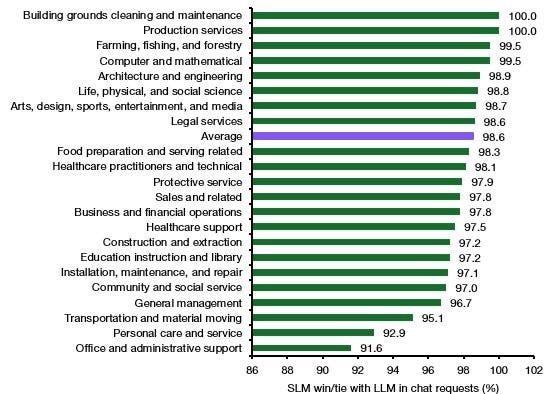
The chart below shows the win/tie ratio for these SLMs to find the correct answer compared with LLMs on standard human chat requests.
As you can see, in nearly every domain, SLMs can provide the same standard answers to everyday requests.
Source: Saad-Falson et al. (2026)
[Click to open in a new window]
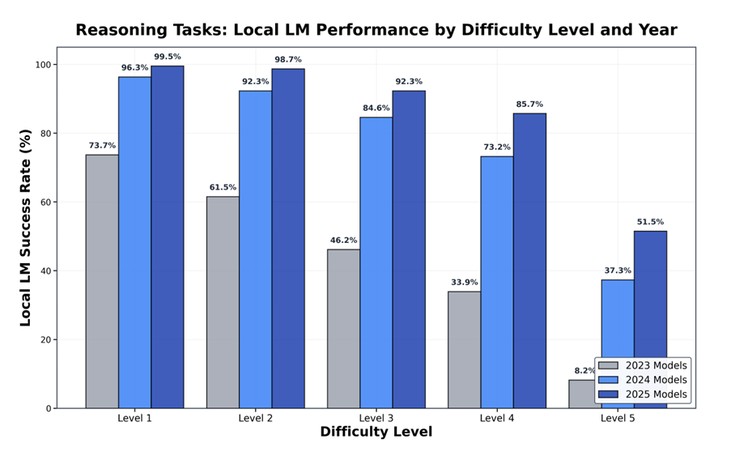
The rate of improvement of these smaller models over time was what caught my attention.
Across the generations studied from 2023 to 2025, intelligence per watt improved 5.3 times. Better models and better hardware both contributed.
Source: Saad-Falson et al. (2026)
[Click to open in a new window]
So the frontier is moving in two directions. The largest systems can tackle harder work, while local systems can handle more useful work within a limited power budget.
But because the big AI companies fill the headlines, we’ve forgotten about the other end.
When we consider how much money it takes to build the latest AI, versus the uses we have for it every day, maybe our thinking is backwards about where AI’s value ends up.
From the Server to Your Pocket
This thinking gives us a plausible direction of travel.
Handle the routine work in your pocket. Send the difficult work elsewhere.
For consumers, that can mean offline access and more personal information staying on the device.
For developers, it can mean avoiding a charge on every request from Microsoft or OpenAI.
For Apple, it could make the hardware more valuable.
Now I’m not saying invest in Apple. I simply pick them as an example of a company that’s stood aside amid this AI craze but could still benefit.
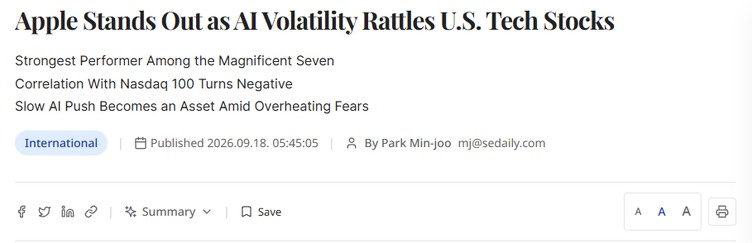
It’s telling that their correlation with the Nasdaq has actually turned negative.
Source: Seoul Economic Daily
For them, this moment is an opportunity to remain boring and benefit from advances across the industry.
If AI makes an iPhone more useful, Apple may sell more phones, encourage upgrades or strengthen the appeal of its services.
It gets paid for the product around the intelligence.
Meanwhile, the hyperscalers have a different calculation. Their investments need enough paying demand, at a sufficient margin, to justify the cost.
Yet if current AI demand is largely made up of simple chat requests and simple human work, this could rapidly unwind as SLMs become more capable.
There are, of course, plenty of counterarguments. Cheaper AI could unleash so much new demand that cloud spending continues to grow.
Training, complex reasoning and large business workloads might still need enormous computing resources. Plus, Apple still has to execute to stay relevant.
That is why the word ‘maybe’ matters.
Still, investors should leave room for a future in which AI succeeds spectacularly… yet the returns are distributed very unevenly.
Not every use case will need the biggest and baddest AI. And if political concerns come thick and fast with the newest capabilities, maybe just ‘good enough’ wins on the consumer side.
The company pouring the most concrete need not collect the most profit.
Apple may find that a growing share of the value ends up in the device you carry out the door.
Regards,

Charlie Ormond,
ATLAS and Altucher’s Investment Network Australia




Comments