



Last week, I took you down the small-cap rabbit hole.
The riddle finished on a metal that melts in your hand.
Gallium.
That company I was talking about is actually mostly a gold stock in terms of in-ground value.
About three-quarters gold value to gallium value, last I checked.
And gold is moving again.
The first half of this year was miserable for the yellow metal.
It slid into a bear market back in June on the back of the Iran war, and it still sits nearly a fifth below where it traded before that conflict started in late February.
Then last week happened.
Bullion put on more than 7% in five days, its best week since late January, and it was holding above US$4,300 an ounce in Asian trade this morning.
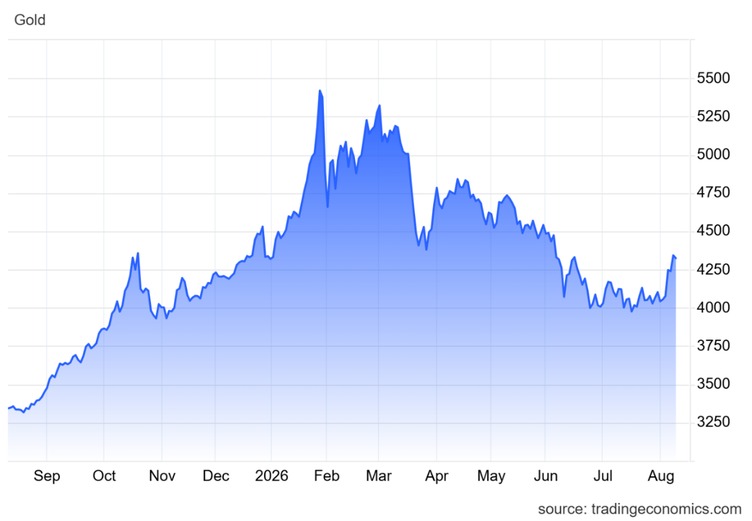
Source: tradingcommodities.com
[Click to open in a new window]
Two things did the pushing.
American employers unexpectedly shed jobs in July, the two months before that looked worse once the revisions landed, and the US dollar fell away while the odds of another Federal Reserve hike faded.
The second reason is the one I ran through last Tuesday.
China keeps buying.
The People’s Bank of China added roughly 20 tonnes of gold in July, its 21st straight month of accumulation and its biggest monthly top-up since October 2023.
Chinese gold-backed ETFs also pulled in money for their longest stretch since March.
That is the Michael Howell argument showing up in the data rather than in a chart deck.
Now the bit that matters
if you own small caps.
While the metal was doing 7%, the VanEck fund that holds the big global gold producers put on 21% over the same five days.
Its junior sibling did better again at 22.4%.
Here is the mechanics in plain English.
Say a producer pulls an ounce of gold out of the ground for US$3,000 and sells it for US$4,000, so it pockets US$1,000.
Lift the gold price to US$4,300, and the metal has moved 7.5% while that miner’s profit per ounce has moved 30%.
Profit leverage is why gold equities run harder than the bar sitting in the vault.
Drop another rung down and the effect gets stranger.
Explorers and developers have no margin to leverage, so the market instead reprices the ounces sitting in their ground and their odds of raising the money to dig them up.
A junior with a capable board and a decent deposit can suddenly fill a placement at a price that would have been laughed out of the room in June.
Capital markets usually lag the underlying commodity price.
And none of this arrives on schedule.
The chain runs from the metal, to the majors, to the developers, to the explorers, and each link tends to take weeks rather than hours.
A rising gold price makes a badly run company slightly less badly run and nothing more.
I have spent recent months putting readers of Australian Small-Cap Investigator and Fat Tail Micro-Caps into gold stocks, right through the stretch where nobody wanted them.
The ASX end of this market is usually last to get the memo.
So I think there’s still time for gold juniors.
But the window to get them at knock-down prices may not last long…
Warm regards,

Dr. Lachlann Tierney,
Australian Small-Cap Investigator and Fat Tail Microcaps





Comments