



An equestrian racing festival approaches in Melbourne.
The mood is not so festive in the chambers of the RBA.
They’re racing to tamp down on the Canberra money volcano.
Meanwhile, there are some downright odd puzzles forming in mining stocks.
After some shockingly poor recent form for ASX commodity stocks, are they a smoky for a rebound into Christmas?
Copper fetched around US$14,100 a tonne last Monday, within about 5% of the record it set in August.
Long-term uranium contract prices have hit a record US$96 a pound, according to fund manager Sprott.
Gold has cooled from its peak near US$5,600 an ounce earlier this year, but at around US$4,000 it still fetches roughly double what it did three years ago.
And yet…the betting (stock) market.
A week ago, on Friday 23 October, the ASX materials sector fell 3.8% in a single session and finished the week at its lowest level since March.
Uranium stocks have copped it even harder.
A major US-listed uranium miners fund has fallen about 52% from its January peak, while the metal itself has held firm.
In fact, the U spot price is moving up ever so slightly the last few days:
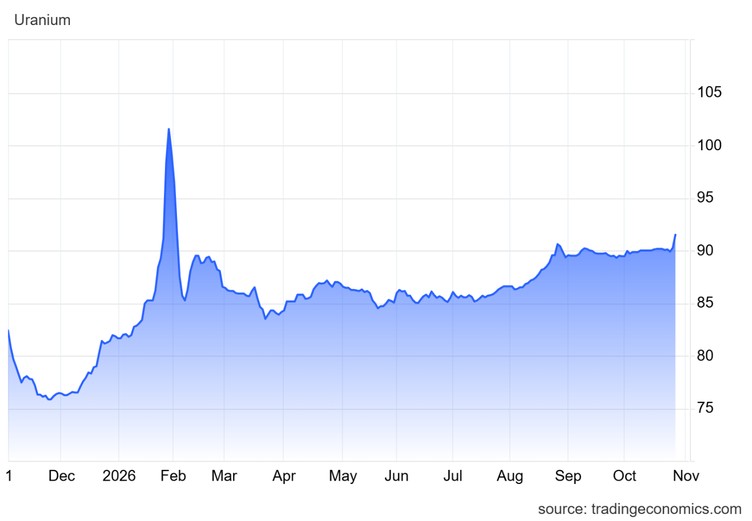
Source: TradingEconomics (30 October 2026 data)
[Click to open in a new window]
Gold miners tell a similar story.
Sprott’s data shows earnings forecasts for the sector rising sharply, yet the price investors will pay for those earnings has stayed stubbornly low.
Tough going on a heavy track
So why is the market ignoring the form?
Higher interest rates make investors less willing to pay today for profits that arrive years down the road.
Australia is firmly in ‘money now’ mode.
Mining projects (especially developers) are about as long-dated as investments get, so they feel it more than most.
Sprott also calls the equity side of the uranium rout a liquidity shock.
In plain English, big funds that borrowed to invest have been cutting risk in a hurry, and small, volatile miners are the easiest things to dump.
Tuesday’s other big race
That brings me to tomorrow.
The Reserve Bank hands down its rate decision at 2:30pm, half an hour before the Cup field jumps.
The cash rate is 4.60% after four hikes already this year. Another 0.25 percentage point rise would take it to 4.85%, the highest level since 2008.
We all know what happened then.
A dark omen appears?
Right now, a hike is the short-priced favourite.
All four big banks are tipping one, and bond market pricing for a hike jumped above 80% after last Wednesday’s inflation figures.
Those figures were ugly.
The trimmed mean, the RBA’s preferred gauge of underlying inflation that strips out the wildest price swings, rose 1% in the September quarter against the RBA’s own forecast of 0.8%.
That puts annual underlying inflation at 3.7%, well above the RBA’s 2% to 3% target band.
Deputy Governor Andrew Hauser has already warned that inflation expectations drifting away from target would be a central banker’s ‘nightmare’.
Still, favourites don’t always work out.
Unemployment hit a five-year high of 4.7% in September, and last week New Zealand’s central bank stunned markets by holding rates when most expected a hike.
Oh joy, more of us out of work. Will that stay the execution?
When the track dries out
Another hike would likely keep pressure on miners in the short term.
Higher rates tend to squeeze the smaller, riskier end of the market first.
Markets are capricious, though, and gaps like this one have a habit of closing.
Copper at US$14,000 a tonne and record uranium contract prices eventually show up as cash in company accounts.
The trick is picking which ones.
That’s where my colleague James Cooper comes in. James spent years as a senior geologist on mine sites across Australia, Canada and Africa before moving into investment research.
He reads a mining company’s form guide better than anyone I know, from the drill core to the balance sheet.
To see which miners James believes are worth backing while the market looks the other way, check this out:
Warm regards,
Dr. Lachlann Tierney,
Australian Small-Cap Investigator and Fat Tail Microcaps





Comments