



“If I had asked people what they wanted, they would have said faster horses”
― Henry Ford
Last time, I started with Orwell and ended with a rather expensive gap.
The gap between a technology’s arrival and the economic return it promises.
AI investors have good reason to care about that delay. So does anyone wondering about their job.
As I alluded to, Stanford economist Paul David explored this gap in his famous 1990 paper, The Dynamo and the Computer: An Historical Perspective on the Modern Productivity Paradox.
To understand it, let’s step inside a factory more than a century ago.
Mind the belts.
Life Under the Shaft
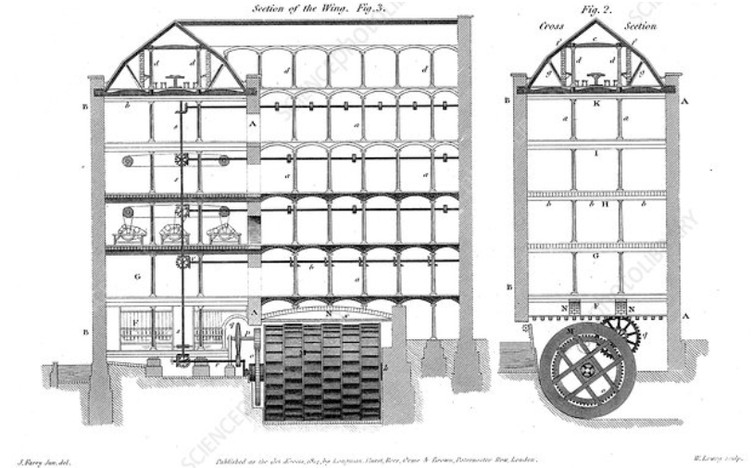
The nineteenth-century factory ran on one enormous engine turning a central shaft, with belts running off it to every machine in the building.
Below is a great example of an advanced waterwheel mill that shared the same layout later steam-powered factories adopted.
Lemma Waterwheel Mill 1813
Source: Science Library
That arrangement shaped the building, inside and out. Machines sat wherever power could reach them. Ceilings needed bracing to carry the overhead gear.
Long shafts lose power, so factories stacked machines over several storeys to keep them near the drive.
Centralised power also meant centralised failure. One broken gear could halt production, while friction between moving parts wasted huge amounts of energy.
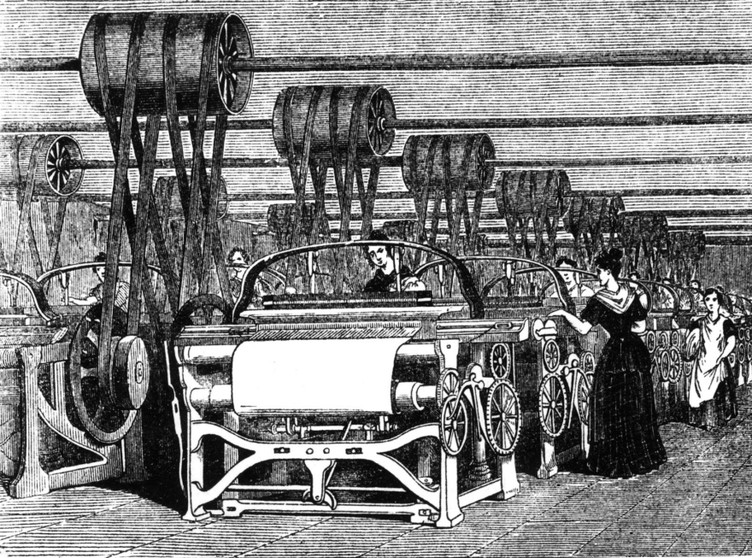
Here’s a rather clean depiction of a steam-driven power loom.
Cotton Loom 1857
Source: World History Archive
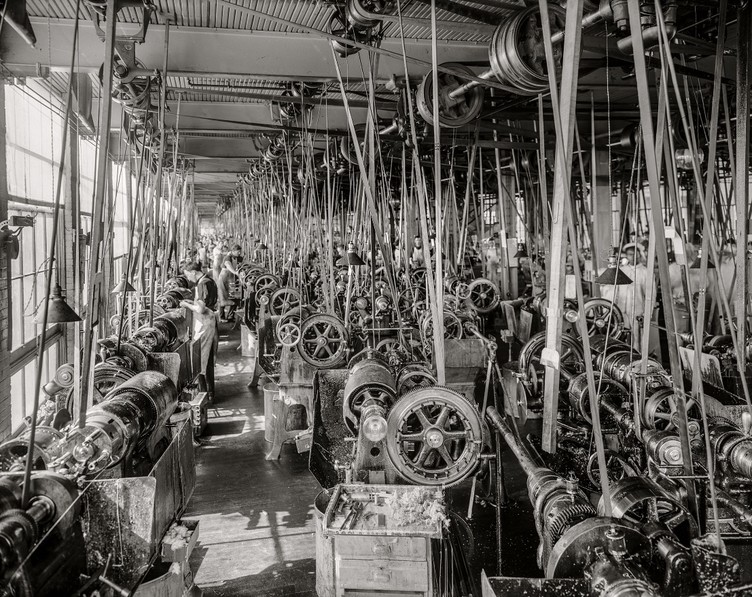
In reality, these factories were loud, dirty and incredibly dangerous places. Hair, hands, limbs and lives were often lost.
Oil and other flammable lubricants dripped from the ceiling. Fire was a constant threat.
As production became more complex, the factory ceiling became a maze of rapidly spinning shafts, pulleys and belts.
1902 Screw Machine Department
Source: Detroit Photographic Company
A New Motor, Same Old Factory
Then electricity arrived.
Like AI today, electrification was hailed as the dawn of a new age.
One that came with promises of ‘the end of drudgery’ and plenty of risk in equal measure.
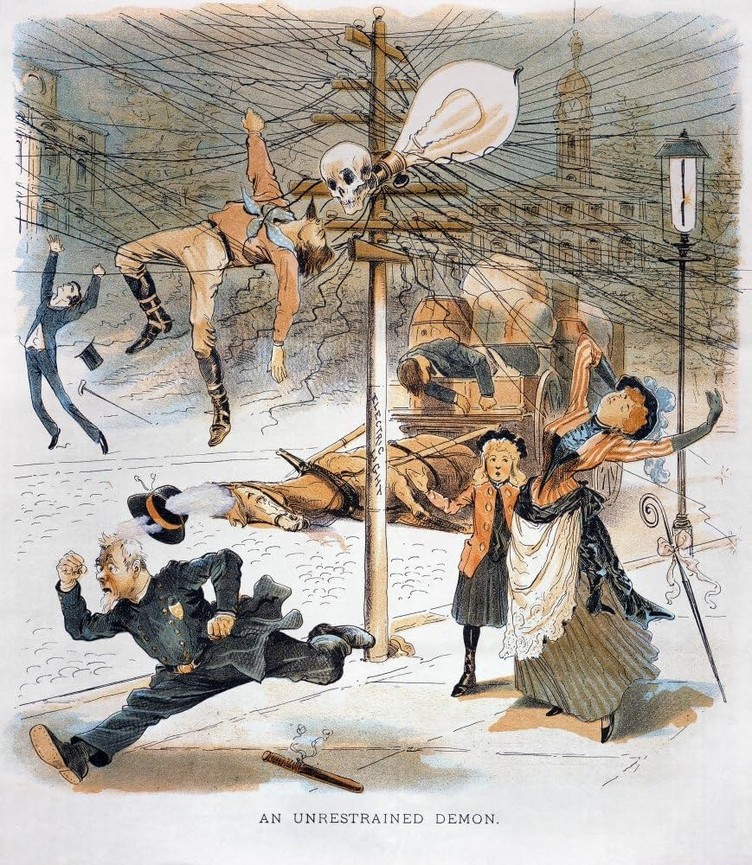
It even had its share of doomers who fretted about the proliferation of ‘an unrestrained demon’.
Anti-Electricity Cartoon 1889
Source: Judge Magazine, 1889
However, like the early computer age, little changed at first in the workplace.
Electric light lengthened the factory day. But the work itself stayed the same.
Why? Factories bolted the new technology onto the old factory layout. They swapped the steam engine for a large electric dynamo, but they kept the shafts and belts.
Perfectly sensible. The factory already existed. Its equipment still worked. Why throw it all out. But the same decision limited what electricity could achieve.
The machines remained tied to a system built around the old power source. Spending capital to scale out production faced many of the same costs and limitations.
It’s like trying to fix those old Christmas tree lights by adding more lights.
Here’s a visual example, a Ford factory wing from 1917 that was host to 50 miles of belts and pulleys.
Ford Crankshaft Grinding Dept. 1917
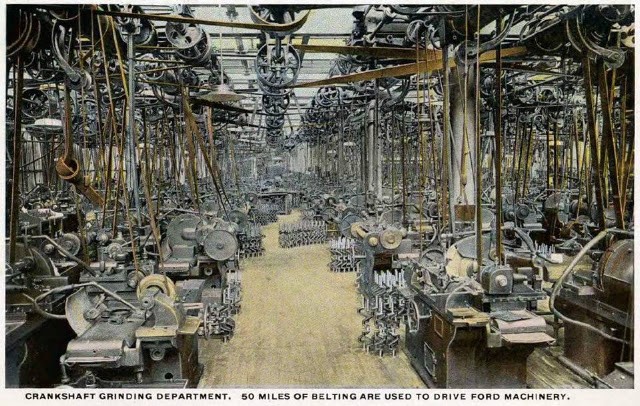
Source: Ford Motor Company Postcard 1917
This messy, complicated factory is the heart of Paul David’s explanation for the productivity lag.
In 1899, electric motors accounted for less than 5% of mechanical-drive capacity in US factories. It took roughly another two decades to reach half.
Having a remarkable invention available was only the beginning.
When the Belts Came Off
The real change came in the 1920s, when individual machines got their own motors.
Engineers call this the unit drive revolution.
Now machinery could be arranged around the order of production. Materials could move through the factory more efficiently. A machine could stop for maintenance or be moved without bringing everything else to a halt.
You no longer needed heavy bracing, so buildings got lighter. You no longer needed height, so factories went single-storey.
Removing overhead belts also made room for better lighting and safer working conditions.
General Motors, Die Division 1930s

Source: Get Archive
Modular workspaces meant modular management. Departments and structures formed around this, and new modes of managing work arose.
None of this came in the box. This took experience, new investment and people who knew how to build and run the new arrangements.
A new generation of engineers was needed to rethink the factory layout and the bounds of what was possible.
David links the spread of these changes to the manufacturing productivity surge of the 1920s.
There’s no reason to assume AI must follow the same timetable. Software travels rather faster than a new factory gets built. AI could reimagine layouts faster than a new generation.
But the broader structural problem looks familiar.
The Belts in Your Office
Imagine a business that gives everyone an AI subscription.
Reports get written faster. Emails become longer. Presentations gain another 20 slides.
But everything still travels through the same approval chain. The same figures are emailed back and forth among decision-makers. The same manager signs off on every exception.
You’ve sped up paperwork production. But the decision still takes a week.
I suspect plenty of you are picturing your own office.
One where the systems haven’t changed in years, and every new app/service or program is added atop the sandcastle. Another login to manage, another password to remember.
These structures mirror that old shaft in the factory — the kind of place where adding AI isn’t going to be the productivity coup we all expect.
The useful question is what happens to the whole job with AI, not just tasks.
Take an insurance claim. An AI tool might draft a response almost instantly. But the claim still needs accurate records, an assessment, a decision and someone accountable for that decision.
Improving the workflow might require restructuring how records are stored, structured, and connected. That means changing how information moves through businesses and who can act on it.
It also means asking which reports, hierarchies, and handovers still serve a purpose.
Some will. Others may exist because somebody needed them in 2007.
David spotted another problem in the 90s that feels very current.
Information can become a burden. Producing and distributing it may be cheap, but reading and judging remains expensive.
Think how quickly AI can produce meeting summaries, internal proposals and endless emails. Somebody still has to read the bloody things.
You might just assume that would be another AI. But then, who holds the responsibility, who checks the checkers?
Increasingly, that answer might be AI, but for now, we’re creating a traffic jam of rubbish.
David also made a subtler point. Machines wear out. Information structures don’t.
A reporting ritual or hierarchy can survive indefinitely. So can an approval process everyone dislikes but nobody feels entitled to remove.
Waiting for an organisation to modernise itself may be a long wait.
So Who Wins
The evidence on who actually gets a return from this technology is starting to firm up, and it points in the same direction Paul David did.
An NBER working paper this year surveyed close to 6,000 executives across the US, UK, Germany and Australia. Around 70% were using AI. Yet more than 80% reported no measurable effect on employment or productivity over the past three years.
By contrast, a Harvard Business School field experiment found that firms taught to redesign their end-to-end workflows around AI, rather than speed up individual tasks, generated roughly 90% more revenue than equally equipped peers.
Same tools. Different factory.
That’s the filter I’d apply when looking at companies. Not whether a company is using AI, because they all are, and it tells you nothing.
The question is whether it has rebuilt the business around AI, or bolted a subscription onto the existing shaft.
This is also where smaller companies have an underrated edge. A business with 100 staff and a few legacy systems can rebuild its operating model within a year.
A business with two hundred thousand staff and forty years of process can’t, and management knows it.
This can also mean looking at incumbent tech leaders with some scepticism. Assuming the winners of the last layout will win the next is a bet against most of economic history.
The new motors are here. The question for every business you own is whether it has redesigned the factory or just changed what turns the shaft.
I know which I’d rather hold.
Regards,

Charlie Ormond,
ATLAS and Altucher’s Investment Network Australia




Comments