




I remember watching an old British sitcom called Dad’s Army when I was a kid.
It was about a cadre of old-timers who were in the Home Guard – the battalion of people left at home to mind the place, while the young men went off to war.
One of the funnier characters was a Grandad called Corporal Jones.
His catchphrase was to run around in circles, screaming ‘don’t panic, don’t panic’ whenever danger appeared.
Here he is here:

Source: BBC
The comedic effect was the instant panic he created by doing this. It always made me laugh.
He came to mind before I wrote today’s memo.
You see, I was going to call the piece ‘don’t panic on rates call’ or something like that. But then I remembered old Corporal Jones and thought better of it!
So, what was I NOT panicking about?
Well, tomorrow we get the RBA’s latest interest rate decision. It’ll dominate headlines, and the odds say we’re going to get a rise.
According to the ASX RBA Rate Tracker, financial markets price an 86% to 90% chance of a rate increase.
Almost a certainty.
That’s likely to hit general consumer confidence and perhaps the general stock market, too.
At the same time, we’ve got global bond yields and oil prices back on the march after a brief mid-week respite last week.
Oh, and there was another AI scare. This time, a ‘hack’ on Australia’s Medicare (though some of the industry notes I’ve seen say this was less a hack and more a case of leaving the proverbial door wide open!).
As we noted last Monday, the doomsayers have plenty to fret about.
In fact, they remind me of another character from the show – a Scottish perma-pessimist called Private Fraser.
Here was his reaction to Corporal Jones every time:

Source: BBC
And yet, as we also discussed last week, there’s a lot to be positive about when it comes to the structural trends driving demand for Australia’s commodities.
Huge spending on AI, re-industrialisation, electrification, and defence, to name four of the more important ones.
One stat I read this week said total demand for critical materials is projected to rise from 35,380 kilotons (kt) to over 52,000 kt by 2040, with specific sub-segments like renewable power and battery minerals projected to grow by more than 400% by 2050.
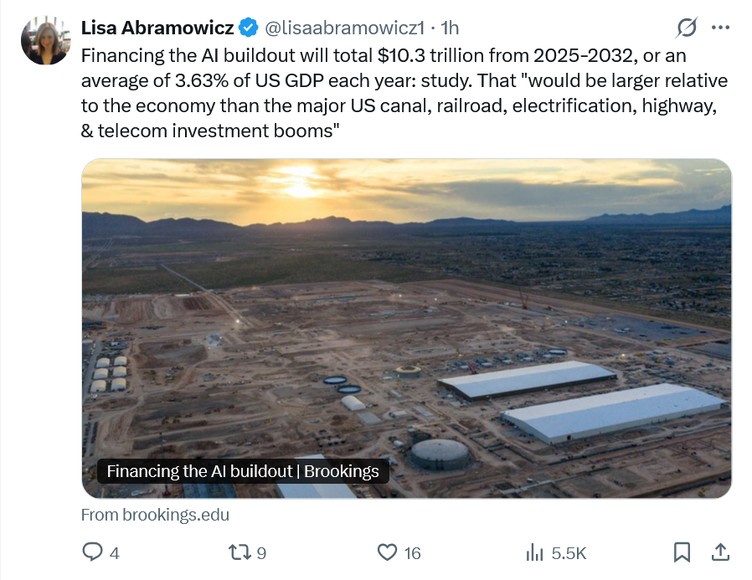
I also came across this bit of information from Bloomberg’s Lisa Abramowicz on AI:
Source: X.com
This kind of talk fuels the commodities demand narrative – even if you need to be more sober-minded about the facts.
But as we noted last week, AI at its peak only accounts for 4% of total copper demand. Substantial, but not the whole story.
The constant challenge for you as an investor is to separate narrative from fact – to work out where they converge and, more importantly, diverge.
Take iron ore…
Our largest export remains
incredibly resilient
The latest data (August) from Port Hedland and Dampier in WA show that iron ore exports are up 2% year-on-year.
In fact, Fortescue has had a record year for iron ore shipments.
201.3 million tonnes of the red metal, surpassing the 200 million tonne mark in a single year for the first time in its history.
This is especially impressive when you remember that China’s property market is in the midst of a multi-year downturn.
Development investment in China is down 19.9%, new home sales are down 12.1%, and new home starts are down around 25%.
Property plus infrastructure makes up around 45%-50% of China’s demand for iron ore.
So, the constant demand for iron ore in the face of these headwinds has been surprising to say the least. People who sold on the narrative are still confused!
That said, we can’t be complacent.
As the old market saying goes, ‘the trend is your friend until the bend at the end.’
Seeing the ‘bend’ as it happens is the hard part.
Which is why I’ll be watching
this piece of data very closely
Probably more important for miners than the RBA’s call on Tuesday is a less-heralded data point from China on Wednesday or Thursday.
It’s the official NBS Manufacturing PMI.
This is a broad measure of manufacturing activity – the workhorse of the Chinese economy and a good barometer for global growth.
Last month, it jumped from 49.2 to 49.8, beating estimates.
That’s still in contraction territory (below 50), but if the momentum continues in this month’s reading, we could be re-entering an expansion phase (above 50).
For mining investors, a positive reading would tell us conditions remain good for our biggest customer and, in turn, good for us.
Of course, if it goes the other way, that’s another thing for the market to fret about. Will it be the straw that breaks the camel’s back?
Let’s see what happens…
Regards,

James Cooper,
Mining: Phase One and Diggers and Drillers




Comments