




First, it is essential to clarify that no one can predict with absolute certainty that a company will be taken over.
But there are ways to put the odds in your favour.
And I think the best place to start is the geology.
I know that might sound a little biased coming from a geologist!
Ask a mining engineer or a finance professional, and they’ll probably tell you it’s the company’s track record of meeting production guidance or its ability to mine at a lower cost.
All valid.
However, at this stage of the mining cycle, we should focus on juniors and companies that have yet to reach production.
And at that point in their business cycle, all that really matters is the asset sitting in the ground—how does the geology stack up in the eyes of a major?
After all, it’s not the company they’re buying, it’s their rocks!
That’s why a potential buyer will examine key aspects of a deposit, such as grade, metallurgy, and potential for further discovery.
Ultimately, all these factors will play into the underlying economics of a future mine.
But there’s one prominent feature that they’ll zero in on above anything else…
Acquisition Criteria #1: Deposit Size
For a major, there’s no point paying a premium on an asset that can’t generate profits over a sustained period.
Each mine requires vast infrastructure; plus, development can take up to 10-15 years. Sometimes longer.
That’s why producers like BIG deposits; for them, it’s a matter of economies of scale.
If it doesn’t offer decades of production, it’s unlikely to attract big-name attention.
Therefore, if you are considering a junior as a potential takeover play, consider the mine life, which is essentially a function of the size of the deposit.
So, how do you know if it’s a large deposit?
Well, this really depends on the commodity.
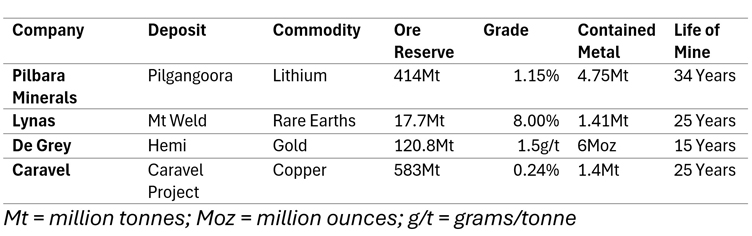
A good starting point is to examine existing projects already in production and use this as a baseline to determine whether a junior has something worthwhile.
Here are some examples below:
[Click to open in a new window]
Of course, most junior mining stocks probably haven’t advanced their project to the point of holding a mineral reserve, like the examples above.
This requires extensive infill drilling, which only occurs after detailed feasibility studies have been completed.
However, in the absence of mineral reserve data, junior miners will probably have what’s known as an ‘initial’ resource estimate for their deposit.
This is essentially an early-stage estimate of the deposit size.
Specific mining codes ensure that directors aren’t bloating their estimates.
And while that’s true, layers of creativity can sometimes be built into these early resource projections. So, tread carefully.
Take it for what they are… An educated guess that can err on the side of optimism.
Anyway, it offers a starting point.
From there, you can compare the numbers to an active mine, and that will give you a quick, back-of-the-envelope idea of whether a project is actually within the realms of being a large-scale deposit.
And therefore, in the sights of a future acquisition deal.
Stay tuned for the next edition, where I will highlight additional selection criteria to consider when seeking acquisition opportunities.
Until then.
Regards,

James Cooper,
Mining: Phase One and Diggers and Drillers




Comments