



Yesterday I wrote about why lithium could be the biggest winner from the Iran conflict.
Today, I want to talk about two metals that most people aren’t thinking about much in this context.
Copper and nickel.
The numbers around what could unfold for these two metals are adding up in a big way.
Here’s why…
A devilish scent wafts from the
Strait. I smell a supply squeeze
The Strait of Hormuz has been closed since late February.
Most people are focused on oil.
But the Gulf isn’t just sitting on crude — it’s also one of the world’s largest sources of sulphur, a byproduct of oil and gas production.
My colleagues Charlie Ormond and James Cooper are also following this sulphur story.
Turns out, the region accounts for roughly a quarter of global sulphur output, according to the US Geological Survey.
And sulphur — converted into sulphuric acid — is a critical input for both copper and nickel production.
For copper miners using solvent extraction and electrowinning (SX-EW) technology on oxide ores, sulphuric acid is the leaching reagent.
About one-fifth of global refined copper comes from this process.
For nickel, the HPAL (high-pressure acid leaching) plants that Indonesia runs at enormous scale need 25 to 30 tonnes of acid just to produce a single tonne of product called “mixed hydroxide precipitate.”
With Gulf sulphur effectively trapped, prices have started moving further.
China — the world’s largest sulphuric acid producer — is now banning exports.
Turkey has already done so. India is weighing the same.
Nick-hell about to break loose?
Indonesia is the world’s largest nickel producer. It sources around 75% of its sulphur from the Middle East.
Macquarie estimates that the sulphur price surge has already added ~US$4,000 per tonne to Indonesian HPAL nickel production costs, pushing the cost curve up to ~US$14,500-18,000 per tonne.
So no wonder, the LME nickel price hit an 11-week high of ~US$18,655 per tonne this week.
And here’s the thing — Indonesian mine closures were already squeezing supply before this.
PT Vale Indonesia suspended mining activities in January after approval delays on its 2026 output plan.
PT Weda Bay Nickel — the world’s biggest nickel mine — was told to slash its production quota too.
And the Indonesian government deliberately cut the national nickel ore quota from 379 million tonnes in 2025 to around 260-270 million tonnes in 2026.
That’s a cut of roughly one-third.
Now here’s where it gets really interesting.
AI is a copper and nickel glutton
There’s been a lot of coverage on copper and AI data centres.
Each megawatt of data centre capacity requires roughly ~6-8 tonnes of copper.
Goldman Sachs projects US data centre power demand to hit 47 gigawatts by 2030, a ~150% increase from today.
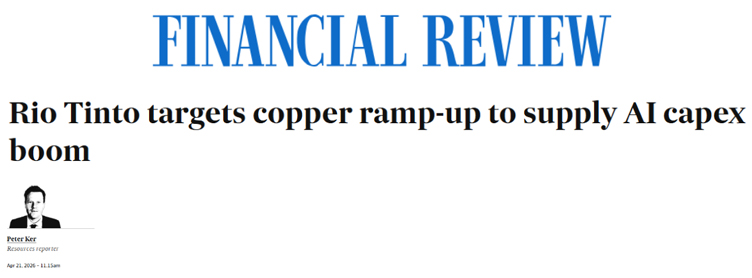
Rio Tinto itself said last week that it is positioning in copper because the US is in the middle of “a major AI capex boom”:
Source: Australian Financial Review
Less discussed is nickel.
I’ve been running some numbers on nickel demand from the AI buildout — specifically from the stainless steel used in data centre infrastructure and cooling systems.
The numbers suggest that if AI capex spending continues at its current trajectory, nickel demand from this source alone could be enough to flip what is currently a modest supply surplus into a deficit within the next year or two.
Combine that with the Indonesian production cuts and the sulphur supply shock, and the setup for nickel looks very different to what the consensus was pricing in six months ago.
I’m already seeing it on the ground in the market, companies are gently dusting off nickel projects left, right and centre.
But no one really cares. YET.
Copper paying for past capex sins…
For copper, the Iran conflict is accelerating a problem that was already decades in the making.
Ore grades have declined ~40% since 1991.
Mine development timelines now average 17 years from discovery to production.
The IEA is warning of a potential ~30% supply shortfall by 2035.
The Democratic Republic of Congo — the world’s second-largest copper producer — relies on Gulf sulphur for the majority of its SX-EW operations, which account for half of its output.
Natixis calculates that every ~US$100-per-tonne rise in the sulphur price translates into a ~4% rise in cash operating costs there.
Chile — the world’s number one producer — relies on China for around ~20% of its sulphuric acid requirements, and China just banned exports.
And we’re already above +US$6/lb for copper.
When you mine deeper and grades fall, you need more energy, more acid, more everything — just to get the same amount of copper out of the ground.
And for me, worries about slowing global growth are minor compared with long-festering supply problems that could boil over.
Here’s what I’m doing…
I’ve been building exposure to this thesis for some time.
Readers of Australian Small-Cap Investigator and Fat Tail Micro-Caps are already positioned in companies that stand to benefit from exactly this kind of environment.
One where supply is squeezed from multiple directions at once, and the demand side is being turbocharged by the AI buildout.
And THEN sent into overdrive by the Iran conflict.
I expect big moves in the months ahead.
Warm regards,

Dr. Lachlann Tierney,
Australian Small-Cap Investigator and Fat Tail Microcaps





Comments