



I grew up playing board games, learning about military history and making model fighter aircraft.
(Clearly, I was one of the cool kids)
Heck, my father still plays Risk 2 on the computer. Some 25 years after it came out in 2000.
Fast forward to today and not much has changed.
When I recommend a stock to members, it always has some form of geopolitical input behind it.
There are games, and then games within games.
I think people often fundamentally misunderstand what board games teach us.
(Just look into the history of how Monopoly came about — poor Henry George)
Back at the University of Melbourne, my mates and I would play Risk into the wee hours of the morning in the library.
We called it “The Game of Diplomacy”, not “The Game of Global Domination” as the Risk tagline claimed.
We would pass notes. Form elaborate alliances. Betray each other with ruthless efficiency.
The game taught us something critical. When you’re holding Australia with its measly two bonus armies per turn, you’d better make friends fast.
Because the real power isn’t in the territories you control. It’s in the alliances you forge and the enemies you create for others.
This week, that lesson is playing out on the global stage in ways that would be terrifying for Europe.
Trump’s knows the board well…
As you’ve seen, Donald Trump wants Greenland. He’s not subtle about it.
The US President has threatened military force to acquire Denmark’s autonomous territory. He’s slapped 10% tariffs on eight European NATO allies who oppose him: Denmark, Norway, Sweden, Germany, the UK, France, Finland, and the Netherlands.
Those tariffs jump to 25% in June if Europe doesn’t play ball.
On the surface, this looks like madness. Denmark is a founding NATO member. You don’t threaten allies with military invasion and economic warfare.
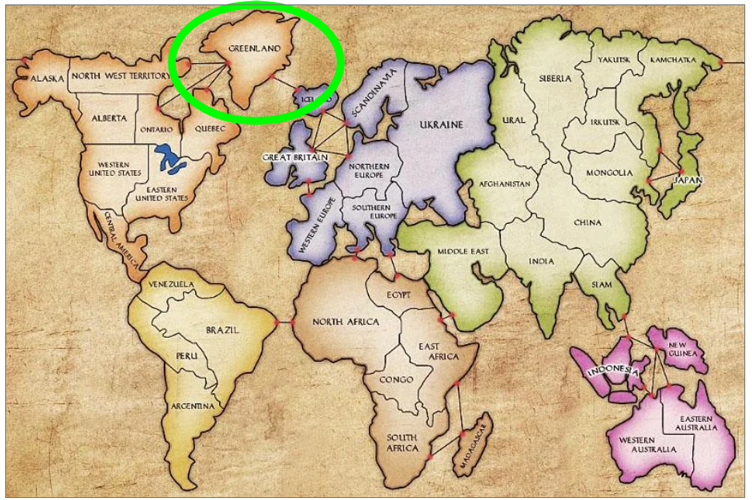
But Trump isn’t playing checkers. He’s playing Risk.
Greenland sits between North America and Europe:
Source: Reddit
It controls future Arctic shipping lanes as ice melts. Most importantly, it holds massive deposits of rare earth elements, copper, gold, zinc, and uranium.
This is about critical minerals and security. Remember, China processes 75% of the world’s lithium. They control the battery supply chain. They regularly weaponise critical minerals.
Trump wants an alternative. Greenland is the ultimate get-out-of-jail card in the minerals war.
Europe’s a tricky part of the board…
Here’s where it gets interesting for investors. Europe is caught in a classic Risk dilemma.
They’re holding a continent they can’t defend.
Too many entry points! Trust me, it’s a nightmare holding onto Europe.
They lack energy security (still buying expensive US LNG after cutting Russian gas). They lack defence capability (spending plans won’t materialise for years). They lack unity (populists are winning across the bloc).
Now their security guarantor is threatening them while massaging Russia.
European leaders are scrambling. Emergency summits. Talk of deploying the “Anti-Coercion Instrument”… their trade bazooka. Potential tariffs on $107 billion of US goods.
They face a tough choice, China has been making overtures and passing notes.
The balance of power is shifting. And Canada just made the shift explicit.
Carney’s intriguing overture to China…
While Europe dithers, Canadian Prime Minister Mark Carney landed in Beijing this week.
This is the first visit by a Canadian PM to China since 2017.
Carney and Xi Jinping announced a new strategic partnership. Five pillars: energy, trade, public safety, multilateralism, and culture.
Translation: Canada is interested in cutting a deal with America’s primary rival.
Or at least gesturing they might do a more real and bigger deal.
This is extraordinary. Remember, just last year Trump threatened Canada with 25% tariffs and joked about making it the 51st state.
Canada took notes. Then passed them to China.
The irony is thick. Canada spent years blocking Chinese ownership of mining companies. They positioned themselves as the West’s alternative for critical minerals.
I think Canada is just playing it smart and hedging on risks present in the diplomatic web of relationships.
But bear in mind China has been spying on Canada for decades…(you know the headlines that no one cares about that disappear quickly?)
Canada is a battery beast
Follow the technology trail.
China has been caught multiple times conducting espionage against Canadian battery research. In 2022, Hydro-Quebec researcher Yuesheng Wang was charged with economic espionage for sharing battery technology secrets with Chinese entities.
Canada is very advanced in battery research. Dalhousie University’s Jeff Dahn runs one of the world’s premier battery labs.
Dahn pioneered lithium-ion battery development. His team holds the Tesla research contract. They’ve developed batteries that last nearly four million miles.
China wants that technology. China needs energy.
Carney just opened the door to a bit more “you scratch my back” etc…
How the board is shaping up today
Let me bring this back to our university library at circa 2am. Cards spread across the table. Alliances forming and breaking.
The player holding Europe always faced the same problem. Six access points to defend. Surrounded by stronger powers. The four bonus armies per turn never quite enough.
Eventually, Europe would always get carved up. Unless they made a deal.
Today’s global Risk board looks similar. Trump controls North America and is reaching for Greenland’s resources. China holds Asia and the entire battery supply chain. Russia pressures from the east.
Europe has no good moves. So they’ll probably try and make “the least bad” one.
Canada is learning how to make new friends — it may come back to the fold, but it wants to play hard to get for as long as possible, of course.
Australia should benefit from
its strategic position
For investors, the implications are clear.
The “rules-based international order” is swiftly decaying. Transactional relationships are replacing ideological alliances. Resource nationalism is accelerating.
Critical minerals talk is being replaced with critical minerals action.
The board is being redrawn. The alliances are shifting.
My father will keep playing Risk 2 on his computer. The computer opponents never change their strategies.
The real world isn’t so predictable. But the principles remain the same.
Control resources. Make strategic alliances. Know when to betray.
Right now, Europe is learning what every Risk player eventually discovers.
When you’re surrounded and running low on armies, the notes you passed earlier matter a lot less than the territories you control.
And Europe controls neither the resources nor the power to dictate terms anymore.
Unless something changes dramatically…
At some point, even lucky rolls won’t help.
Their loss will likely be other ’s gain.
Regards,

Dr. Lachlann Tierney,
Australian Small-Cap Investigator and Fat Tail Microcaps





Comments