



When a market is caught in a range for an extended period, there’s a lot of head-scratching going on.
Both bulls and bears often end up frustrated and unhappy.
Prices will often gravitate to the midpoint of the range, which I call the ‘point of control’. It’s also the point of maximum indecision.
Bulls are usually buying in the top half of the range, and bears are selling and getting short in the bottom half of the range.
At the midpoint, everyone is unhappy.
Figuring out which way the market will break out of a range is tricky, but you can listen to hints along the way.
You have to create lines in the sand where you will change your view and listen closely to what is going on.
Is the selling pressure where you would expect it to be?
If so, remain on high alert.
That’s where we are with the S&P/ASX 200 right now.
The rally this week has been convincingly rejected from resistance levels, and we are closing the week back below the 10 and 20-week moving averages.
Is the strong selling pressure we have seen today related to fears about what will happen at next week’s budget announcement?
How will they handle the transition to the new capital gains tax rules?
Do I trust them to do it fairly? Nope.
Maybe selling out of stocks with huge capital gains is the wise thing to do before the hammer comes down on Tuesday.
For example, if I hold a stock I bought two years ago that’s up 200%, and then I hold it for another two years without any further gains, what happens when I sell it?
Is the 200% gain grandfathered, so I get to keep around 75% of the money?
Or will the new rules claim that 200% was made over 4 years and split the profits evenly under the different rules?
I guess our questions will be answered next Tuesday. Hopefully, you will have the chance to sell after the rule change and keep the benefits already accrued under the old regime.
If not, Out come the pitchforks.
In other news, Aussie banks have been holding up extremely well during the recent turmoil. But now some cracks are beginning to appear.
Recent results have shown softening growth, higher bad debts, and stretched valuations.
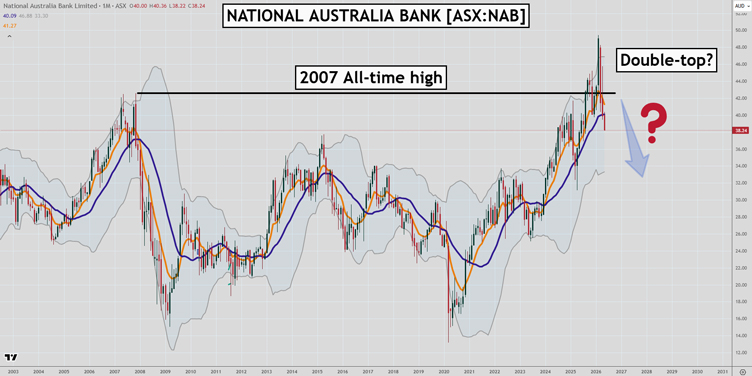
The technical set-up in the banks is also quite interesting from a classical technical analysis perspective.
Double tops are an oldie but a goodie.
NAB leads banks lower
Source: TradingView
[Click to open in a new window]
Major reversals often occur when retests of former all-time highs fail to hold. The chart above shows National Australia Bank [ASX:NAB] having a false break of its all-time high from 2007.
With rising interest rates and a softening property market, which is about to face a major change in tax policy, I wonder what the unintended consequences will be.
The banks may very well cop it in the neck.
They have run too far on the weight of passive money flowing into them at ever larger rates as their share of the indices has increased.
What happens when that self-reinforcing loop reverses?
I guess we may be about to find out if the shift in CGT rules causes selling across property and stocks.
Charlie and I discuss all of the above in today’s Closing Bell video. We finish up with a quick look at the rally building in Bitcoin as oil comes off the boil and gold recovers.
Regards,

Murray Dawes,
Retirement Trader, International Stock Trader and
Murray’s Trading Room
PS: If the Closing Bell chats have been sparking ideas, imagine what we can do when we sit down together every week. Inside Murray’s Trading Room, you’ll have the opportunity to get direct feedback on trades chosen by you and fellow members, go deeper into my trading model, and join live or watch the replay when it suits you. Join today and use code CLOSINGBELL to get 50% off your first year!




Comments