



Tomorrow, the United States will turn 250.
There will be fireworks over the National Mall, Fourth of July BBQs and plenty of talk about the idea the country began with. That a free people answer to no power but their own.
An anniversary of this size invites more than ceremony, though. It asks for a look at the nation’s condition, not just its founding.
And here, it’s fair to say, the vibes aren’t great.
‘If the American Dream isn’t quite dead, it certainly isn’t thriving,’ summed up Harmeet Kaur after looking at the latest dismal Gallup polls.
Domestic hardships aside, America’s impact on the global stage looks to be entering a new phase.
Two long-held assumptions about America are quietly being retired. The first is that it will lead the global order. The second is that it will keep trade open while it does.
The speech beneath the fireworks
Treasury Secretary Scott Bessent set out the new thinking last week at the Economic Club of New York’s America 250 gala. He called the approach ‘economic statecraft’.
The phrase means using American economic power in the service of national sovereignty.
For most of the past century, Washington has built and guarded an open global system.
In telling its own history, the US would point to the opening of its market and its tolerance of trade imbalances as the price of a more prosperous world.
I would argue for a historical rendition that was a bit more realistic than the shining city on the hill would stomach.
Regardless, Bessent argues that those habits slowly hardened into weaknesses. Factories moved offshore, and supply chains gathered in countries that do not share American interests.
So, the terms are changing. Access to the US market, he said, will no longer be unconditional. Partners who want in will be expected to offer something in return.
The retreat from free trade
Lowest cost is no longer the deciding test. Bessent now asks whether a supply chain can survive a crisis, withstand pressure, and keep running through a war or a cyberattack.
That’s a measured way of describing a country that’s stepping back from globalisation wholesale. This is not just a passing political mood — it’s now modern US doctrine.
Free trade has few friends left in either political party. And NAFTA is now cast as the executioner of the middle class that once defined America.
So, it seems the very nation that wrote the rules of modern free trade is now walking back from them.
For us here in Australia, this shift has left us economically and politically bipolar. We sit between our largest customer, China, and our security partner in Washington.
And things aren’t going to get simpler. A more transactional America will ask more of its allies, us included. A bolstered China could push further into our affairs.
An echo of empire
There is an uncomfortable historical rhyme in all of this. The economist Richard Wolff put it bluntly:
‘Free trade built Britain’s empire. When real competition arose, the empire’s turn to economic nationalism failed to save it. Free trade also built the US empire. Now that real competition arose, the US turn to economic nationalism will fail to save it.’
His warning is simple. Economic nationalism tends to arrive late, once a dominant power is already being overtaken. It rarely reverses the decline it is meant to halt.
Ray Dalio sees the same pattern in geopolitics. He recently compared America’s handling of Iran and the Strait of Hormuz to Britain’s loss of the Suez Canal in 1956.
That was the episode that confirmed the end of British power.
After a recent extended world tour in the East, Dalio believes leaders across Asia have drawn a similar conclusion.
They believe the American public will not bear the cost of a major war, and doubt it can fight on two fronts at once.
If that view holds, few now expect Washington to defend Taiwan against Chinese pressure. Allies hosting US bases as a counterweight to China have begun to recalculate.
The evidence is in the traffic to Beijing. There’s been a steady increase in the number of heads of state and ministers arriving to build relationships with President Xi.
Leaders who’ve visited China this year
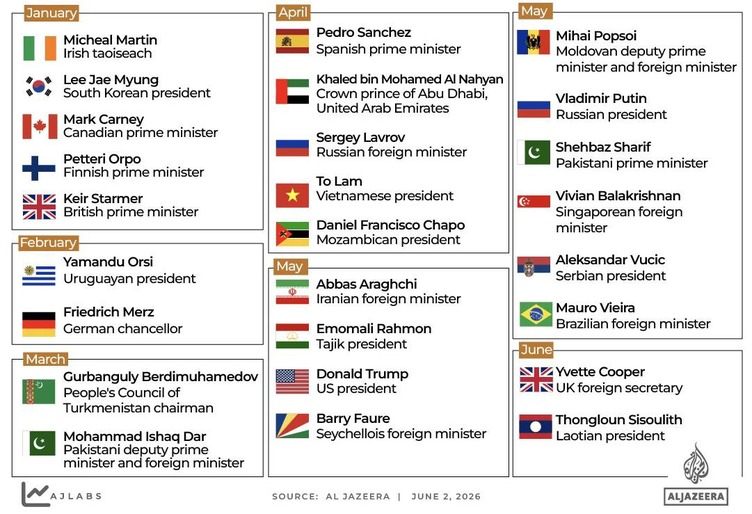
Source: Al Jazeera
[Click to open in a new window]
Dalio calls it the early stage of a tribute system across the region. One that harks back to China’s Middle Kingdom days.
Australia’s choice
This leaves Australia with an awkward decision. We can bind ourselves closer to a fortress America as it pulls up its drawbridge.
That means an inward United States, one that rewards trusted partners but offers a thinner guarantee on security and trade.
Or we can tie ourselves to the growth of a Chinese future. A country whose culture and values we vehemently disagree with, yet one that may be content to leave us alone, so long as the iron ore keeps flowing.
We may not get a clean choice. The decision is being made for us in pieces.
For investors, one feature stands out. Both roads run through the same place: materials.
A fortress America reshoring its supply chains still needs critical minerals and would sooner buy them from allies than rivals. A growing China still needs our metals.
A structural case sits underneath both futures. Whichever way the drawbridge falls, Australia’s hedge is dug out of the ground.
Regards,

Charlie Ormond,
ATLAS and Altucher’s Investment Network Australia




Comments