



Most investors spend their days watching the top 200 names on the ASX.
I spend mine a long way below that.
I focus a large part of my attention on areas well below the Small Ordinaries, in the land of micro-caps, which is the part of the market most people ignore.
And that’s often for good reason. It’s certainly not for the faint of heart.
To operate in this area with any aplomb, you’ve got to be a risk taker.
But you also need a firm grasp of what makes this opaque end of the market tick.
Which is why I’m writing to you today, about the seemingly counter-intuitive appeal of ASX micro-caps right now.
If you’ve been reading Fat Tail Daily this year you’d be well abreast of the things that are hurting risk-appetite in Australia right now…
The budget hurt, the Iran conflict hurt, and mortgages are squeezing disposable income away from seemingly ‘risky areas’ of the market (including great micro-caps).
Something changed in the last fortnight though, and it is worth your time even if you never buy a company under $100M.
Consider this…
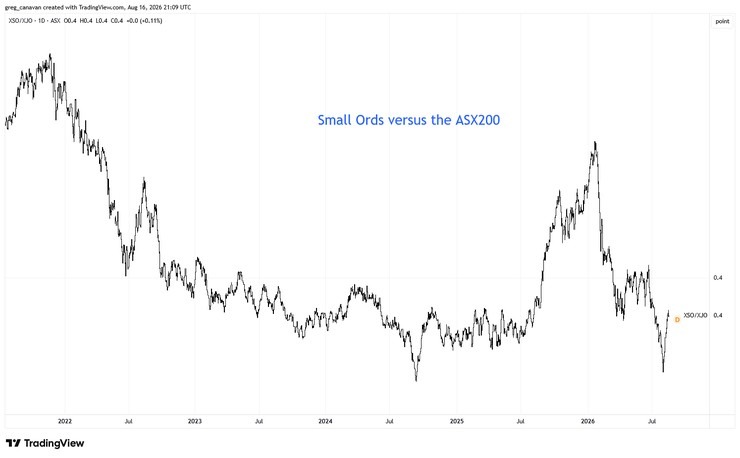
Here’s a chart that makes the point well.
Small Ordinaries against the ASX 200, sliding with only a minor interruption since 2022:
Source: TradingView
[Click to open in a new window]
Four years of relative decline.
Since 2022, the market decided to play defence.
That means loading up on big, boring bureaucratic companies that superannuation funds are obliged to invest in as part of their mandate.
But my own barometer for risk-appetite sits one rung further down than your standard ‘small cap’ stocks.
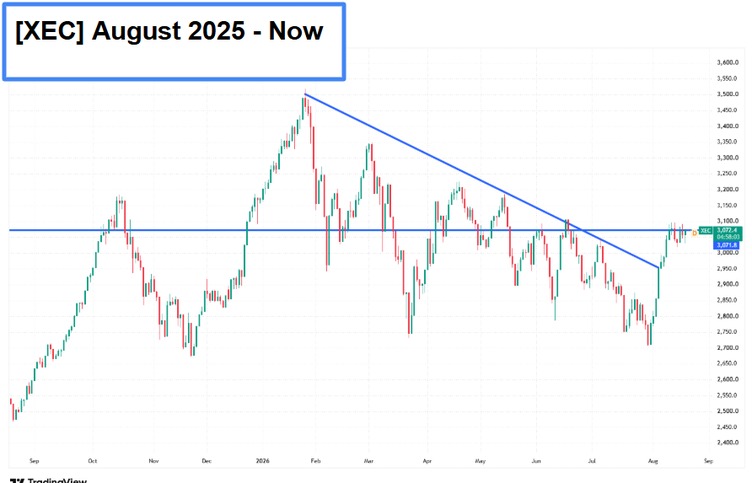
The S&P/ASX Emerging Companies Index covers the genuinely small end of the market, the companies too little to make the Small Ordinaries cut (even though some of them are BIG by my standards).
And it spent the first half of 2026 making lower highs under a downtrend that began in February:
Source: TradingView
[Click to open in a new window]
That downtrend appeared to break early this month.
Meaning the index now trades where it traded last October.
Ten months of budget headlines, war headlines and rate headlines, and the scoreboard reads zero.
Sometimes when everyone agrees, the market snaps your head back.
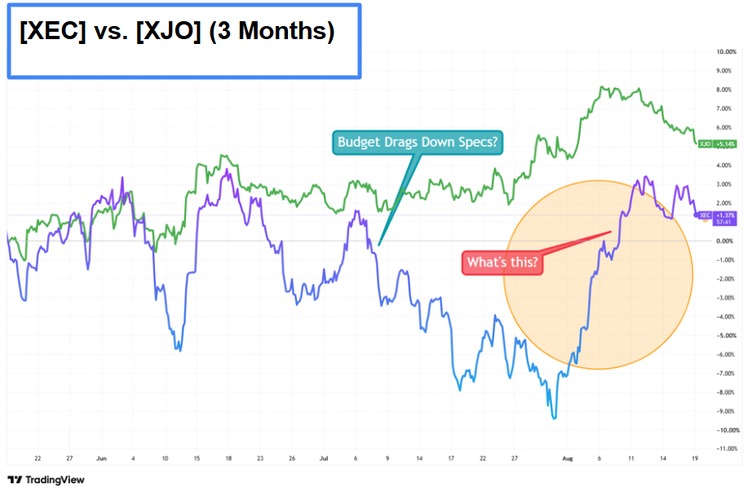
The relative picture is starker.
Across the three months to 19 August the Emerging Companies index went nowhere while the ASX 200 added ~5.9%, and most of that gap closed inside the last fortnight:
Source: TradingView
[Click to open in a new window]
I flagged a similar setup back in April.
I asked whether it was a fake-out, and the answer was yes, because the small stock indices went on to make fresh lows in July.
One good fortnight is a nice start.
The companies did not
stand still for 10 months
The small stock index has been effectively flat for ten months.
The well-run companies inside it have not been.
Three things drove capital out of the small end this year.
The budget was the biggest.
Changes to capital gains treatment pushed a generation of Australian investors out of the property trade and into whatever felt safest, which turned out to be large caps and term deposits.
The budget rollout also had the Iran conflict layered on top, which whacked us with sustained high oil prices.
AND to top it all off: Aussie rates stayed higher for longer, which kept the opportunity cost of owning something speculative uncomfortably high.
BUT…
None of them changed a gold drilling result, a resource estimate or a cash balance.
So in a nutshell, my thesis is that micro-cap operational performance is not being fully rewarded…YET.
But what if it were? And which companies would benefit the most?
Every company I vet in the micro-cap sphere gets scored against five criteria.
Capital structure, meaning a tight share count, a founder or cornerstone investor with real money at stake, and (ideally) a limited overhang of cheap options waiting to be exercised.
Options are the right to buy new shares at a set price, and when a pile of them get exercised your slice of the company shrinks.
Cash runway, because at this end of the market the bank balance is what stands between a company and a nasty capital raise. It also pays for the drilling and the announcements that move share prices.
Micro-caps rely on capital markets to survive.
And a market that’s hurting makes equity expensive to raise.
A micro-cap company that needs $5M and has to raise at a 30% discount does permanent damage to everyone already on the register.
That is why cash runway sits second on my checklist, immediately behind capital structure.
This is a key focus for me right now.
Catalyst, meaning something specific and on a timetable rather than a vague hope of good news.
Cycle, which is whether the macro is working for that company now or in two years.
You can go cyclical or counter-cyclical, just know what you’re getting in for in the first place.
And finally, credibility, which comes down to whether the board and management have built anything before.
Using these criteria, I’ve got a rubric for answering the challenge in today’s attention economy…
Look where others don’t
Right now, micro-caps are in a middling phase (and were stone cold dead just a couple of months ago).
That’s the opportunity the market sniffed out while the headlines were dragging the small stock indices lower.
Smart capital is clearly positioning before the crowd shows up again.
And remember, most companies fail the criteria on more than one point.
As I mentioned, micro-caps are among the riskiest stocks on the market. You could lose some or all of your investment.
Your eyes should be wide to that outcome.
So never invest more than you are prepared to lose.
But having a system and sticking to it gives you a much better shot at success.
All the great investors will attest to having a core set of principles.
Mine just so happen to focus on repeatable analysis on the most speculative of stocks.
Call it “advanced punting” or “speculative risk management”.
It may sound oxymoronic…
But at the very least it helps you understand the core mechanics of a part of the market that appears at first glance to be as random as a roulette table.
Trust me, that’s simply not the case.
There’s a rhythm to this end of the market I’ve learned to respect.
Long stretches where nothing works and nobody cares. Then a window, which is usually extremely brief, where everything built during the grinding period gets repriced all at once.
Now, it’s hard to get the timing exact. But what you can do is know where to look before the crowd remembers to.
Which brings me to a heads-up.
Recently, Woody, our publisher here at Fat Tail, sat me down in front of the cameras and grilled me on all of this.
He wanted the charts I’ve shown you today, and then he wanted what I’ve actually seen on the ground this year…the factory floors, word from the boardrooms, the drill results.
In short, the companies doing the right things at exactly the wrong moment in the sentiment cycle.
As you’ll see, it’s the ‘wrong moment’ from a sentiment perspective, but the most compelling from an investment opportunity perspective.
Anyway, we split it into three short conversations.
Woody’s releasing the first this Friday, right here in Fat Tail Daily, with the other two to follow over the weekend.
If today’s message made sense to you, they’ll show you what it looks like up close.
So watch out for Friday’s Fat Tail Daily. More to come…
Warm regards,

Dr. Lachlann Tierney,
Australian Small-Cap Investigator and Fat Tail Microcaps





Comments