




A story buried halfway down the AFR’s homepage piqued my interest last week.
This news could spark a wave of mergers, acquisitions, and dealmaking as the next phase of the commodity cycle takes hold.
More on this shortly.
But first…
Albermarle Updates the Lithium Story
(and it’s Very Good)
Last Monday, we discussed the opportunity brewing in the lithium sector.
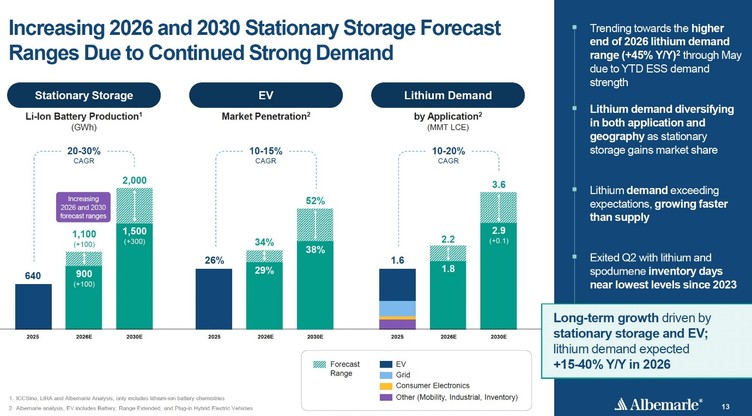
A few days later, Albermarle Corp [NYSE: ALB], the world’s largest producer of lithium for electric vehicles, reported half-year results.
The numbers were eye-wateringly good:
Sales rose 31%, profit margins hit 49%, and earnings surpassed the per-share consensus of $3.03 to reach $5.87.
Management sounded excited on the conference call:
“ESS (energy storage) demand off the charts.”
“Battery installations outpacing production.”
“Physical market is very tight – spodumene inventories at historic lows, carbonate/hydroxide inventories in weeks, not months.”
They certainly don’t see any threat to demand (from sodium or anywhere else) coming soon.
As this slide shows, they’ve now upgraded their 2026-2030 demand forecasts:
Source: Albermarle
[Click to open in a new window]
Incidentally, I’m in Perth right now, and have been speaking to a few geo mates on the ground.
Most are more positive on lithium than the market currently is.
Though they would say that!
Still, it’s hard to argue in the face of Albermarle’s stellar results.
Speaking of Perth, this city was a key part of the story that caught my attention last week…
Enter Bank of America
Bank of America (which ranks among the world’s banking giants) just announced they’re setting up a five-man team in Perth next year.
Dan Janes, head of investment banking in Australia, explained:
‘…the new Perth office reflects a strategic commitment to Western Australia and a focus on natural resources as a core global growth engine.’
They’re not the first American investment bank to set up here.
Citigroup established a minor presence in 2015, and Goldman Sachs has had a satellite office since 2012.
But historically speaking, it’s rare.
Through the 2002-2007 mining boom, international banks operated out of Melbourne or Sydney on a fly-in, fly-out basis.
Things were tough going for them back then.
Perth was a closed shop.
Local financiers used the old boy’s network to lock out the foreign banks.
But something has changed that might make them feel more welcome this time…
Locking the Locals Out
That ‘something’ is the recent changes to capital gains taxes (CGT).
The changes go live on 1st July 2027, and it’s no coincidence that Bank of America sets up shop just before that.
They clearly see a gap in the market.
Let me explain why…
You see, the new CGT rules hit high-growth shares harder than most.
For one, there’s no longer the 50% discount for holding them over one year.
Replacing it is an index-linked model. This favours slower growth, income stocks over riskier high-growth ones.
On a like-for-like basis, you’ll pay more tax on any big winners under this new regime.
But it gets worse…
As Stockspot’s analysis here shows, you get less relief from your losers, too!
In areas like mining and biotech, where a spread of big winners and losers is typical, this isn’t great.
And we’re already seeing investors change their behaviour in response.
Marc Jocum, at fund manager Global X, noted:
“We saw a clear pivot in investor behaviour immediately following the budget, and that seems to be gathering momentum; investors are seeking out income-oriented strategies that may be better positioned under a new higher CGT regime.”
Now, I should point out that there are workarounds.
SMSF’s (self-managed super funds) still retain generous tax advantages for investing in direct shares.
It’s also worth consulting with your accountant to explore other structures that may better suit your needs in this new reality.
But there’s no question, these CGT changes will dampen local appetite for riskier stocks.
Recently, the Association of Mining and Exploration Companies highlighted this fact.
They warned that 74% of surveyed retail investors plan to limit their participation in local capital raises specifically because of these changes.
So, where’s the cash going to come from to fund Australia’s junior miners?
Enter Bank of America…
When One Door Closes
This is the opportunity Bank of America clearly sees.
That gap in local funding is their big ‘in’ to the closed shop of WA mining.
It’s also the lifeline junior players will need.
As local funding slows, access to international capital markets will be critical for miners in the years ahead.
The good news is it’ll ensure Australian projects still get funded as the commodity cycle plays out.
That’s the silver lining to this mess.
It won’t kill investment in the mining sector as some feared. Instead, it’ll merely shift more ownership to offshore entities that don’t pay tax in Australia.
Talk about an own goal for the government!
But for ordinary Aussie investors, Bank of America’s entry is also a sign that the mining opportunity is still alive and kicking.
It could even go into overdrive.
Think about it…
We’re about to see a swathe of cash-hungry miners meeting a group of deal-hungry bankers!
Which companies will be targets?
Who is on the takeover hunt?
Who has the leverage to get the best of the deal?
Work this out, and the opportunities remain immense, regardless of the tax rules.
Stay tuned…
Regards,

James Cooper,
Mining: Phase One and Diggers and Drillers




Comments