



The next RBA .25% rise is about as locked in as it possibly can be.
The ASX 200 [XJO] continues to trade down today, and I expect more pain ahead.
But there’s a move afoot to alter the capital gains tax, which could have implications for the market well beyond the inevitable rate rise.
This is the latest news I read this morning on capital gains tax (CGT):
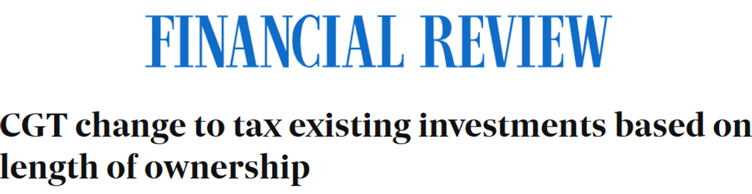
Source: Australian Financial Review
[Click to open in a new window]
It’s expected that the 50% CGT discount on assets held longer than 12 months will be replaced with a pre-1999 indexation model, taxing gains after stripping inflation.
This is tax “reform” in 2026…the revival of a 27-year-old system.
They paint the CGT discount as a tax break for property hoarders.
Currently, assets held for at least 12 months receive a 50% CGT discount. These are our homes and stocks, our investments.
The story goes that removing the discount is one of many fixes to the housing crisis.
No good investment goes unpunished
For as long as I’ve invested, this discount timeline has factored into my decision-making.
In the world of compounding, patience is rewarded, and returns of 2% and 5% create very different financial outcomes over time.
And the long game has a track record.
Almost every decent ASX or property holding has outperformed inflation over the past 25 years.
The 50% discount is the rule that lets that strategy compound properly.
That rule is on the chopping block.
Intergenerational inequality is the lingua franca of the policy wonks in Canberra.
The young don’t have assets, so if we just take from those that do have assets, we can spread it around more.
The money once again goes up to the government and gets circulated around the economy.
The Canberra mentality has always been:
‘Just give us more, we can fix it.’
‘C’mon… just little bit more’ they say.
But the tax take never comes down with any “reform”.
And it’s been suggested that super funds may retain the discount, which tells us a lot.
Of course, big institutional money gets shielded. The same money that owns around a third of the ASX 200.
I suspect there will be many perverse outcomes of this proposed policy:
- Increased capital flight from domestic indices
- Valuation rorts
- An even greater need for fancy accountants
- A chilling effect on funds’ appetite to allocate risk capital
But I also have a strange optimism about this proposed change.
Perhaps, just maybe, it might inspire a new generation of small-cap investors.
The thinking might be, “I’m going to get soaked on tax anyway, might as well go whole hog and up the risk appetite even further!”
Opportunities ahead…
Point is, you can never fully predict how major changes like this play out.
For example, the old adage “sell in May and go away” points to seasonal patterns in markets where tax-loss harvesting impacts stocks until the conclusion of the financial year.
I’ll be watching for hints of that pattern creeping in across my watchlists.
Or then again, the US might pull a rabbit out of the hat and get ships moving through the Strait of Hormuz…
Overall, my outlook for the ASX 200 and ASX small caps over the next few months is now calibrated to moderate bearishness.
However, the washout of the RBA, the budget and the brewing diesel crisis should also throw up some excellent opportunities at reduced valuations.
For me, that continues to be a range of developers across commodities in energy and energy raw materials.
That’s because the government can’t get prices down; only the market can do that.
And the market will do that by allocating capital to the best projects that enable us to produce more of the real stuff we need.
That’s where I’m looking.
Regards,

Dr. Lachlann Tierney,
Australian Small-Cap Investigator and Fat Tail Microcaps





Comments