




On Friday, January 30, 2026, global precious metals markets experienced one of their most dramatic sell-offs in decades.
Gold prices went from setting all-time new highs to suffering one of their biggest one-day percentage drops ever recorded. Silver posted its steepest single-session decline since 1980.
The shock resonated through the bones of precious-metal investors as they watched, in horror, billions of dollars being wiped off the valuations of metals and mining stocks.
Few appreciate how voluminous this move was, in part because gold and silver had already posted significant gains in the weeks prior.
But in many ways, January 30, 2026, was the Black Friday for precious-metal markets… The fear of missing out degenerated rapidly into the fear of not being able to cash out.
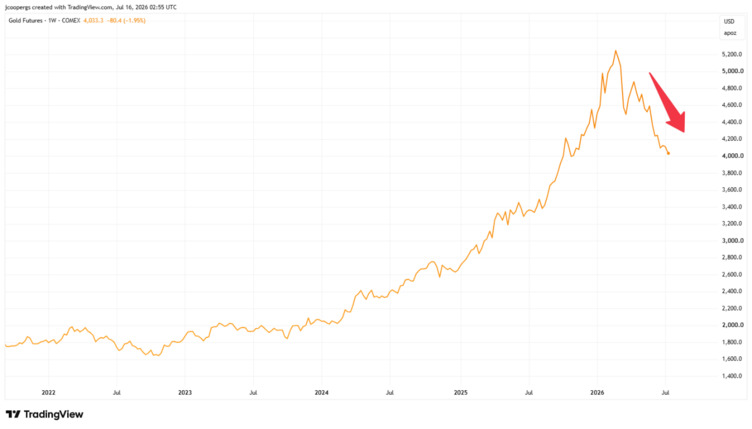
But, since those March lows, conditions in the precious metals market have continued to deteriorate, and the market still remains weak from a technical perspective:
[Click to open in a new window]
So, what’s going on?
In terms of gold’s role as a geopolitical hedge, it seems to be failing in 2026; as the war in the Middle East continues, gold prices are sliding.
Various excuses have been made for gold, such as the need for liquidity and the fact that it was an easy choice, given that investors were sitting on strong paper profits accumulated over the last couple of years.
Perhaps. But I don’t buy it. Gold’s role as a geopolitical hedge has always been murky; war is not gold’s stated purpose.
Some historical takeaways: The Yom Kippur War of the 1970s…
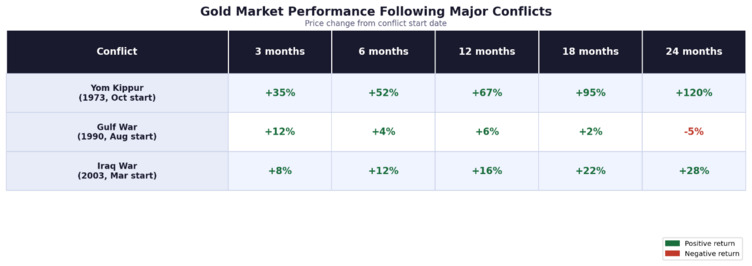
Back then, gold surged almost 35% in the 3 months following the conflict’s kick-off. And it then swelled by almost 70% 12 months after the war.
Clearly, that’s strong correlative evidence of gold’s safe-haven status? The Yom Kippur War has often been cited as a reason to own gold.
The same could be said for gold’s stellar performance following the 2003 Iraq War… That catalysed a major gold rally, with gold rising 12% over the 12 months following the start of that conflict.
But was it war that supported higher gold prices, or was it the backdrop that underpinned strong commodity prices throughout the 1970s and early 2000s?
Well, to answer that, we could turn to another conflict in the Middle East, one that didn’t coincide with a decade of strong commodity price inflation… Say, the Gulf War of 1990.
In that instance, gold prices remained dull, 3 months out from the war. And they remained flat 6 months out, and 12 months after the conflict began:
Source: Trading View/Perplexity
[Click to open in a new window]
In other words, when gold wasn’t in a commodity price inflation era, war had little impact on pushing prices higher.
Gold’s role as a safe-haven asset clearly has some cracks… And the evidence was there well before this latest conflict in Iran.
The 1970s were a decade marked by higher gold prices, and the Yom Kippur War was just one of many factors that supported the gold price rally.
Bottom line: don’t put too much weight on what’s happening in Iran and the future trajectory of gold prices. Keep them separate.
And weigh gold against its real barometer…
Like this one: Governments are divided on a lot of issues, but destroying the collective value of their currencies isn’t one of them.
Sovereign debt, reckless fiscal spending, falling tax receipts, and unchecked war budgets; all these issues will be offset by their weakening currencies.
And it’s why gold remains a ‘buy-the-dip’ asset class for at least some of your portfolio allocation.
On that note, my colleague, Brian Chu, our resident gold expert, has just finished putting together a new presentation for his readers.
I suggest checking that out to get more insights into why you should be thinking about precious metals as an ‘accumulator’, not a speculator. And right now, it is an excellent time to find heavy discounts across key gold names.
You can access Brian’s latest presentation for free here.
***
On a separate note, I’ve got a timely broadcast coming next Thursday. We’re calling it ‘The Super Bid-Up’, and it goes live at 2pm AEST on Thursday, 23 July.
It’s free to join. I’ll break down why Washington and Beijing are locked in a bidding war over a narrow slice of AI-critical resources and the five stocks best placed to benefit. Plus one investment — ticker included — free, just for tuning in. Reserve your spot here.
Until next time.
Regards,

James Cooper,
Mining: Phase One and Diggers and Drillers




Comments