



“Those who would give up essential liberty, to purchase a little temporary safety, deserve neither liberty nor safety.”
— Benjamin Franklin
Until yesterday, I’d have said Alex Karp and I agreed on nothing.
If you don’t know who I’m talking about, don’t fret. I’ll cover this story in two parts. First, who Alex is and, more importantly, his company.
Then why he has been proven right by the latest controversy at OpenAI, plus a key investing angle for the future of AI.
As a big tech CEO, Alex runs what I consider one of the most dangerous companies in existence. A surveillance panopticon of our modern era. Palantir.
If you don’t know Palantir, it’s best known as a data analytics company that acts more like a defence contractor.
It has a market cap of US$407 billion, about half the value of the ‘five primes’ mega defence companies, on roughly 1% of their combined revenue.

Palantir was co-founded by Peter Thiel, and like most of Thiel’s ventures, it takes its name from The Lord of the Rings. They even call some of their employees ‘Hobbits’.
If you’ve read Tolkien’s books or seen the movies, the names of Thiel’s companies might have a familiar ring.
Companies like Mithril Capital (a VC named after the most precious mineral of Middle-earth) and Anduril Industries (an autonomous weapons company named after Aragorn’s sword) are just one of many.
In a similar vein, Palantir is named after the seeing stones in the story.

Source: Culture State
The great irony here is that in Tolkien’s books, these ‘seeing stones’ granted immense power, but were also a key source of human corruption.
Nerdy analogies aside, Alex and Palantir have been no strangers to headlines. Mainly because he’s so outspoken.
The Flame of the West
Famous for his wandering interviews, the Frankfurt-trained social theorist has since become the enabler of ‘big tech’ within government.
He set out the justification in The Technological Republic, the 2025 book he wrote with Nicholas Zamiska. In it, he calls for a reinvigoration of the big government projects that brought us the atomic bomb and the internet.
The New Yorker described the book’s central claim as: ‘the survival of the American experiment depends on the technological revitalization of the military-industrial complex.’
Firing off 22-point manifestos and embracing ‘hard power’ (read: violence) to support Western supremacy, Alex and Palantir have become full-throated enablers of the modern surveillance state and autonomous weapons using AI.
Their AI systems assist both Israel and the US in selecting thousands of bombing targets in Gaza and Iran.
That included the bombing of a primary school in Minab that killed 160 people at the beginning of the Iran conflict, most of them kids between 7 and 12.
The school was an adjacent, some have claimed, repurposed part of the military base. But the AI’s data was outdated, so it was still seen as a legitimate target by the AI.

Source: Planet Labs PBC: NPR (strikes in white)
Then there is Palantir’s Gotham. A data system used by law enforcement and ICE agents that integrates tens of billions of data points to track people.
It links multiple databases at once — including public records, utility bills, driver’s licenses, and law enforcement files.
Ostensibly sold as a push towards safety and anti-immigration policing, the system has been described as ‘Turnkey totalitarianism’ by NSA technical director, turned whistleblower, William Binney.
Through leaks, we’ve learned it also buys data from data brokers and scans social media with facial recognition software to track real-time locations.
These data brokers have an average of 1,000 data points per person, including here in Australia. These can include:
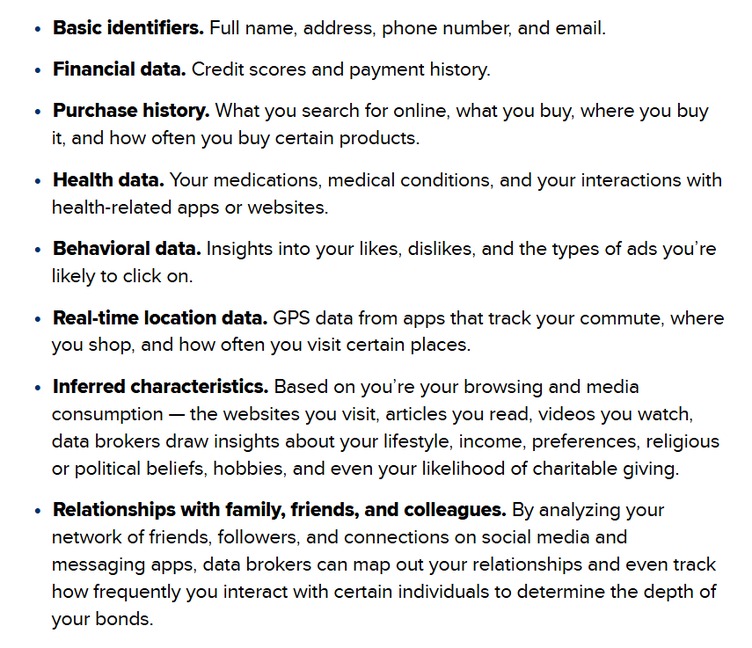
Source: CNBC
Dataclysm
All of this can be lumped under what is colloquially being called ‘The Nerd Reich’.
A collection of reactionary tech leaders, like Karp, Thiel, and Musk, who have become self-appointed bulwarks of the West.
I’d argue the threat comes from within. At the freedoms that are being given up in the name of security.
As Justice Louis Brandeis stamped into history with his famous Supreme Court dissent in the first wiretapping case of the prohibition era.
‘Experience should teach us to be most on our guard to protect liberty when the government’s purposes are beneficent…The greatest dangers to liberty lurk in insidious encroachment by men of zeal, well-meaning but without understanding.’
In his 2014 book Dataclysm: Who We Are (When We Think No One’s Looking), Christian Rudder, the founder of dating site OkCupid, gave us one of the first modern warnings from within the tent.
Through his dating website, Christian details the vast predictive power of big data over human behaviour.
How your Facebook likes can predict your sexual orientation and intelligence. And how your personal data is used to hire you, fire you, and sell you stuff you don’t need.
That book seems quaint in this AI era.
With the proliferation of powerful predictive AI systems, these challenges are everywhere.
Just last week, Coles cut ties with Palantir after advocacy group GetUp! led a pressure campaign highlighting the privacy concerns.

Source: GetUp Digital Billboard Campaign
And yet this is where Palantir diverges from the rest of the AI labs.
Because, despite my long list of grievances I have with Alex and his company, he’s absolutely right about where big AI is headed.
And his warning just two months ago has become prescient to the latest controversy to sweep over OpenAI.
As Alex warned, ‘something has gone completely wrong.’
That story comes Saturday; plus an investing angle few have considered in AI.
Until then.
Regards,

Charlie Ormond,
ATLAS and Altucher’s Investment Network Australia




Comments