



Rate cuts were supposed to be the story of 2026.
Instead, we are sitting here arguing about how many more hikes are coming.
Never underestimate how profligate a government can be, they will always spend more than you think.
Last week Commonwealth Bank, Goldman Sachs, ANZ, Deutsche Bank and NAB all tore up their forecasts inside about 48 hours.
The trigger was last Wednesday’s (bad) inflation results, which came in hotter than anyone wanted.
It landed on top of RBA minutes showing a board with almost no tolerance left for rising prices.
CBA now has a quarter-point hike to 4.6% pencilled in for November, with a live chance the board goes early at the September meeting.
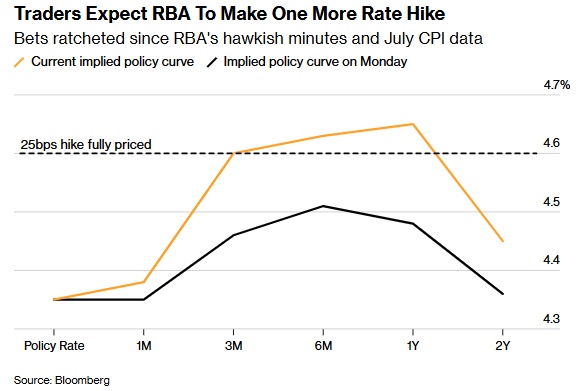
Source: Bloomberg
[Click to open in a new window]
Traders have followed the analysts on this one.
A November hike is now fully priced, up from roughly 48% at the start of that week, and September itself is sitting near a coin flip.
Bonds sold off for three sessions straight, with the three-year government yield pushing up to 4.67%.
Looks like the bond market in Australia doesn’t think much of the government’s ability to rein in spending, same as in the US.
Spending like it’s Boxing Day…but it’s not
This is the number that makes a hike hard to argue against.
Household spending rose 1.1% in July alone, and 7% against the same month last year.
Hopefully a government-engineered wealth apocalypse on the housing front will help with a negative wealth effect?
Grim.
The cash rate is already back at 4.35% after three hikes in the first half of this year, which wiped out the brief easing cycle of 2025.
And the RBA has not touched the middle of its 2–3% target band in almost five years.
So where does that leave the small end?
Rates staying up at home makes for a difficult environment for speculative Australian companies.
Higher rates lift the bar that every project must clear before a financier says yes.
And when a term deposit pays you north of 4% for doing precisely nothing, capital oftentimes gets lazy.
The budget will favour boring, large bureaucratic companies.
Which brings me to something I have been banging on about for months.
The best ASX small caps from here will likely need to find their tailwind somewhere other than Australia.
Gold is the obvious one.
It trades off US real yields, and whatever the Fed does next, the RBA has no impact on that.
Then there is the second one, and it is the one I am watching closest.
US critical minerals policy.
Washington has worked out that it cannot keep sourcing rare earths and processing capacity from a strategic rival.
The money and the political will are now lining up behind fixing that.
A decent share of that supply could end up coming out of Australian dirt, or at least dug by Australian companies in other parts of the world, part-funded by American policy.
Something big is brewing on that front.
I will have a lot more to say about it in my next piece.
Warm regards,

Dr. Lachlann Tierney,
Australian Small-Cap Investigator and Fat Tail Microcaps





Comments