




This headline caught my attention last month:
‘China signs deal with Zambia, Tanzania for $1.4 billion railway upgrade.’
According to the piece, China, Zambia, and Tanzania signed a $1.4 billion deal to refurbish the Tanzania-Zambia railway.
The agreement aims to rehabilitate the railway and purchase new locomotives, passenger coaches and wagons.
You can read the entire piece here.
This railway is known as the TAZARA; it begins in Zambia and ends in Tanzania’s capital, Dar es Salaam.
I actually caught the TAZARA back in 2012 while I was working as a geologist in Zambia.
And I can tell you, this tired, 50-year-old railway is in desperate need of an upgrade!
At one point, we broke down for over 24 hours in the middle of the bush, waiting for a replacement part to arrive.
However, I believe there’s more to this deal than just a token gesture of goodwill to those who use and rely on the TAZARA railway line.
Mining Memo’s Take
What’s going down in the Deep Heart of Africa? And why does it matter for investors?
As you may be aware, I’ve been covering various aspects of this story throughout 2025.
As I write this, the US is ALSO working with African nations to revamp another old, disused railway line: The Lobito Railway Corridor.
It forms part of an ongoing saga between China and the US to revitalise transport routes to Africa’s coast.
Again, this is not about helping the impoverished villages that have inadequate transportation to major cities; I believe it all boils down to what sits in the middle of the continent:
The Central African Copper Belt.
This geological anomaly runs through Zambia and the Democratic Republic of Congo, approximately across the middle of the African continent.
For decades, it has been an essential source of global copper supply.
There’s a handful of copper mines scattered across the area, but the mines are typically remote.
The infrastructure here is underdeveloped, and it often takes weeks to transport ore from mine to port, crossing various national borders.
In terms of the US strategy, the abandoned Lobito railway could provide a crucial link, allowing the US access to this critically important commodity and shipping it to ports along Africa’s West Coast.
The US has a clear geographical advantage by securing partnerships along Africa’s West Coast.
That’s because it offers DIRECT shipping access to the continent’s raw materials. Check it out:
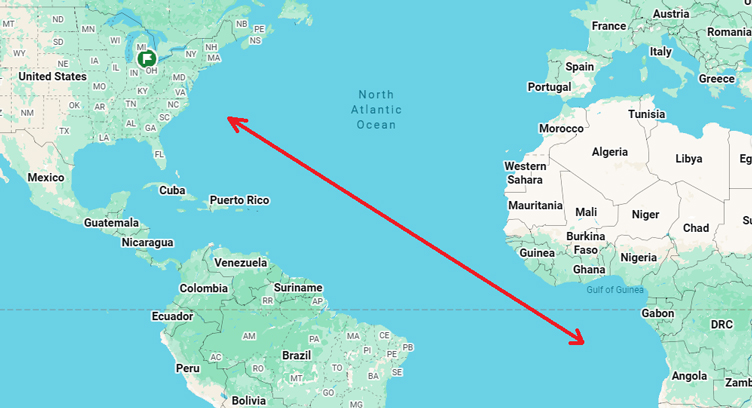
Source: Google Maps
[Click to open in a new window]
Why does that matter?
Think about this… How would the US secure critical minerals if global supply chains break down?
South America will remain an important source, and so will Canada.
But West Africa could offer another essential option for the US in the event of a catastrophic event that disrupts global trade.
Because no matter what happens to the rest of the world, the US should be able to ‘contain’ the waters within its own neighbourhood, the Atlantic Ocean.
That would mean continual safe access to Africa’s vast mineral wealth.
That might explain President Trump’s recent meetings…
Extending personal invitations to leaders from unknown countries along Africa’s West Coast earlier this year, including those from Gabon, Guinea-Bissau, Liberia, Mauritania, and Senegal.
Inviting them all to a one-on-one meeting at the White House.
Meanwhile, the US is pouring billions towards upgrading the continent’s decrepit railway lines.
Pay close attention to what happens here over the coming months…
America could be laying the groundwork for its future mineral strategy in the Central African Copper Belt.
Crucially, however, China is also underway with an identical strategy.
Stay tuned.
Regards,

James Cooper,
Mining: Phase One and Diggers and Drillers
P.S. I have identified direct ways for investors to capitalise on this geopolitical pinch point, which revolves around the crucial supply of minerals like copper. You can find out more here.




Comments