

‘The crisis consists precisely in the fact that the old is dying and the new cannot be born; in this interregnum a great variety of morbid symptoms appear.’
—Antonio Gramsci
This is the last part of my piece, Our Modern Interregnum. Click the link for the first section.
Today, we look at possible futures for this moment. And how to invest in the solution.
***
The Bitter Pill
The West didn’t lose its industrial base in a war. It sold it. Piece by piece, factory by factory, to the lowest-cost producer, and called it efficiency.
Every factory closed. Every skill base left to rot. Every sole supplier driven out by Chinese pricing. Each one was signed off by a financial system that couldn’t tell the difference between efficiency and self-destruction.
This wasn’t forced on anyone. It spread through culture.
The idea that financial returns equalled strength became so accepted that nobody questioned it. Business schools taught it. Analysts enforced it. Rising asset prices confirmed it.
An entire generation of Western leaders learned to read one ledger. And that ledger always showed a profit.
And on the other side, a deficit that has left us vulnerable.
Yes, Chinese companies are often unprofitable. Margins are thin. Returns on capital look terrible by Western standards.
But when the reckoning comes, China will have the factories, the power plants, and the railways. The West simply won’t.
China builds things that exist in the physical world. The West generates returns that exist on paper.
For decades, both ledgers moved together. Now they’ve split apart. That gap is no longer an academic point. It’s an existential one.
Another way to view this is simply through commodity cycles.
We’ve already seen commodities take the spotlight for the ASX so far this year.
Looking at longer-term trends, I believe this has much farther to go.
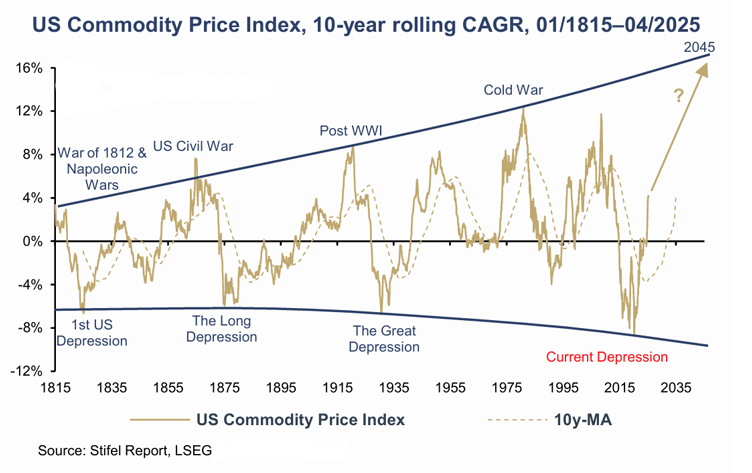
Source: Stifel Report
[Click to open in a new window]
Three Possible Futures
Despite being imprisoned by Mussolini, Antonio Gramsci remained hopeful that the crisis of his era would end.
He ultimately died in his cell in 1937. Before the cataclysmic end of his era.
Here’s hoping we won’t see that repeat.
As I see it, our current interregnum (gap between eras) has three possible endings:
Continued decay: The financial ledger stays in charge. Our problems pile up, but continue to be treated as isolated incidents.
Our elites keep extracting value from a weakening system. Industrial capacity keeps shrinking. Strategic dependence keeps growing.
The interregnum drags on until a crisis too big to ignore forces a reckoning.
This is the path of least resistance, and unfortunately, the one that plays into our current institutions.
You only need to look at the UN to see how out of touch the systems we built after the last crisis are for today.
The Trap: When a nation decides that a risky war is better than a slow and certain decline, we end up here.
Known as ‘Thucydides Trap, ’ this is a war brought on when a rising power threatens a ruling one.
In our modern times, it would mean America lashing out against China, rather than the other way around.
Economic pressure has always had a breaking point. Japan’s decision to attack Pearl Harbour in 1941 — after the US oil embargo — is a modern example. History has many more.
Like Gramsci’s era, the interregnum doesn’t end through adaptation or decay. It ends through violence.
The dire consequences don’t need spelling out.
The Bitter Pill: The far more hopeful path, and one I see as most likely.
The West realises what’s happening. It rebuilds critical industries and accepts the cost: higher prices, slower timelines, lower financial returns.
This is what the US did in 1942, not through top-down control, but through realigned incentives and new institutions. It is, in part, what Trump is attempting now.
It’s the ‘engineering turn’ author Dan Wang says America needs, but that its lawyer-dominated culture is built to resist.
As the Chinese say: 良药苦口 — ‘Good medicine tastes bitter.’
What to Do With This
Going back to Gramsci’s phrase — not monsters, but morbid symptoms — carries an instruction inside it.
Symptoms can be diagnosed. Diagnoses can lead to treatment. But only if someone is willing to look.
What’s happening now isn’t mysterious. It’s the predictable result of four decades of confusing financial value with physical reality.
A system that rewarded extracting value from productive capacity. That trained its leaders to manage symbols, not substances. That handed the ability to make things to a strategic rival in exchange for cheaper goods and higher stock prices.
The old world is dying. The world of frictionless globalisation, unlimited liquidity, and the belief that money automatically creates matter.
The new world is being born. One governed by physics. Constrained by time. Contested by rivals who know that the physical ledger is the only one that ultimately counts.
The reckoning is coming. The physical world is reasserting itself.
In 2026, the returns go to those who understand that markets trade on emotion, but settle on physics.
***
The interregnum won’t last forever. The window to position ahead of it is shorter than most people think.
Lachlann Tierney has spent months identifying it. His thesis is called Pax Silica, and it begins where this essay ends. Click here to view his latest presentation.
Regards,
Charlie Ormond,
Small-Cap Systems and Altucher’s Investment Network Australia




Comments