



The most dangerous words in markets are ‘it’s different this time.’ The second most dangerous might be a politician telling you not to worry.
Over the weekend, fewer than half the homes that went to auction across our capital cities found a buyer.
The preliminary clearance rate came in at 49.2% and will likely be revised downward toward 40% as failed sales trickle in.
Sydney clocked its weakest auction week in more than six years, with a clearance rate of 47.3%. That’s a level we haven’t seen since the first hard lockdown of April 2020.
Melbourne recorded its softest result in almost five years. And just 1,771 homes went under the hammer nationally, down more than 13% on this time last year.
For a market that has spent a decade as the great Australian wealth-builder, this moment is worth watching.
Don’t Look Down
As is tradition, our leaders would rather you didn’t stare too hard.
Treasurer Jim Chalmers spent his Sunday on the ABC playing down the data, warning against overreacting to a week or two.
He’s not technically wrong; a single soft weekend is noise. But the trend has been fairly consistent since the start of the year.
Clearance rates have been grinding lower since February, when they sat comfortably above 60%.
A reading above 60% signals a balanced market; below that, prices tend to fall. We’re now in the low 40s.
That ain’t a wobble — it’s a direction.
Three Things Broke at Once
It’s rarely one thing. Here, it’s three converging at the same moment.
First, interest rates. The RBA has hiked three times this year to 4.35% before pausing. The lag effect of those hikes is now working through household budgets. Every extra point strips borrowing power out of the market.
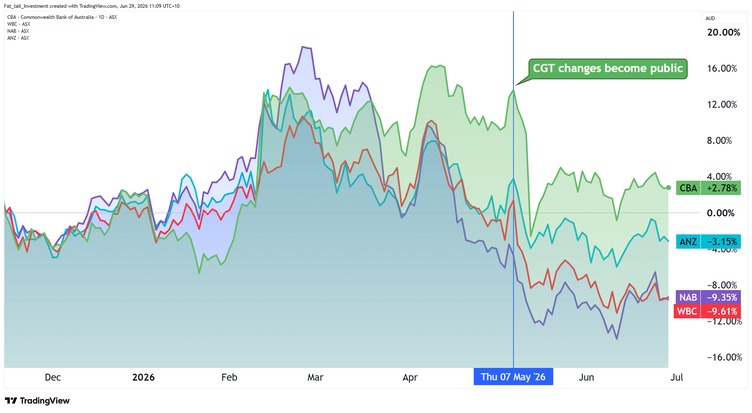
Second, and probably the biggest hit, was the budget. Labor’s May changes to negative gearing and the capital gains tax discount landed like a brick.
The effect was immediate. Westpac has reported investor mortgage applications fell 20% in the weeks following. The marginal investment buyer who used to bid up your three-bedder has simply gone home.
Third, the oil shock. The Iran conflict pushed petrol prices higher, feeding an inflation print that’s keeping the RBA hawkish and squeezing households who might otherwise be saving a deposit.
Press a market from above by rates, from the side by tax, and from below by a cost-of-living squeeze, and this is what you get.
The Disappearing Seller
More than a fifth of scheduled auctions were pulled from the market this week.
Sellers are reading the room. Rather than face a public pass-in, they’re either not listing or accepting weaker offers before auction day.
That means the headline clearance rate is, if anything, flattering the market. The weakest properties are being withdrawn before they can drag the number down.
But it also creates a standoff. Buyers wait for lower prices, sellers cling to what their neighbour got eighteen months ago, and the market doesn’t crash so much as seize.
This Reaches Your Portfolio
You might think this is a problem for property investors, not share investors. That would be a mistake.
Housing is the beating heart of the Australian consumer economy and, by extension, the ASX. When the family home stops rising in value, the ‘wealth effect’ goes into reverse and people spend less.
Bloomberg reckons the downturn has already wiped around $185 billion off Sydney and Melbourne home values. The flow-through is sharpest in the Big Four banks, who live and die on their mortgage books.
Source: TradingView
[Click to open in a new window]
We’ve already seen Commonwealth Bank cut rates to chase a shrinking pool of borrowers, a move that will likely squeeze margins across the sector.
Add in the discretionary retailers and developers that depend on a confident household, and a seized-up housing market becomes a slow leak for the economy and, by extension, the ASX.
It’s All About Timing
If this week proves anything, it’s that the same asset can be a brilliant buy or a painful mistake depending entirely on when you act.
The buyers who paid top dollar eighteen months ago and the buyers circling these auctions today are looking at the same houses.
The same is true in equities. Picking the right stock is only half the battle.
Get the entry wrong or hold through a turn you should have seen coming, and a great idea can still cost you money.
Most investors focus entirely on what to buy and almost never on when.
That’s exactly the gap my colleague Murray Dawes has spent his career closing. Murray is a 30-year market veteran who has traded through crashes, manias, and every false dawn in between, and he’s still standing.
His Retirement Trader service has returned 351% since 2018. That’s an average yearly return of 19% through some seriously turbulent times.
Now he’s opening the doors to Murray’s Trading Room.
First, by offering a free masterclass on timing your investments, built around the exact framework Murray uses himself.
No jargon, no black boxes, just a clear, repeatable method for managing risk and finding the right trades.
If you want to learn how a three-decade veteran actually times his entries and exits, take your seat in Murray’s Trading Masterclass here.
Regards,

Charlie Ormond,
ATLAS and Altucher’s Investment Network Australia




Comments