



Elon Musk spent last month pitching his next big idea. He wants to build AI data centres in orbit, using a fleet of up to one million satellites.
Each satellite would carry racks of computer chips, large solar arrays and radiators to shed heat. Laser links would connect the fleet and beam data back down to Earth.
Musk says each unit could generate 150 kilowatts of power at its peak. SpaceX plans a dedicated factory, dubbed Gigasat, to mass-produce them by the end of next year.
The timing was no accident. The pitch landed four days before SpaceX’s public listing, which valued the company at more than US$1.75 trillion and made it the seventh most valuable company in America.
Orbital data centres, alongside Musk’s xAI venture, were at the core of the investor story.
Musk argues SpaceX is the only operator that knows how to run constellations at this scale. Starlink already has more than 10,000 satellites in orbit, and its next generation carries much of the technology the AI satellites will need.
He’s not alone in looking up. Google, Microsoft and Blue Origin are exploring orbital computing, along with a wave of venture-backed startups.
Beneath the waves
While Silicon Valley looks to the stars, China is heading in the other direction.
In June, the world’s first wind-powered underwater data centre began commercial operations about 10 kilometres off the coast of Shanghai.
The Lingang facility sits 10 metres below the surface, beside an offshore wind farm of more than 50 turbines. HiCloud built it with a state-owned construction giant, at a cost of around 1.6 billion yuan (US$225 million).
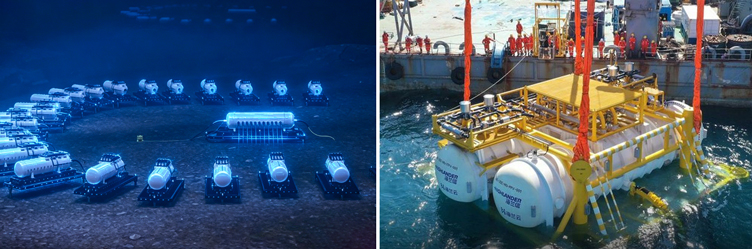
Source: HiCloud
The first phase offers 24 megawatts of capacity going to DeepSeek, the AI lab that rattled markets last year with its cheap, efficient models
And this isn’t China’s first crack at the idea. HiCloud launched the world’s first commercial underwater data centre off Hainan Island in 2023.
It now plans to scale its subsea capacity to 500 megawatts. Given data centres’ near-constant power draw, that’s the equivalent of roughly 800,000 Australian homes.
Two answers to the same problem
Both projects are chasing a solution to the same bottleneck. Chips are no longer the only limit on AI’s growth. Power, cooling, water and land are now just as binding.
A typical land-based data centre burns 25% to 40% of its electricity simply keeping servers cool. Water cooling has become an efficient answer on land, but water use is also becoming a flashpoint.
The UN’s water institute warned last month that data centres could consume 9.3 trillion litres of water a year by 2030. That’s enough to cover the annual household needs of all 1.3 billion people in sub-Saharan Africa.
Add community pushback and clogged power grids, and prime sites are getting harder to find.
Space solves those problems with near-unlimited solar energy and no neighbours to upset.
And through its experience with Starlink, SpaceX has become proficient at flat-packing its satellites for bulk launch (see below).
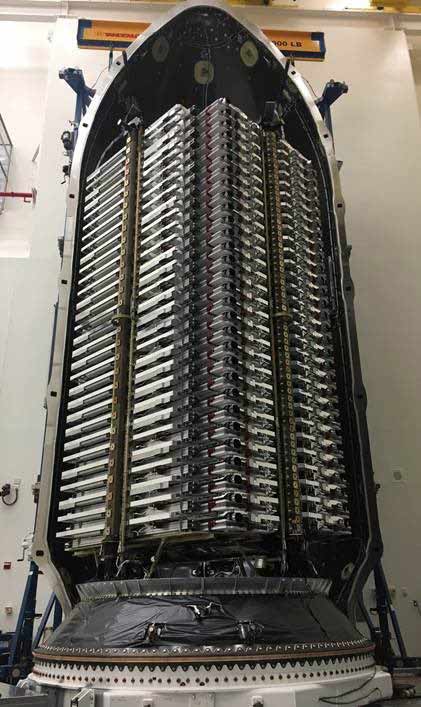
Source: TheSpaceTechie
The catch is that nobody has ever run serious computing loads in orbit.
Radiation is a major threat to sensitive AI chips. Plus, debris and the impossibility of easy repairs remain open questions. So does the launch bill, which depends on Starship, a rocket still working through its test programme.
The ocean offers a humbler fix that already works. Seawater does the cooling for free, cutting total power use by more than a fifth compared with land-based centres, according to project officials.
The Shanghai facility runs at a power usage effectiveness of 1.15. A perfect score is 1.0, and the global average has been stuck near 1.54 for years.
But of course, the sea is no pushover either. Corrosion and storms pose their own headaches for planners.
The West has tried this path in the past. Microsoft sank a test pod off the coast of Scotland back in 2018 and reported promising results two years later.
Then the project stalled. China adopted the concept and pushed it through to commercial deployment.
Power is the constant
Orbital computing can seem compelling as a headline-grabbing growth story. But investors buying SpaceX today are paying for technology that doesn’t yet exist.
China’s approach is less glamorous, but it generates revenue now. It also shows where AI competition is heading. The next leg of this race will be won as much on cheap, efficient power as on model quality.
One caveat, though. Inside big companies, the AI free-for-all of early 2026 is giving way to budgets.
Analysts at SemiAnalysis spoke with more than 50 large enterprises and found token caps are now the norm. Allowances run from US$250 a month at one aerospace giant to around US$2,000 at firms like Stripe.
That’s a sharp turn from the ‘tokenmaxxing’ craze earlier this year, when companies like Meta pushed staff to burn as many AI tokens as possible.
Uber famously blew through its annual AI coding budget in four months before capping staff at US$1,500 a month.
But budgets look like a sign of maturity rather than retreat. The same survey found the typical Fortune 500 company still spends well under US$100 per employee on AI.
If that’s the starting point, enterprise demand could have a long way to run.
For investors, a question mark still hangs over compute costs and capex spending.
Neither the satellite swarm nor the submarine server farm will change that soon. Underwater sites face corrosion and tricky maintenance. Orbital ones face physics.
Still, cooling and power used to sit in the appendix of a data centre pitch. Now they’re the whole story.
Whether the answer lies in orbit or on the ocean floor, the money will follow whoever cools their chips the cheapest.
Regards,

Charlie Ormond,
ATLAS and Altucher’s Investment Network Australia




Comments