



On 1 May 2003, George W. Bush landed a fighter jet on the USS Abraham Lincoln and declared that major combat operations in Iraq were over.
Behind him hung a banner reading ‘Mission Accomplished’. The war ran for another eight years, cementing that phrase into the political lexicon for all the wrong reasons.
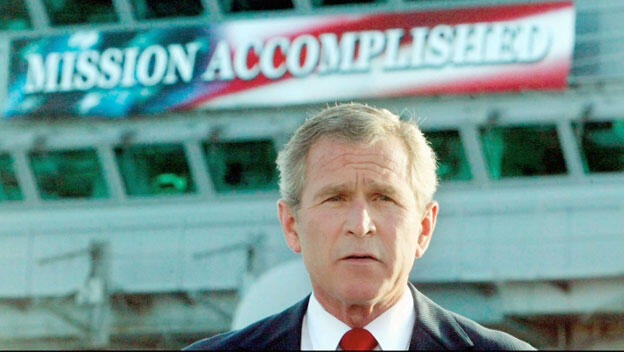
Source: History.com
That banner came to mind twice this week. Once watching the Strait and once watching the new Fed Chair in front of Congress.
Let’s start with Monday.
US stocks fell after Trump announced he was reinstating the blockade on Iranian shipping through the Strait of Hormuz.
He also floated something new. A 20% fee on all cargo passing through, payable to the US as the self-declared ‘Guardian of the Hormuz Strait’.
Global markets fell, with chip stocks bearing the brunt of the pain.
But oil did the real damage. Brent has already surged ~13% to nearly US$86 a barrel this week, with Monday’s jump the biggest since the first days of the conflict.
Then Tuesday arrived, and the mood flipped.
June inflation data came in well below expectations. US consumer prices fell 0.4% for the month, the largest monthly decline in more than six years.
Annual inflation dropped to 3.5%, against forecasts of 3.8% and down from 4.2% in May.
The driver was simple. Petrol got cheaper. The ceasefire held through most of June, and pump prices fell alongside crude.
Markets liked what they saw… And back up we go again.
Traders slashed the odds of a rate hike at this month’s Fed meeting, from 35% before the data to about 15% after.
One soft print, and the pressure seemed to lift.
Warsh Won’t Declare Victory
The inflation data landed on the same morning Kevin Warsh gave his first testimony as Fed Chair.
A cooler number was a gift for a man appointed partly for his sympathy with lower rates. It let him talk tough on inflation without committing to hikes that would enrage his boss.
He took the gift, but carried the lesson from Bush Jr.
‘There might be some that look at this morning’s data and say, Oh, mission accomplished, everything is swell,’ Warsh told the House Financial Services Committee. ‘That is not my view.’
He repeated the usual Fed spiel about no tolerance for inflation and recommitted to the 2% target. But true to his stance against forward guidance, he gave no hint on the next rate move.
Core inflation, which strips out food and energy, eased to 2.6% for the year. That’s progress, though still above target.
And here’s the catch Warsh clearly understands. June’s improvement came almost entirely from energy. The same energy prices that reversed hard this week.
If cheap petrol delivered this win, expensive petrol can take it away just as quickly. Brent has already settled back above US$80.
Which brings us to the Strait.
The Toll That Lasted a Day
Trump’s 20% cargo fee survived barely 24 hours.
Shipping firms had called the fee illegal. Industry estimates put the cost at over US$30 million per transit for the largest tankers.
Last night, he scrapped it, saying Gulf states would instead make ‘massive’ trade and investment deals with the US.
Markets treated the reversal as another storm passing. That reading may be too generous.
Energy economist Anas Alhajji called the fee suggestion ‘among the most damaging unforced errors of his presidency’.
In his words, it ‘handed the IRGC a ready-made justification to impose its own levies while simultaneously alienating key Gulf allies whose cooperation is essential for regional stability’.
Iran wasted no time proving the point. Foreign Minister Abbas Araghchi mocked the proposal within hours and promised Tehran’s own future tolls would be lower. ‘20% is of course too much,’ he wrote. ‘We will be fair.’
I wrote in April that Iran was likely building a toll booth on Hormuz. Now Washington has publicly endorsed the principle that chokepoint security deserves payment.
Tehran will keep that receipt for decades.
The fee is gone, but the words remain. And the shooting hasn’t stopped either.
The US has now launched strikes on Iran for three consecutive nights. Iran has hit tankers off Oman and targets in Kuwait, Bahrain and Jordan.
June’s inflation relief was real. But it was borrowed from a ceasefire that no longer exists.
Every barrel that moves through Hormuz now carries higher insurance, higher freight and a fatter risk premium. That feeds into July’s petrol prices, and then into the next CPI print.
Warsh sees the trap. A victory lap now, followed by forced rate hikes later, would wreck his credibility. Trump has yet to pay that cost.
Bush’s banner became shorthand for declaring victory too early. Over two decades later, the lesson still holds.
It applies to presidents, to central bankers and to investors pricing this conflict as if the mission is complete.
Regards,

Charlie Ormond,
ATLAS and Altucher’s Investment Network Australia




Comments