

Australia’s stock market has been somewhat shielded from the US market chaos in the lead up to the Nvidia earnings result.
But due to some nasty inflation numbers and a fear that rate cuts are off the table, the ASX finished November lower than the US market which shed ~1% while the domestic exchange fell ~3%.
Longer term, at the top end of the ASX returns over the last year have been a paltry ~1.7% though – pretty much flatlining.
So it cuts both ways, we’ve traded less risk in our market for less inspiring returns for at least a few decades.
Day to day though, the ASX moves up and down each day depending on what happened overnight in the US market.
And today’s ASX trading looks like a cautious “up day” across my small-cap and micro-cap watchlists, albeit more of a mixed bag than last week’s quite strong week of trading.
Why is the market suddenly positive –
I thought the AI bubble was bursting?
The answer is clear.
Even though Nvidia makes up ~8% of the market cap weighted US stock market there’s a bigger fish in the pond.
The US Fed – the institution that makes the global reserve currency that is the foundation of the US$400-500 trillion dollar global financial system.
I’m confident that this alone is the main reason the market is now moving up after a scary AI freakout.
(And maybe a smidgen of Ukraine peace hope which has constricted supply chains around the world)
The common thread is Trump, who wields his status as the most powerful man in the world to get the market to dance to his tune.
If Santa Trump wants a stock market rally in December, then a rally he shall get.
Here’s the lowdown on why
the market is moving up…
On Sunday, Trump told reporters he knows exactly who he’s picking as the next Fed chair. The announcement is coming soon.
The smart money is betting on Kevin Hassett, Trump’s chief economic advisor and a vocal dove on interest rates.
Markets have responded with enthusiasm. The S&P 500 is within striking distance of 7,000. Rate cut expectations have exploded from 30% to nearly 90% in just four days. Treasury yields have dipped below 4%. The market likes what it hears.
As I wrote two weeks ago in my Nvidia piece, my attention is very focused on what central bankers do. Not what chip makers earn. Central bankers control the money printer. They decide who wins and who loses.
The Nvidia earnings beat was another predictably extraordinary set of number from the chip beast. Revenue up 62% to US$57BN. The company has visibility into US$500BN in future sales.
The stock initially pumped, then dumped, before edging back up. The market was jittery, even in the face of spectacular results.
Because the hedge funds and the rest of the institutional finance-industrial complex know that the real game is being played out at the US Fed.
Here are the two things I’m watching.
Trump’s pick needs to tread cautiously
The market’s initial reaction to Hassett has been positive. Rates down, stocks up.
That math is simple.
But there’s a deeper story here that should make every investor nervous. Hassett is Trump’s guy. He’s been running the National Economic Council, pushing for aggressive rate cuts. The market loves that today. But what about tomorrow?
The Fed is supposed to be independent. When ideologically driven central bankers get their hands on the money printer, bad things can happen. Markets know this at a primal level.
Turkey’s central bank is the case study on whacky economic theories about low rates.
An unorthodox belief that high interest rates cause inflation rather than quell it led to a multi-year experiment that destroyed the Turkish lira.
The central bank cut rates aggressively from 19% down to 15% in late 2021 despite runaway inflation. The currency collapsed. Inflation hit over 80% at its peak.
Only recently, under new leadership, has Turkey’s central bank raised rates to around 40% to fight inflation. But the damage to household purchasing power has been catastrophic. Wage earners saw their savings decimated. Pensioners got wiped out. The economy contracted.
What if after the Thanksgiving holiday, the US market starts to get signals that the US Fed likes the Turkey approach a bit too much?
The bond market will revolt. Long-term yields could spike. The dollar could collapse. Inflation expectations could go haywire. We’ve seen this movie before. It’s called the 1970s.
If Trump picks the person the market thinks will get the job there is a tightrope walk. Right now, markets are giving him the benefit of the doubt. That could change in an instant.
Gold back on menu in the medium-term?
How the pace of rate cuts will shape
the debasement trade
Trump’s pick in Hassett has made his position crystal clear. He thinks the Fed should cut rates now.
Goose the accelerator too much though, and then the debasement trade in gold could get manic.
Right now, I’m currently looking at a range of gold producers and developers on the ASX that fit my due diligence criteria and have important newsflow that should come through in the next 6 to 12 months.
That’s the period I expect gold to really shine again given what we now know about the US Fed chair.
In the meantime, bring on the Santa Rally.
Three weeks ago very few thought it was even a remote possibility.
And yet, here we are.
If you are a regular reader you’ll know I was a contrarian bull during the sell off ahead of the Nvidia earnings release.
To riff on Rudyard Kipling a bit, part of being a good investor is made easier if you “keep your head when all about you are losing theirs”.
Hope you have a good start to the week.
Best Wishes,

Lachlann Tierney,
Australian Small-Cap Investigator and Fat Tail Micro-Caps
***
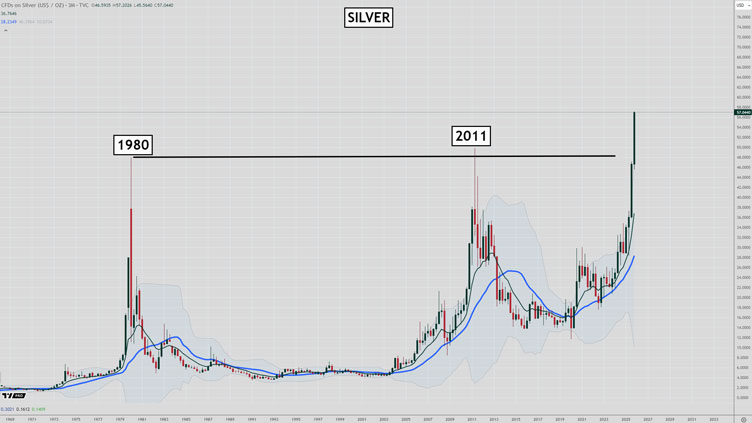
Murray’s Chart of the Day – Silver

Source: TradingView
We have just witnessed an extraordinary breakout in the price of silver.
I recently said the odds of a false break of the 1980 and 2011 highs near US$50 was increasing after such a big run in silver prices in 2025.
But that thought is off the table for now.
Instead we are facing a breakout above a multi-decade resistance level.
If the price of silver can’t hold at these lofty levels and falls back below US$50 in the short-term, we can become confident that a further correction in the silver price will unfold.
But until then you have to view this as a serious breakout that could see the silver price continue to move rapidly higher.
The price of silver was US$48 in 1980.
If you adjust for inflation, that is equivalent to US$188 in today’s money.
If we use the 2011 high of US$49 instead, we get to a current value of US$70.
So if this is a breakout, we could be surprised by just how high silver goes.
Regards,

Murray Dawes,
Retirement Trader and International Stock Trader





Comments