



While many property investors are pondering when to sell…
How does this affect the stock market in Australia?
Today I’ve got a roadmap for navigating the stock market as our government-engineered housing crash plays out.
And a lot of it comes down to your own personal psychology.
Yesterday, I laid out the dark underbelly of the global bond market.
Today, I lay out something very different…and it all comes back to some fundamental principles of managing your own psychology as an investor.
No matter what the government of the day launches down your throat.
Let’s start with the ideal outcome: being up…BIG.
There is a moment every investor knows well.
You are sitting on a big winner.
The thesis has played out.
And a little monster inside you starts whispering, just let it ride.
Resisting that voice is one of the hardest things you will ever do with your own money.
When it works out…bank it
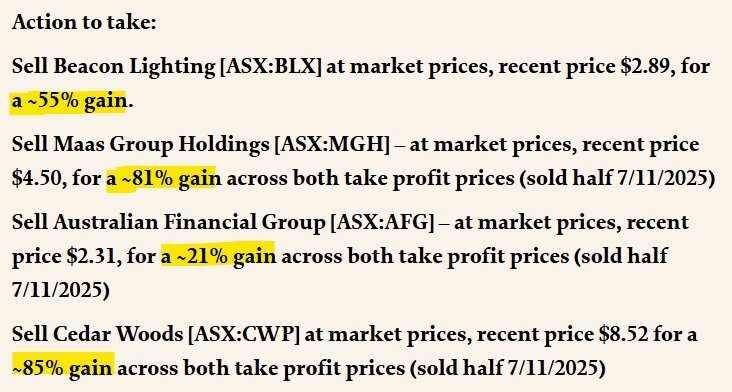
Back in early December, we sold the last of our Property Bounce Back stocks in Australian Small-Cap Investigator.
In total, there were four positions, four solid wins:
Source: Fat Tail Investment Research
All closed out across two rounds of profit-taking.
At the time it felt early to some.
The thesis had run for three years. The gains were real, but the runway for more upside looked short.
That call is looking rather prescient today given what the Aussie government is pushing through in Canberra.
Because the 2026 Budget has done something Australian governments have spent decades avoiding.
It has aimed directly at the tax settings that prop up the property market.
Why we sold when we did
Let me be clear about one thing first.
We did not exit those four stocks because we saw this Budget coming.
Betting on politics is usually a fool’s errand.
No, we sold because the major macro forces were taking shape.
Sticky inflation was boxing in the RBA, major parties were looking to cut back on immigration, and runaway house prices were crushing a tired economy.
The tailwind behind housing-exposed small caps had run out of puff.
That is the whole game in this part of the market.
You buy a good company with favourable macro, stay in while it performs, and exit when the thesis has played out.
We did exactly that.
Then the Budget turned a sensible exit into a REALLY fortunate one.
Second order effect: what about the ASX!?
A strategically engineered property downturn does not just stay in property.
It spreads.
Slower housing turnover, weaker investor lending, softer spending on renovations and big-ticket items, and pressure on anyone whose earnings are tied to a hot housing market.
There is a long list of ASX stocks exposed to this chain reaction.
Developers, building materials, mortgage brokers, and housing-linked retailers all sit in the firing line.
Basically, all the companies I had closed on the Australian Small-Cap Investigator are these types of stocks.
But the really BIG second-order effect is the banks.
Australian bank valuations have been stretched for a long time, carried higher by a housing market that only ever seemed to go up.
CBA trading at 30X P/E?
Madness!
And if that engine stalls, paying premium prices for bank shares gets a lot harder to justify.
The market is already sniffing this out.
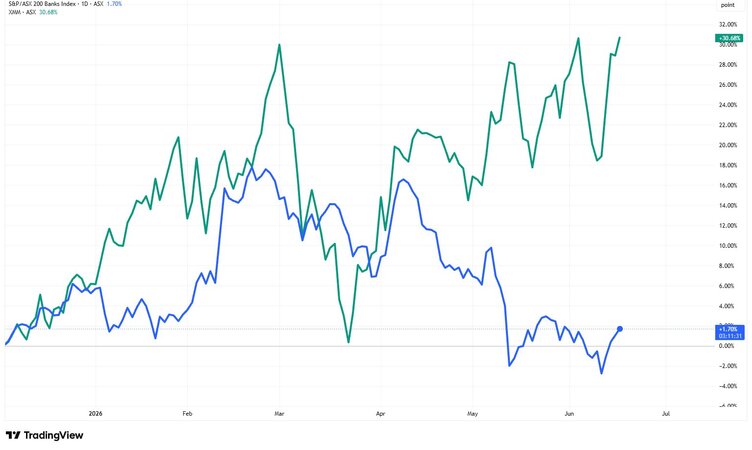
The ASX 200 Banks Index [XBK] has been in a steady three-month downtrend – while the big miners (ASX 300 Metals and Mining Index [XMM]) are ripping:
Source: TradingView
[Click to open in a new window]
I flagged this big rotation back in December, in a piece called Banks Down, Miners Up: The easiest 5-10 year trade on the ASX.
The simple idea was to sell the banks and buy the miners, treating it as a no-brainer.
That was always a long-horizon call.
But the early scoreboard is encouraging.
Banks are rolling over while metals and mining keep climbing.
From here, I see two scenarios worth thinking about.
Scenario one is the tactical one:
The most painful Budget measures remain in place for only a year to eighteen months from 1 July 2027.
In this version, the market wears a stretch of adjustment pain as the new regime bites.
Then polls start pointing to a change of government, boosting the most beaten-up housing and credit stocks in a relief rally over expectations of a rollback.
That is a trade for the brave.
You buy what the policy broke, before the election result makes the reversal official.
Scenario two is the structural one.
Labor wins the next election and the changes become entrenched.
Here the market concludes this is not a temporary scare but a new regime.
Capital steadily leaves the domestic property complex (think stocks that need a strong housing market for growth) and rotates toward companies that can fund themselves.
Boring divvy names galore.
Risk capital eats dirt.
Which brings me to this wild implication of the new budget.
Your portfolio is now a political position
This is nuts.
Once a government targets housing directly, an election stops being an abstract contest of values and ideology.
It becomes a referendum on your own balance sheet.
Personal finance is the new battleground.
And sidebar: it’s funny how the wisest words often come from places you least expect.
Once upon a time, I was seated in a gazebo in Springfield Park in London circa 2016.
Chatting to the local groundskeeper about politics he said:
“I reckon everyone votes with their pocketbook.”
It’s a certain financial realism about political ideology.
And that thinking is now vividly, searingly clear in the wake of what Albo and Chalmers have cooked up.
Millions of households will vote based on whether their home, their tax bill, and their retirement trajectory improve or get worse under the next mob in charge.
That makes personal finance the great dividing line of the next two years.
Which means your portfolio is no longer politically neutral.
It is a prediction market-style bet on which political party ends up controlling the tax system.
Insane and true.
Hold fast…keep your head
So how do you invest through a government-engineered property downturn?
Part of the answer is what we already did.
You find the courage to sell, even when that little monster is begging you to let a winner ride a bit longer.
Selling near the top is not greedy or fearful.
It is just finishing the job you started when you bought.
But here is the optimistic note to end on.
Whatever happens in Canberra over the next two years, this kind of insane political torpedo kick up the middle of the field always throws up (at least some) wonderful buying opportunities in the market.
This is my advice for handling your stock market exposure…
Stay emotionally balanced.
Remember why you got into the position in the first place.
And let the thesis, not the little monster in your head, make the call.
Warm regards,

Dr. Lachlann Tierney,
Australian Small-Cap Investigator and Fat Tail Microcaps





Comments