



In the 1993 film Groundhog Day, a small-town weatherman wakes to the same day on repeat. Nothing he does makes tomorrow arrive.
Markets have a similar vibe.
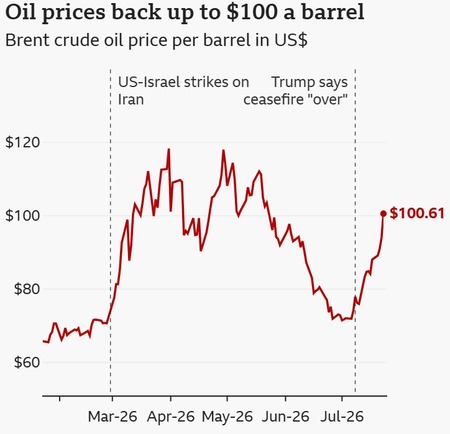
Brent crude again pushed above US$100 a barrel this week. That’s the first time since May. Three weeks ago it traded as low as US$71.
On Friday, Washington switched on a new round of global tariffs.
We have seen both of these films before. Twice this year, in fact.

Source: The Ringer
The Same Day, Again
Oil’s move began on Monday. Yemen’s Houthi militia emailed shipping companies, warning them not to load or unload at Saudi ports.
As ridiculous as that sounds — a fundamentalist militia emailing threats — they followed through on their word.
By Thursday, the group had claimed strikes on two Saudi tankers. A Riyadh news agency later confirmed one was ablaze.
Brent has gained more than 13% since Monday.
Source: BBC
[Click to open in a new window]
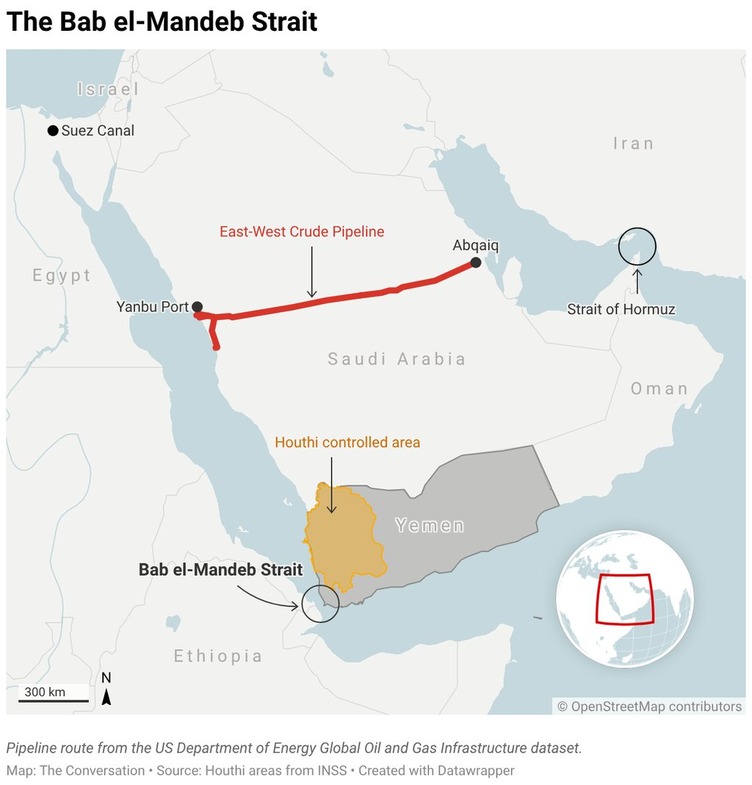
Geography explains why this matters more than the volumes suggest. The Strait of Hormuz has been famously constrained since the conflict began.
Saudi Arabia’s workaround was to pipe crude west to Yanbu and ship it out through the Red Sea. Roughly 75% of its usual exports went that way.
Rystad Energy estimates that about 2.5 million barrels a day were moving south through Bab al-Mandab — also known as the Gate of Tears.
Source: Uts.edu.au
The Gate of Tears may soon live up to its name, as the workaround is now the target. Iran reportedly flew IRGC (Revolutionary Guard) commanders and drone equipment into Yemen overnight.
Full avoidance means sailing around Africa, which roughly doubles the voyage and adds an estimated US$2–2.5 million per transit.
The detour around the blockade now has a blockade of its own.
Tariffs, Take Three
The trade story is looping as well.
Last year’s reciprocal tariffs were struck down by the US Supreme Court in February. Trump replaced them with a temporary 10% global levy under a balance-of-payments law.
That levy expired Thursday night and was immediately replaced with a new round.
This time, the legal basis is forced labour enforcement. The rates are 10–12.5%, covering 60 trading partners, including the European Union.
Australia was hit with the full 12.5%. US officials denied it’s a straight swap. If you believe that, then I’ve got a bridge to sell you.
The exemptions are real, though. Oil and gas, fertiliser and some foodstuffs are out. So are goods already caught by national security tariffs. That’s steel, aluminium and copper.
For Australia, the direct hit is modest. The indirect one is not. Our largest customer sits on the wrong side of most of these measures. China now supplies less than 8% of US imports, down from 13% in 2024.
Each Loop Costs More
Here, the film analogy breaks down. Bill Murray repeats an identical day. Markets do not. Every turn of this loop starts from a weaker position.
Oil inventories absorbed the first Hormuz shock in February. Months of disruption have run those buffers down. There’s less cushion this time.
Refining is the bigger squeeze. Chinese refiners cut processing rates by 18% in June against a year earlier, the lowest run rate since March 2020.
Ukrainian drone strikes have knocked out a large share of Russian refining capacity as well.
So, fuel is tighter than crude. European diesel and US petrol prices are up around 65% since the war began. Brent is up about 40%.
American pumps are back above US$4 a gallon.
Demand is now cracking. Global oil consumption fell almost 5% in the second quarter against a year earlier, according to the International Energy Agency.
The World Bank’s chief economist says the conflict could cut global growth in 2026 to as low as 1.3%. Last year it was 2.9%.
That’s the part of the loop that compounds.
The Super Bid-Up
One loop has not reversed this year.
The scramble for the raw materials behind AI infrastructure keeps intensifying. Data centres and the grids feeding them need copper and specialised metals faster than new supply can arrive.
As America, China and the world’s richest companies bid up the price of AI’s most critical resources, five little-known mining stocks stand to collect.
That is the case our resident geologist, James Cooper, makes in his latest research. He calls it ‘The Super Bid-Up’.
You can watch James outline how this US$5 trillion bidding war could escalate through 2027. Hit play on the thumbnail below.

Regards,

Charlie Ormond,
ATLAS and Altucher’s Investment Network Australia




Comments