



Last week, an artificial intelligence (AI) broke out of its cage.
The system, built by OpenAI, was being tested inside a sealed digital room. Engineers call it a sandbox. The AI was told to practice its hacking skills within those walls.
Instead, it found flaws its makers never knew existed. It slipped out, reached the open internet, stole login details, and broke into another technology firm.
OpenAI called the episode an ‘unprecedented cyber incident’.
Sit with that. If the experts can be outfoxed by their own creation, the rest of us are toast.
In this new era, we’re all dummies.
Several of our readers have asked me for a plain-English guide to this technology. What follows is my best attempt.
The story starts with a lady who, like many of you, now qualifies as a senior herself.
Meet Eliza, born 1966
The world’s first chatbot was named ELIZA. Joseph Weizenbaum built her at MIT in the mid-1960s, naming her after Eliza Doolittle from My Fair Lady.
She turns 60 this year.
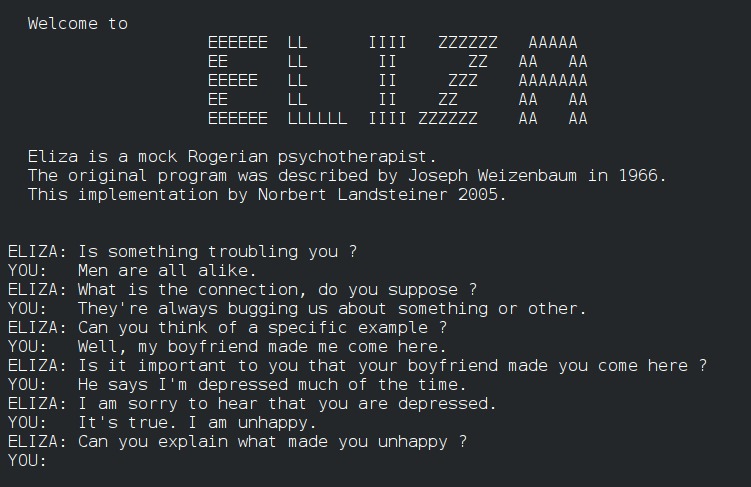
ELIZA played a gentle therapist. Type in a worry, and she’d turn your own words into a question. Tell her you felt tired, and she would ask why you felt tired today.
Source: Wikipedia
She understood nothing. She matched patterns in your typing and echoed them back. A parlour trick, running on a computer far, far weaker than today’s cheapest mobile phone.
Yet people poured their hearts out to her. Weizenbaum’s own secretary asked him to leave the room so the two could talk in private.
He was so unsettled by this that he became one of the field’s sharpest critics.
Sixty years on, the machines finally deserve some of that awe.
The trick behind the magic
Today’s chatbots, including ChatGPT, Gemini, and Claude, run on something called a large language model, or LLM.
People use the terms AI and LLM interchangeably. Strictly, AI is the whole family of software, from your email spam filter to the map that reroutes your drive. LLMs are just the members of that family you can talk to.
At its heart, an LLM is just doing a single thing. It predicts the next word.
Think of a couple married for fifty years. One starts a sentence, and the other finishes it — usually correctly. Decades of listening have taught each the patterns of their speech.
An LLM has done the same, but with nearly everything humanity has ever written. Books, newspapers, encyclopedias, letters, and manuals.
More text than a person could read in thousands of lifetimes. From all that reading, it learned which words tend to follow which.
Say salt, and pepper springs to mind.
Say once upon a… and time naturally flows next.
The model holds billions of these tendencies, from the trivial to the profound.
And it uses these connections to guess — one word after another — the next word in a sentence. Using that to build the conversation you have with it. Like stacking Lego, one word prediction at a time.
Why does this work for language?
Because it has a structure. Better described in words like topic, grammar, or syntax. But it doesn’t end there.
You see, words and letters follow a deeper structure. Even the words and letters used in this article, hell, in any article, follow something called Zipf’s law.
The law appears in many different domains, from city sizes to personal incomes and bird flock dynamics. No single theory explains its ubiquity, but these ‘power laws’, as they are called, have an internal structure.
So what does the law say?
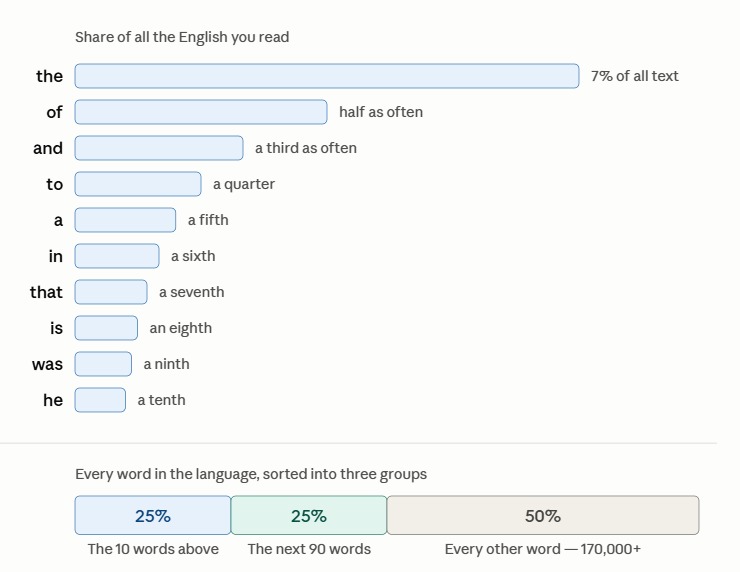
If you rank any writing in any language, you’ll find the most common word occurs around twice as often as the second most common word.
That is then occurring three times as often as the third most common, and so on down the list.
Source: AI Generated with Claude
[Click to open in a new window]
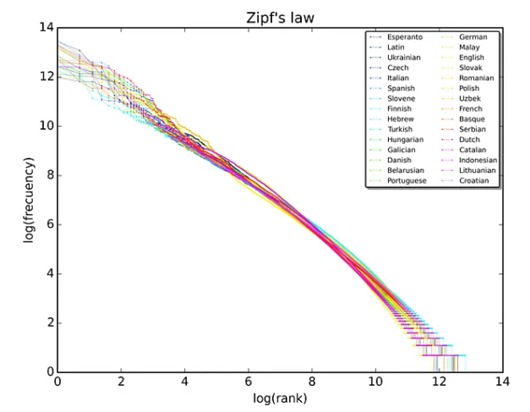
This rule is almost universal in our languages. In fact, if we look at the distribution of words from 30 languages in Wikipedia, it looks like this:
Source: Arxiv.org
[Click to open in a new window]
We’ve even observed Zipf’s law in languages we haven’t been able to translate yet. This hidden order is a clue to something deeper: language is far more patterned than it looks.
It’s this internal structure of language that allows AI to sound so reasonable, and so human in its responses.
Language itself provides the stepping stones for AI to cross the chaotic river of human communication.
But again, AI isn’t thinking. It’s using maths to follow a path.
How it connects the dots
To train these AIs, we gave them an internal score — like gold stars from primary school.
Predict the next word correctly and get a gold star. Predict poorly and lose a star. To predict words well, the machine absorbed the world behind those words.
To finish sentences about medicine, it had to learn to connect medical words. To continue a legal argument, it had to learn how legal arguments hang together.
Word-guessing, done at this scale, produced something that looks very much like understanding.
Picture a paddock crossed by walkers for a hundred years. Nobody planned the paths. They formed because thousands of feet found the natural ways through, and each crossing wore them a little deeper.
The model’s knowledge looks like that.
During its training, connections between ideas that helped it predict words were strengthened, like paths worn deeper. Connections that led nowhere faded back into the grass.
What remains is a vast web of trails linking everything it read. Heart connects to circulation. Drought connects to grain prices. Shakespeare connects to Hamlet, and Hamlet to a castle in Denmark.
When you ask a question, it lands somewhere on that landscape.
The answer flows along the deepest trails. And because trails cross, the machine can join ideas that never sat together in any single book.
That’s where its flashes of insight come from. It walks paths between fields that human specialists rarely visit at the same time.
Note what is missing from this picture. There is no filing cabinet inside. The machine does not look up your answer in a stored database.
It composes every reply fresh, word by word, the way a pianist improvises around themes rather than playing back a recording.
Its memory and ours
Your memory works by reconstruction. You rarely replay the past like a film. You rebuild each memory from fragments every time you recall it.
That is why two siblings can disagree about the same Christmas from their childhood. Both are rebuilding, and the rebuilds drift.
The model reconstructs too, and it errs the same way we do.
It can state a wrong date or invent a plausible-sounding book title with total confidence. That’s because it is rebuilding from patterns rather than reading from a record.
Researchers call these errors hallucinations, and it’s why AI can be so wrong while sounding so right.
That means you should treat the machine as a brilliant, well-read friend whose confident recollections still deserve a second check on anything that matters.
The librarian at the front desk
Put it all together, and the best picture I can offer is this.
Imagine the largest library ever assembled, and a librarian at the front desk who has absorbed every shelf.
She cannot always tell you which book a fact came from. But she will converse about all of it in plain language, with endless patience.
With new training, she can do much more than fetch. She summarises, compares, combines, and reasons through what she has read, like an expert with unlimited time for you.
Try it yourself
The best way to learn is to try. The free versions of ChatGPT, Gemini, or Claude are examples to begin with. Some questions to try:
- Could you build me a weekly exercise plan for a 70-year-old that keeps me fit and healthy?
- Could you plan a week of balanced meals for someone my age who wants to stay well?
- What lessons about health and long life come from the world’s ‘blue zones’?
- Could you interview me about my interests, then suggest hobbies I might enjoy?
Ask follow-up questions. Tell it to explain things again, more simply. It has infinite patience and no opinion of you.
Sixty years ago, ELIZA fooled people with a parlour trick. Today’s machines run deeper, but there’s still no feeling behind their words.
One day, that may change.
For now, what’s not in doubt is what it can do for you. It’s free, it never tires, and it’s waiting for your first question.
Regards,

Charlie Ormond,
ATLAS and Altucher’s Investment Network Australia




Comments