



‘It’s easier to imagine the end of the world than the end of the status quo.’
— Fredric Jameson
If you’ve listened to enough conversations about AI and big tech, you’ve heard the same refrains:
‘This spending isn’t sustainable.’
‘I can’t see how they monetise this.’
Some of this may be true. But much of it reflects a failure of imagination about how radically commerce could change.
Today, I want to sketch one possible future. It may not affect you or me directly. But it could quietly sweep younger generations into a gilded cage.
And ultimately justify the exorbitant cost big tech is prepared to pay today, in order to control the future.
Last week, Google unveiled something that could fundamentally reshape how we shop. And naturally, it’s a mash of AI, behavioural economics (read manipulation), and major retailers.
UCP for U and ME
It’s called the Universal Commerce Protocol (UCP). Developed alongside Shopify, Walmart, Target, and Etsy, and endorsed by Mastercard, Visa, Stripe, and over 20 other companies.
UCP creates a ‘common language’ that allows AI agents to browse products, compare prices, and complete purchases on your behalf, end to end.
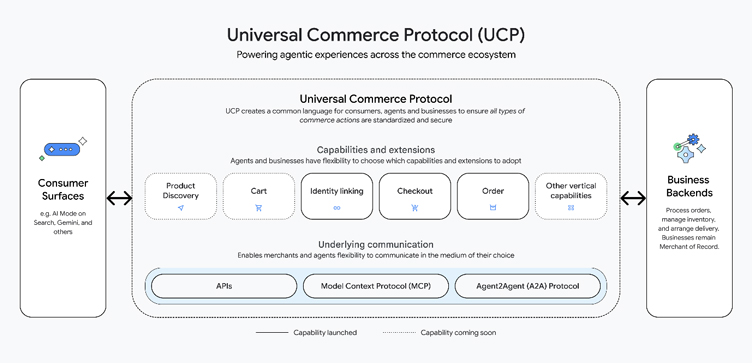
Source: Google
[Click to open in a new window]
On the surface, it sounds convenient. No more abandoned carts. No more checkout friction.
Ask Gemini (Google’s AI) about a suitcase, and the agent can research it, select it, and buy it without you ever leaving the conversation.
But dig deeper, and you’ll find something far more concerning.
This isn’t just a new payment rail. It’s the infrastructure for what economist Yanis Varoufakis has called ‘technofeudalism’.
In other words, it’s the establishment of a system where you stop being a customer in a market and start becoming a serf in someone else’s digital fief.
From Markets to Fiefdoms
In this future, capitalism’s twin pillars, markets and profit, are being quietly replaced by platforms and rent.
Think about what happens when you shop on Amazon. You’re not really participating in a market in any meaningful sense.
You’re entering a private digital estate where the landlord controls who can sell, what you see, and how much everyone pays for the privilege.
At first, this is a willing trip to the estate. But as it grows larger, it continues to devour its competitors. Just look at mom-and-pop stores in the US vs. Amazon, etc.
UCP supercharges this model. By creating a universal protocol for AI agents to transact across retailers, Google is positioning itself as the tollbooth between you and every online purchase.
Again, unlikely a concern for folks like you and me. But younger generations of ferocious online shoppers? They’re averaging a package every 2–3 days in the US.
And do you think they’ll know the difference between a market and a fief?
In a market, you can walk away. In a fief, you work the lord’s land because there’s nowhere else to go.
Once your AI, search engine, shopping assistant, and payment credentials all live inside one ecosystem, where exactly do you go?
Feudal Lords at War
Google isn’t the only tech giant racing to become the universal interface for commerce in an AI future. Amazon is playing the same game.
Last year, Amazon quietly launched ‘Buy for Me’, an AI agent that scrapes products from third-party websites and lets shoppers purchase them without leaving Amazon’s app.
The catch? Retailers never agreed to participate. Small businesses discovered they’d been drafted into Amazon’s marketplace only when strange orders started arriving.
The backlash has been fierce. One retailer found her products listed alongside AI-generated images of items she’d never sold.
Amazon’s response was an onerous opt-out process that put the burden on merchants to discover they’ve been conscripted.
The irony is staggering. In November, Amazon sued AI company Perplexity for scraping Amazon’s website to power its AI shopping browser.
This is what competition looks like under technofeudalism.
The lords aren’t fighting for customers. They’re fighting over territory, over who gets to be the gateway through which all commerce must pass.
Google builds partnerships. Amazon annexes land. Different strategies, same endgame.
Future shoppers become a vassal, paying rent to whichever lord claims your territory first.
The Making of a Digital Serf
These AI shopping protocols will be sold as a new way to shop. But they’re really a new way to surveil.
They learn from every conversation you have. Your doubts, your questions, your hesitations. Google calls this ‘user context’.
By bundling search history, conversational data, and retailer profiles, this protocol creates a perfect surveillance feedback loop.
Every scroll, click, chat and buy trains algorithms that make the platform more valuable.
And this quid pro quo of your data for convenience isn’t always clear-cut.
Buried in the protocol is a mechanism that allows businesses to request ‘additional permissions beyond those explicitly requested.’
The protocol even embeds consent for data sharing directly into checkout.
Meaning AI agents can negotiate ‘mid-checkout’ discounts by trading your marketing permissions in real-time.
Your privacy becomes a bargaining chip you didn’t know was on the table.
One Kind of Future
Google’s roadmap makes clear that UCP will evolve into a personalisation platform.
Agents won’t just take your order. They’ll use ‘account linking’ and ‘user context’ to maximise your spend over time.
The company is launching ‘Direct Offers’, a Google Ads pilot that surfaces personalised discounts when the AI detects you’re ready to buy.
Sounds helpful until you read Google’s stated goal to its business partners. The aim is to use the agent’s persuasive power to make you comfortable spending more.
This is the essence of what an AI shopping future could become. A system designed not to serve you, but to modify your behaviour.
The question we could be asking in this future would be:
Is the AI finding you the best deal — or calculating exactly how much your data says you can afford?
We may never know. And that’s precisely the point.
The fiefdom awaits.
Regards,

Charlie Ormond,
ATLAS and Altucher’s Investment Network Australia




Comments