



Oil markets didn’t wait for the diplomats.
Before the second round of US-Iran nuclear talks in Geneva had even finished yesterday, traders were repositioning.
Overnight, crude had jumped more than 4%. The Strait of Hormuz risk premium, dormant for months, was back.
The military backdrop explains why.
The largest warship ever built, USS Gerald R. Ford, left the Caribbean on Tuesday and is now heading through the Strait of Gibraltar toward the Middle East.
It will join the USS Abraham Lincoln, already positioned roughly 700 kilometres off the Iranian coast. F-22s, F-35s, F-16s, in total around 50 fighter jets were repositioned into the region in a single day, bringing the total tally into the triple digits.
The US military presence around Iran is the largest it has been in years.
Washington’s message is not subtle.
Talks going nowhere fast
The Geneva meeting was the second round of indirect nuclear negotiations in two weeks, mediated by Oman.
Iran’s Foreign Minister called the talks ‘constructive.’ Meanwhile, Vice President JD Vance said the opposite. The Iranians, he claims, have refused to acknowledge Washington’s red lines.
The sticking point is pretty fundamental. Trump wants Iran to end uranium enrichment entirely. Iran says that is non-negotiable. Vance gave Tehran two weeks to submit a different framework.
It seems like, in the background, things are moving up a notch. One Trump advisor told Axios that there is a ‘90% chance we see kinetic action in the next few weeks’.
Meanwhile, Iran’s Revolutionary Guard conducted missile drills in the Strait of Hormuz while the talks were underway. Temporarily closing parts of the waterway.
Supreme Leader Khamenei seems to be favouring sabre-rattling as his grip on power looks tenuous.
Whether this is posturing or a prelude, markets are beginning to price it as the latter.
The Strait of Hormuz problem
The focus for markets is Energy. Roughly one-fifth of all global oil flows pass through the Strait of Hormuz.
That’s about 20 million barrels a day. Making it the single most consequential chokepoint in global energy trade.
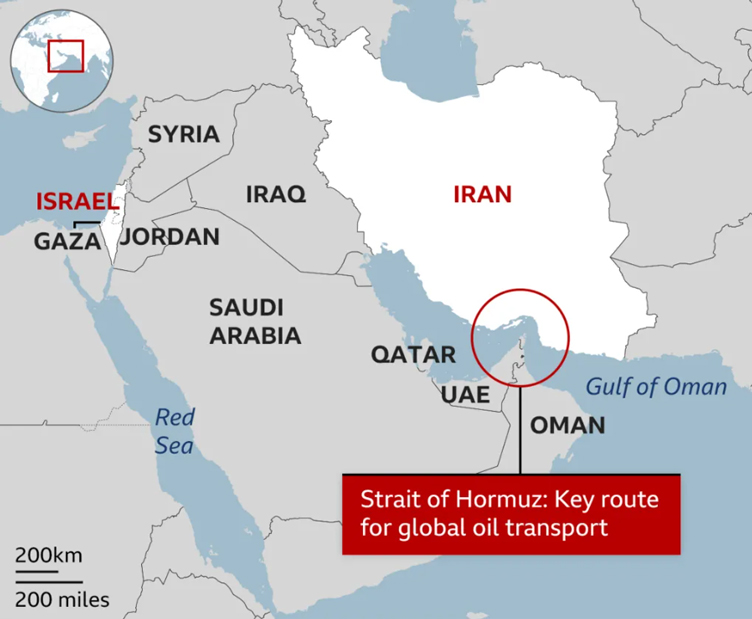
Source: BBC
[Click to open in a new window]
Iran has repeatedly threatened to close it in the event of a US strike. Even a partial or temporary disruption would be catastrophic for supply. The risk doesn’t need to be high to matter. Markets simply have to price in the possibility.
WTI crude settled at US$65 a barrel today. Brent at US$70. Both figures reflect a renewed geopolitical premium being rebuilt into the price.
If tensions escalate further, the uplift could be violent from here.
Last night’s move in Gold could be for the same reasons. Now approaching US$5,000 an ounce again as safe-haven demand, dollar weakness, and central bank buying all converge with a fresh spike in geopolitical risk.
Historically, when oil surges amid supply shock fears, gold tends to follow suit.
But amidst the tensions, Australia seems to be sitting pretty.
Goldilocks Australia
Here is something that rarely gets said plainly: Australia is in an extraordinarily fortunate geopolitical position right now.
While the US and Iran face off in the Persian Gulf, and the broader Western alliance navigates the fractures opened by Trump’s second term, Australia sits in a rare sweet spot.
We are a close US ally and deeply integrated defence relationships, but we’re also China’s largest supplier of iron ore, a major LNG exporter into Asia, and a country Beijing cannot easily replace in its resource supply chain.
That dual position matters more than ever in a world of rising commodity prices and fracturing trade blocs.
When oil spikes due to Middle East tensions, Australian LNG exports, priced off crude benchmarks, become more valuable.
When gold runs, Australia’s status as the world’s second-largest gold producer means the royalties, the employment, and the earnings all flow onshore.
When critical minerals become geopolitical leverage. Australia holds the keys to breaking those monopolies.
China needs what we dig up. The US needs us for security. Neither has a strong incentive to make life difficult for Canberra right now.
It won’t always be this way. The gap between US and Chinese expectations of Australian loyalty will eventually force harder choices.
But for now, the country is genuinely in a Goldilocks position. Close enough to the centre of gravity on both sides to benefit from the commodity boom this tension is generating, without being exposed to the direct consequences of a military escalation.
That’s an underappreciated edge for Australian investors.
We’ve Been Here Before
Tensions with Iran are nothing new. There’s a real scenario where this ends without a shot fired.
Iran’s nuclear infrastructure is likely still hurting from the last strikes by Washington.
Some have argued Tehran would likely accept enrichment restrictions for a time simply because it no longer has much to give up.
If a deal gets done, oil pulls back, commodity-exposed trades reverse, and the risk premium deflates quickly.
But the structural arguments, such as tight global energy supply, underinvestment in exploration, central bank gold accumulation, and Australia’s key resource position, do not depend on the Iran situation to hold.
My colleague Lachy has been digging into the full extent of these geopolitical moves.
He calls the shift Pax Silica and has identified five stocks that he thinks could become major pieces on the board.
Take a look.
Regards,

Charlie Ormond,
ATLAS and Altucher’s Investment Network Australia




Comments