



Yesterday, I told you the bond bosses are buying again.
I think that’s good news for the next couple of months in the market.
However, over the next few years, Washington will have a much bigger problem.
It needs trillions of dollars in fresh loans.
Turns out, its old lenders are drifting away.
For two weeks now, I’ve been following the bond market.
Today, it takes us somewhere a little different.
You might already know I’ve spent the last eight years digging through ASX small caps.
But over that period, I also wrote a PhD on blockchain governance at RMIT.
So this week I’m going deep on crypto, because I think that’s exactly where the bond story leads.
Washington’s debt buyer problem
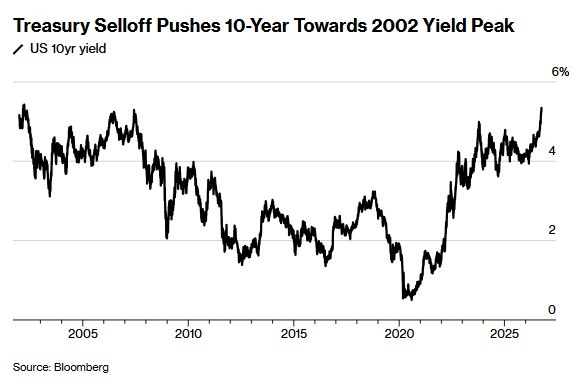
Earlier this month, the yield on 10-year US government debt hit its highest level since 2002.
That’s the interest rate America pays to borrow for a decade, and it climbs when lenders get nervous.
Source: Bloomberg
[Click to open in a new window]
The US government spends far more than it collects.
In the 11 months to August, the gap came to about US$2 trillion.
To cover it, the US Treasury sells IOUs in the form of bonds. And every single one needs a buyer.
The interest on all those IOUs now costs America more than its entire military.
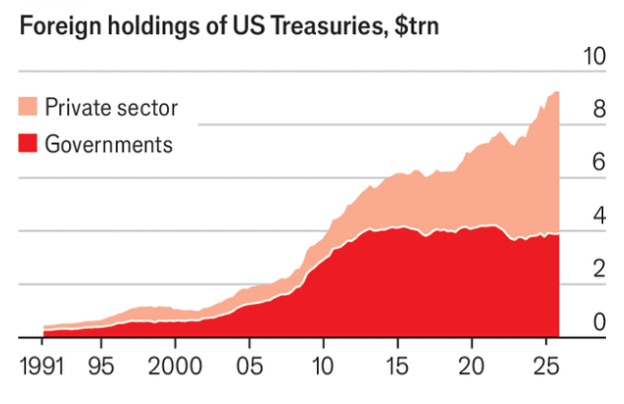
Two of its most reliable buyers have stepped back.
China held more than US$1 trillion of US government debt in 2021, and it’s down to around US$620 billion today.
And governments around the world are increasingly shying away, while the private sector steps in:
Source: The Economist
[Click to open in a new window]
The Federal Reserve, America’s central bank, shrank its own pile for three and a half years until late 2025.
And it’s buying short-term debt again now, but at a fraction of its Covid pace.
Washington also has competition for lenders’ money.
Big Tech is borrowing record sums to fund the AI build-out.
Last quarter, Google’s owner Alphabet spent more on data centres and chips than its business brought in.
That left it with negative free cash flow, the cash left after paying for new investment, for the first time since it listed in 2004.
Then there’s private credit, where investment funds lend straight to companies, outside the banks.
Some of those funds have started limiting how much money investors can take out.
I call this toxic trifecta of forces: “the debt hyper-complex.”
It’s a tangle of giant borrowers all chasing the same pool of lenders, and those lenders want more in return.
Think of the MCG car park after a close game, with 100,000 people jostling for the same few exits.
What an absolute dog’s breakfast.
The lender nobody saw coming
So who’s filling the global debt piggy bank’s gap?
More and more, it’s crypto.
A stablecoin is a digital token designed to maintain a value of exactly US$1.
Tether and Circle run the two biggest, and they park most of the money behind them in short-term US government debt.
Washington wrote that into law last year. The GENIUS Act requires issuers to back every token with safe assets, such as cash or Treasury bills that pay back within 93 days.
That turns stablecoins into a buyer that keeps showing up. Most new money flowing into stablecoins ends up lending to the US government.
Tether alone held about US$141 billion of US Treasury bills and similar assets in March. By its own count, that made it the 17th largest holder of US government debt in the world.
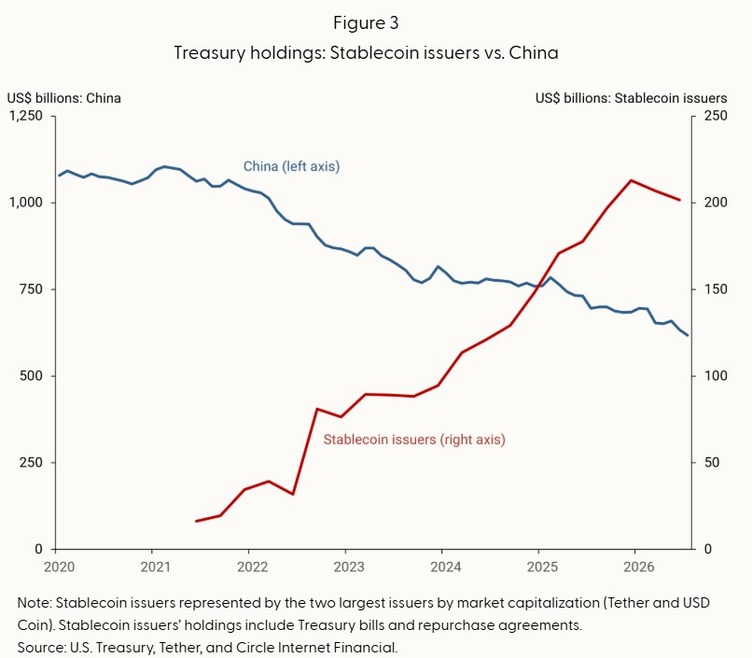
Now for the chart that made my jaw drop.
Source: Federal Reserve Bank of San Francisco
[Click to open in a new window]
This comes from the San Francisco branch of the Federal Reserve.
China, on the left axis, still holds about three times as much, so check the scales before you get too excited.
Over five years, though, the two lines have gone opposite ways, even with a small dip in the red line this year.
Stablecoin issuers grew their holdings more than tenfold, adding about US$200 billion, or over 40% of what China shed.
Since 2023, stablecoin issuers have added more short-term US government debt than Japan, America’s biggest foreign lender.
And recently, US Treasury Secretary Scott Bessent has pointed to forecasts of the stablecoin market growing from about US$300 billion to nearly US$4 trillion.
Crypto’s rules have flipped
In 2017, JPMorgan boss Jamie Dimon called Bitcoin a fraud.
Today, his bank moves dollars on a public blockchain, and the US Treasury leans on stablecoins to help fund its debt.
Seinfeld fans will know this as Bizarro World, where everything runs opposite to how it should.
I can imagine this scene right now:

Source: AI Generated, Lachlann Tierney
Governments spent years trying to stamp crypto out, and China banned it outright in 2021.
Now the world’s biggest borrower needs a slice of crypto to work.
It also raises a bigger question. If the hyper-complex keeps clogging up, where does all that pressure go?
Tomorrow, I’ll show you what Bitcoin did while bond yields climbed this year.
The old financial textbooks would insist it should have fallen.
What it does next…perhaps one for the history books.
Warm regards,

Dr. Lachlann Tierney,
Australian Small-Cap Investigator and Fat Tail Microcaps





Comments