



ASX small-caps to have a surprise renaissance into Christmas.
I’m calling it, I’ve got supporting evidence and that’s the big idea today.
But first, some context from the wild and opaque world of bonds…
Back in January, I compared the big bond investors to Chopper Read.
Casual as you like, they let governments know exactly how things are going to work.

This year, the standover men of global finance have been selling bonds hard.
Now some of the biggest players in that world are quietly turning into buyers.
The papers will keep running scary bond headlines for months, because fear sells.
The people who actually move the money tend to buy well before anyone reports it.
That gap is absolutely crucial for ASX small caps right now.
Here’s why.
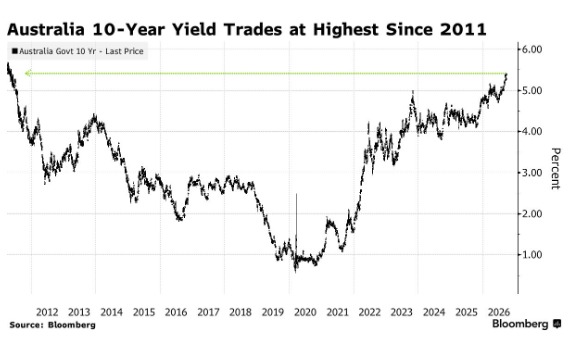
The bond market did the RBA’s job
When investors sell government bonds, the yield goes up.
That’s the interest rate a government pays to borrow, and when it rises, borrowing costs climb right across the economy.
Bloomberg reports yields have climbed so far that they’re now doing some of the work central banks normally do with rate hikes.
So markets have slashed their expectations for more hikes.
Across eight major economies, the rate hikes markets expect have fallen by almost 200 basis points since mid-September.
The biggest pullback of the lot has been right here in Australia.
A basis point is a hundredth of a percentage point, so that’s almost two full percentage points of expected hikes gone in a matter of weeks.
Source: Bloomberg
[Click to open in a new window]
The bond bosses are buying
The biggest money in fixed income, the industry’s term for bonds, is starting to agree.
Take PIMCO, one of the largest bond investors on the planet, with about US$2.3 trillion under management.
In late September, PIMCO’s head of Australian portfolios, said the RBA’s rate hike cycle is “fully priced”.
In plain English, markets have already factored in every hike the RBA is likely to deliver.
Over in the US, PIMCO’s chief investment officer, Dan Ivascyn, has started winding back his bet against long-term government bonds now that they yield more than 5%.
Then there’s RBC BlueBay, a specialist bond manager owned by Royal Bank of Canada that runs well over US$100 billion.
Last week, its fixed income chief, Mark Dowding, told Reuters the worst of this year’s bond bear market may be behind us.
And Aussie bond specialist, Bentham Asset Management’s Richard Quin, told the AFR this week that everyone tends to extrapolate from whatever is happening right now. He called it “a fault we all have”.
To reframe this chorus of voices in the words of the madman behind the Gamestop meme-stock rally: “I like the bond”
And I’m listing these names and fixed income organisations because their voices are signalling to me that a big trap may be forming in the market.
The trap is a classic one.
By the time the front page catches up, the big money has often moved.
Gravity and small caps
Warren Buffett once compared interest rates to gravity.
The higher rates go, the harder they pull down on the price of everything else.
I’ve seen time and time again that small caps feel that pull more than most.
Smaller companies lean harder on borrowed money and fresh capital raisings to fund their growth.
Many also expect their biggest profits years down the track, and those future dollars are worth less today when rates are high.
A truly gnarly federal budget hostile to investors only added to the pain.
BUT: If bond yields are close to peaking, that gravity could start to ease.
The stocks that fell hardest under that pull often have the most room to recover.
Small caps on sale?
I made this point to Fat Tail’s Greg Canavan recently in a chat last week for our members-only publication The Insider.
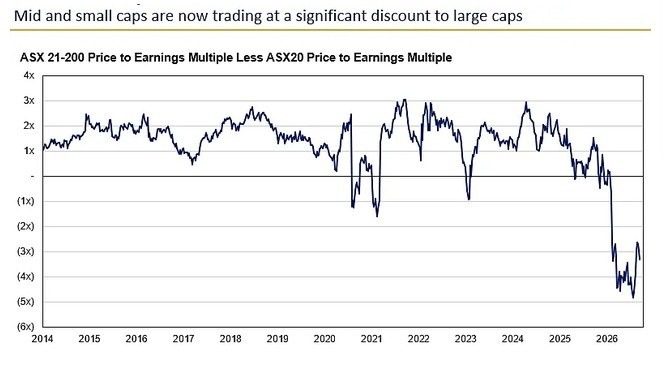
Small caps are trading at a big discount to the largest companies on the ASX.
Case in point, this chart from fund manager Auscap compares the valuation of ASX 200 companies outside the top 20 with the top 20 themselves.
Source: Auscap, Livewire
[Click to open in a new window]
The measure here is the price-to-earnings (PE) ratio, which is how many dollars you pay for each dollar of a company’s annual profit.
For most of the past decade, companies outside the top 20 traded at a premium, as investors paid up for faster growth.
In 2026, that has swung to a discount of three to five PE points, the widest on this chart going back to 2014.
The ASX Small Ordinaries [XSO], which tracks the 200 companies ranked just below the top 100, tells the same story.
It trades on about 14 times next year’s expected earnings, against about 17.5 times for the ASX 200.
Flip the PE upside down and you get the earnings yield, which is roughly the profit you buy with each dollar.
Small caps give you about 7 cents on the dollar, and the ASX 200 a bit under 6 cents.
An Australian 10-year government bond pays a little over 5%.
So the big end barely beats a government bond, while small caps offer close to two percentage points extra.
From experience, gaps like that can close quickly once fear fades and money starts hunting for value again.
Santa could come early
Then there’s the calendar to consider.
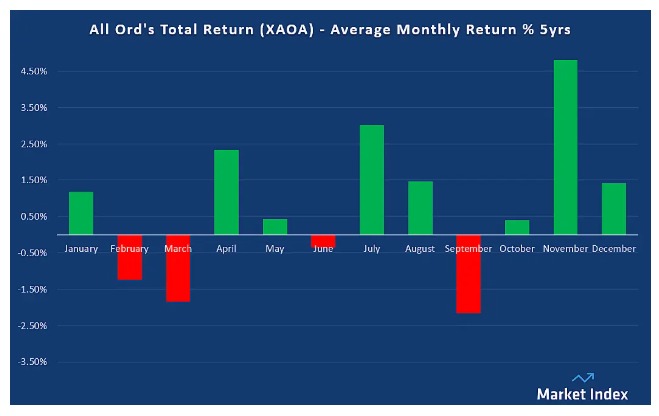
December has historically been the ASX 200’s most reliable month, rising roughly three years in every four.
But a 2024 research report from an astute analyst has also found that more of the end-of-year gains have been arriving in November lately:
Source: Carl Capolingua, Livewire Markets
[Click to open in a new window]
So if a Santa rally turns up this year, positioning early could matter more than it used to.
As is always the case, seasonal patterns are a guide only, and they cover the whole market.
So treat them as just another possible tailwind for small caps.
The real trick is finding the exact right companies for the more specific tailwinds the market is currently throwing up.
Before getting to that, however, consider the downside case too…
What could go wrong
Oil is the big risk.
Brent crude has been hovering around US$100 a barrel, and Iran has stepped up attacks on tankers in the Strait of Hormuz.
The good news is more oil is getting through.
Top commodity traders estimate flows from the Middle East are back to around 80% of pre-war levels – something I highlighted as one source of optimism last week.
There are negative aspects to consider around shipping and, most importantly, insurance costs…
But I dare to dream until at least Wednesday night/Thursday morning (Australia time).
That’s the next test, which is this week’s US inflation figures for September.
A hot number could put a small damper on things, so let’s see how it plays out.
The bond bosses could also be way too early and yields may climb further before they turn.
Bank the wins
There is a viable strategy for navigating all this however, and that means not dilly-dallying when you’ve got something good.
So I’m taking wins when the market offers them.
Earlier this month, I told Australian Small-Cap Investigator subscribers to sell Meteoric Resources [ASX:MEI] for a gain of about 39%.
I’d recommended the Brazilian rare earths developer in a special report just three weeks earlier.
Then Lynas Rare Earths agreed to buy the company in a deal that valued it at a ~68% premium to its previous close.
We banked the gain straight away.
Gains like that have been rare at the smaller end this year.
And past performance is no guide to future returns, of course.
With that said…
I’ve just released a new presentation called Situation Excellent.
It walks through how we found that win and previews other companies from the same report:
Watch Situation Excellent right here (free).
Remember, if it looks like the bond-Choppers are changing their tune…
And the standover men of global finance have started buying again…
I’d be paying attention to what certain ASX small-caps can achieve in the coming months and years ahead.
Talk soon.
Warm regards,

Dr. Lachlann Tierney,
Australian Small-Cap Investigator and Fat Tail Microcaps





Comments