



Bonds and bond investors are scary, scary things.
They can make governments crumble in the UK in the space of less than two months.
They hold sway over the US Federal Reserve chair picks and can boss around markets.
But bonds ain’t it. They’re temporary in the grand scheme of things.
There’s something far larger afoot.
And in a twist of fate, it comes back to bonds.
Let’s start with this little snippet from a piece I wrote here in June:
“Amazon’s March 2026 $37bn USD bond deal attracted $126 billion in peak orders — a 3.4x oversubscription — while the most recent comparable US 10-year Treasury auction of $39bn drew $93 billion in bids, at “a 2.4x bid-to-cover ratio”.
Roughly speaking — investors were 42% more eager, in relative terms, to lend to an AI/tech/retail company than to the US federal government.”
And there it is
The bond yield story playing out right now is telling you the bond market doesn’t want US Treasury notes as much anymore.
That’s because the US government is competing at scale with AI hyperscaler capex for the same pool of capital.
For me, this is all you need to know about the bond market, as a retail investor right now.
A few months back at FT1, Fat Tail Investment Research’s gathering at a fine old hotel in Melbourne, I made the point bluntly.
It was something along the lines of “hyperscaler bonds are on course to eclipse the US Federal Reserve’s Treasury issuance in the coming years”.
If bonds pick governments and central bankers, what happens when the bonds pick, well, everything in this world…the AI, the data centres, the CEOs of the mega-cap tech companies?
Jeff, buddy, you’ve had a great run with Amazon, but please, the door.
Is a superintelligent AGI a bond investor?
It sounds a bit like a Phillip K. Dick novel title, or Asimov with a financial twist.
It’s not as wild as it sounds.
From basements beneath
banks to Mars and beyond
The AI push is working out the opposite of what many expected.
This isn’t the Jetsons yet.
Instead of physical AI (robots), it’s white-collar knowledge work getting gutted.
But physical AI is coming, trust.
Even in the basement loading docks of Melbourne, where I used to work as a removalist, I used to joke with my labouring mates that the job was robot-proof.
Lifting a 500kg boardroom table up from a truck and into some posh office penthouse for one of Australia’s largest banks in the Docklands teaches you something.
The back pain is permanent, but the main takeaway was that human spaces are built for humans.
That’s only for that fleeting, ethereal timeslice we call “now” though.
Soon, though, to be sure, it’s robot spaces for robots.
Maybe we can share?
I’m confident we’ll see humanoid robots everywhere in the next few years.
And here’s where it really ends up
It’s in the rocks.
It’s in the rocks.
A bit of repetition for emphasis.
No rocks, no robots.
Check out this chart on rare earth oxide demand through to 2040:
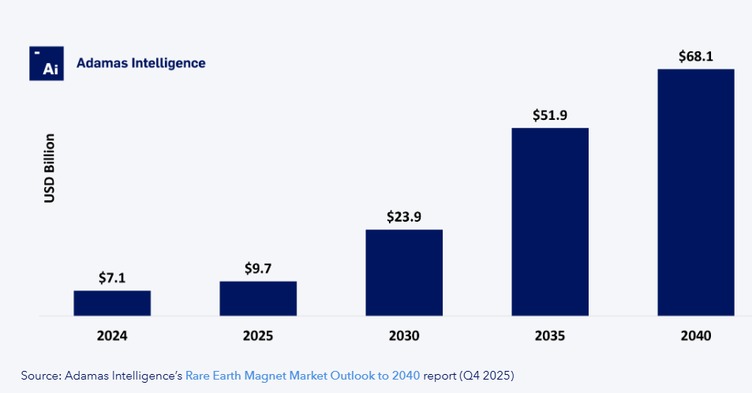
Source: Adamas Intelligence
[Click to open in a new window]
Demand doubling in 4 years. Then doubling again by 2035.
A big driver…robots, have a look at these forecasted demand curves for industrial and service robotics in relation to rare earths Neodymium and Dysprosium:
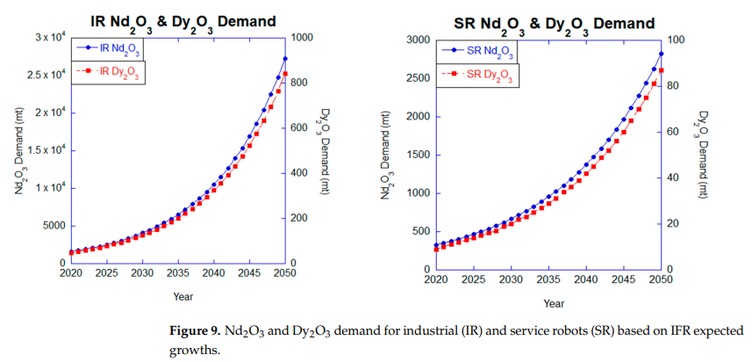
Source: Minerals (Authors: Heim II and Vander Wal)
[Click to open in a new window]
So you can freak out about the bond market.
Or you can remember that the bond market is just a conduit of capital underwriting the future of everything.
And that future is coming fast as all hell.
Warm regards,

Dr. Lachlann Tierney,
Australian Small-Cap Investigator and Fat Tail Microcaps





Comments