




One of Australia’s wealthiest and successful businessman, the late Kerry Packer, once said this in the House of Representatives Select Committee on Print Media in November 1991:
‘I am not evading tax in any way, shape or form. Now of course I am minimising my tax and if anybody in this country doesn’t minimise their tax they want their heads read because as a government I can tell you you’re not spending it that well that we should be donating extra.’
This statement has outlived the legendary and flamboyant media mogul, a catchcry for many who loathe sharing part of their hard-earned gains with bureaucrats.
Today, this statement resonates even louder with many Australians, probably even more so with you given what we’re facing ahead of us.
We’re now just over a week into the 2026-27 financial year.
As an investor, you might be counting down how long you have left to use the 50% discount on capital gains, which you can until 30th June 2027.
Beyond that, it looks dark.
Since the release of the Budget proposals, there have been many articles written commenting on the proposed tax changes. Not to mention many of which are heavily critical of the changes. They lay out the implications of the tax changes, provide the calculations and usually conclude by telling their readers to change their investment strategy, move out of Australia or just give up and put their savings into low-returning investments.
They declare that innovation and entrepreneurship are dead; business in Australia will die by a thousand cuts.
I’ve recently received queries from concerned members of my newsletter service about whether they should sell their investments and change their strategy?
While I share my concerns about how our country is going down the wrong track on more counts than not, I need to clear the fog and remove some of the bleaker forecasts.
This is unusual for me if you regularly follow my work. I sometimes like to dial up the outrage to stir your thoughts and feed indignation.
Take this one as an exception… hopefully it’ll be of value to you too. Especially if you had been despairing about the coming changes.
The wealthy invest with expertise first, gaming the tax regime second
First off, I’ll declare here that I’m no fan of the proposed changes from the Federal Budget. These changes hurt me significantly, as I am a beneficiary of the capital gains discount and use trusts to hold my family’s wealth. Therefore this isn’t a puff piece to shill for the government or the Treasurer, Jim Chalmers.
With that out of the way, let us get into it.
I agree that the latest tax reform is clearly a tax hike on the productive, financially prudent and those who have accumulated capital over time. Yes, the government is going after those ‘who have’ to fund those it claims ‘do not have’. This supposedly makes it ‘fairer’.
Going back to Kerry Packer’s statement, I believe Kerry never meant that the path to wealth was through playing the tax game well.
It’s one way to retain wealth. However, you must create it in the first place!
This is where we go back to how you create wealth – identifying value, paying less than its worth, and selling it when the price is much higher.
How you do that will differ from me, from Kerry Packer, and the millions of Australians out there. The tax changes may affect how much you may have to pay into the government coffers. There’s no denying that.
However, I daresay that you’ll retain more of your gains by sticking to what you’re good at, finding experts and refining techniques to improve your gains and avoid pitfalls. These can more than offset the tax changes.
To understand this better, let’s look back at our history with these tax reforms and how that affected our economy to put things into perspective. After all, a significant component of the proposed tax reform has happened before, in 1985-99.
In 1985, the then-Treasurer, Paul Keating, under the Hawke government, introduced a tax on capital gains to clarify how individuals and businesses pay tax on returns generated from their investments. Businesses could elect to retain some profits and pay these to shareholders as future dividends.
What’s different this time is that the reversion to this tax arrangement (plus a minimum 30% tax on investments and trust distributions) could result in a net transfer from investors and entrepreneurs to the government.
This isn’t entirely different to concerns before the tax changes were introduced in 1985.
Overstated fears – Why the tax reform won’t destroy entrepreneurship and innovation
The tax reform may have made some businesses pay more tax than others. On one hand, the market reallocated capital towards more productive businesses and assets, or those that the arrangement favour. On the other, a scarcity of capital in early-stage businesses may force out those that aren’t productive or competitive. That could tighten various industries by rewarding quality.
For this reason, the Australian economy didn’t stagnate during the 14 years when Keating’s tax reform was in effect.
Yes, recessions came and went. However, no one ever blamed the tax reforms as the primary catalyst for these downturns. Rather, they were a combination of external events (the 1987 stock market crash and the Russian default in 1998) and domestic events (the Australian dollar collapse in 1986 from falling commodity prices and our terms of trade weakening, the recession of 1990-91 from the RBA raising interest rates to fight inflation arising from the excesses of the financial sector deregulation, leading to debt defaults).
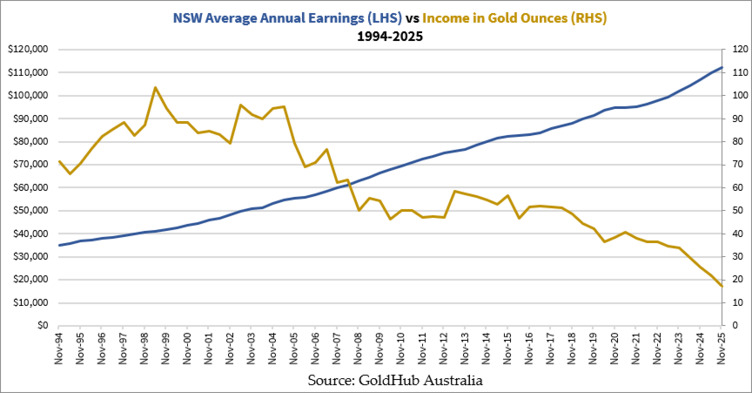
Moreover, the 1980s and 1990s saw significant developments made in wealth-building in the country. Many of you may have lived in that era and remembered it fondly. In fact, the 1990s marked the period of peak prosperity in Australia. To show you how our purchasing power changed over time, let me compare the average worker’s earnings with gold. Here’s how it varied over the last three decades:
[Click to open in a new window]
Despite the introduction of capital gains tax in 1985, Australia experienced one of the most productive periods in its mining history. Great Central Mines discovered Jundee and Plutonic. Delta Gold uncovered Kanowna Belle. Century Zinc advanced what became one of Australia’s largest zinc mines. These companies created enormous shareholder wealth despite operating entirely within the capital gains tax regime.
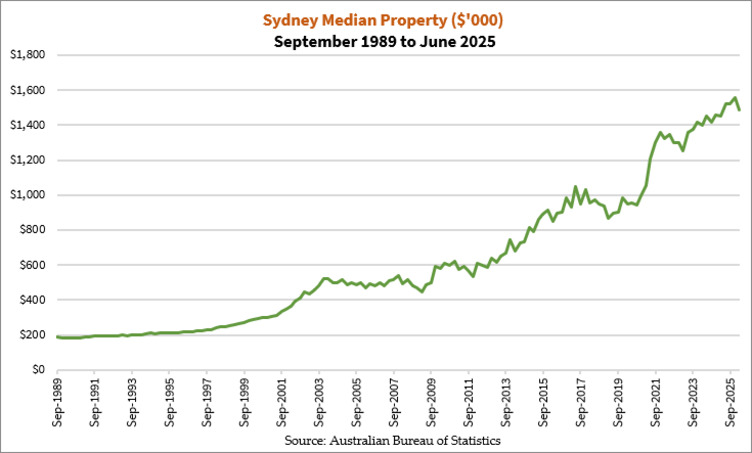
The tax changes by the Howard government in 1999 that brought the 50% discount on capital gains tax helped simplify tax calculations for investors and allowed them to pocket more of their gains. However, falling interest rates, generous lending conditions and negative gearing pushed investors towards residential property. The trend accelerated further after the subprime crisis and the Reserve Bank of Australia interest rate cuts from 2012-21:
[Click to open in a new window]
The rapid increase in property prices since 2001 dwarfed that in almost all other key asset classes in Australia. It’s also for this reason that Australians are enamoured by property investing, far more than any other investment.
The tax arrangements made by the Hawke, Keating and Howard governments heavily skewed in favour of residential property investments. These are the unintentional consequences of policy intervention. The measures were designed to serve a particular purpose, but eventually mutated into a different beast as market investors, tax and legal professionals explored and tested the vulnerabilities.
Don’t change your strategy, work around it
To wrap up, I want to remind you that taxes influence investment returns, but they have never been the primary driver of wealth creation. Australia’s greatest fortunes weren’t built because of a favourable tax regime, it happened because investors recognised exceptional assets before everyone else did. Governments will continue to change tax rules, just as commodity prices, interest rates and political cycles will continue to rise and fall. Your edge as an investor lies not in predicting every policy change, but in consistently identifying quality businesses that can compound wealth regardless of the prevailing tax environment
In the case of precious metals investing, the removal of the discount on capital gains tax may favour more established producers over explorers. However, explorers and developers that makes game-changing discoveries, have a track record of delivering on their milestones, and secure permitting and funding using their economically viable properties will still attract investor capital and deliver outsized returns. Companies operating in other jurisdictions that tax capital gains haven’t deterred major discoveries by small mining companies.
Refine your strategy if you must—but don’t abandon a proven investment process simply because the tax rules change. You might end up losing more on the returns foregone because you play a game that isn’t yours.
If you like what you read today and you want to learn about how I guide my readers to build a precious metals portfolio to outlast the Federal Budget, please click here.
That’s it from me. Have a good weekend ahead!
God Bless,

Brian Chu,
Gold Stock Pro and The Australian Gold Report




Comments