



In today’s Money Morning…Australia lagging US on inflation, by the time it comes the damage will be done…government can’t be trusted on currency…ignore banks, trust dirt and crypto…and more…
[Editor’s note: Ever wonder what the glue is that keeps customers coming back to insurance and financial services businesses? Trust. I sit down to chat with Orni Daniel of Gefen Technologies about technological transformation in these industries and more. The company is soon to be listed on the ASX and it’s an intriguing business due to recent regulatory and compliance pressures on these industries. If AI and automation companies are on your radar or you simply want to learn more about Gefen, be sure to have a listen via this direct download link!]
It’s a question that cuts across ideologies.
Ideology shouldn’t drive your investments, by the way.
Over the last few weeks, the supposedly stellar earnings for the Big Four banks may have investors thinking the time is ripe to take the plunge on one of the various members of the banking oligopoly in this country.
‘Safe as houses’ may as well be ‘safe as banks’.
A ‘no-brainer’ investment for the ages. Across a long enough time frame, perhaps make that a ‘no brains’ investment.
Regardless, the banks are certainly soaking up a heap of capital in the market while small-cap land edges down or moves sideways.
Meanwhile, the RBA and the federal government have teamed up to provide this capital with an extensive bond buying program and immense fiscal stimulus.
Government bonds on issue are going through the roof, as you can see below:
|
|
| Source: RBA |
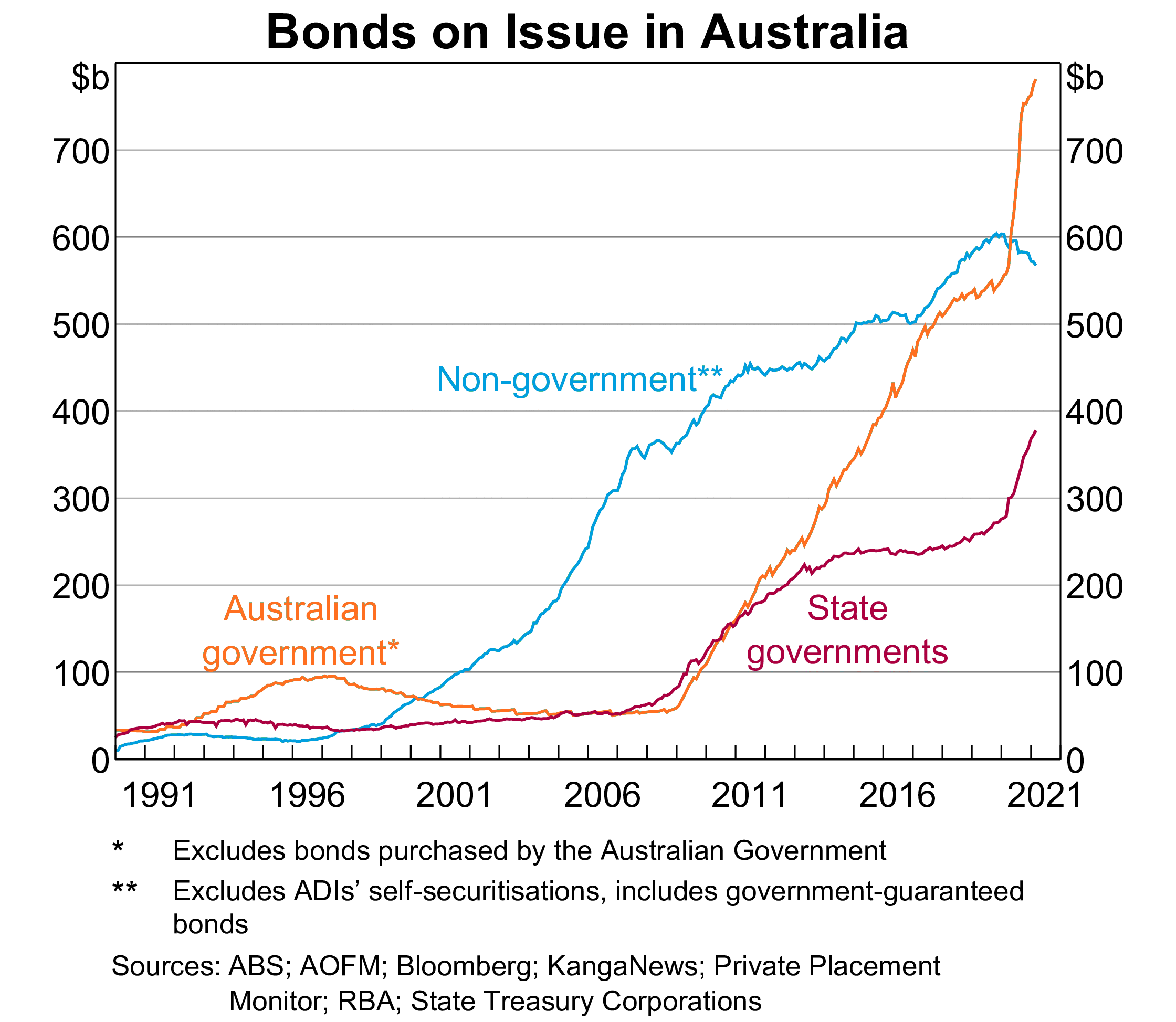
Now I’m no fixed income guru, but if you pump bonds into the world and then buy them back, does that money really mean anything?
What I’m getting at is that the global push towards currency debasement is now deeply rooted in Australia.
It’s why almost one in five Aussies now own crypto. The crypto ethos fundamentally reject both banks and government as trusted aggregators of value.
So, how’s that inflation, quantitative easing (QE), and yield curve control (YCC) going then?
Australia lagging US on inflation, by the time it comes the damage will be done
Here’s how the Australian Financial Review frames the upcoming July RBA meeting:
‘The Reserve Bank’s $200 billion bond buying program, otherwise known as quantitative easing, is likely to be extended in July when the board meets, but it might be wise to expect a slight tapering on the horizon.
‘The RBA board said it will also decide in July on extending its so-called Yield Curve Control (YCC) — where it buys three-year bonds with a maturity date of November 2024 in order to keep benchmark borrowing rates low and help drive further employment growth.
‘If it does jump into buying these bonds, it indicates the RBA does not think inflation will be sustainably back between 2 to 3 per cent until late 2024. And if the bank thinks that, then interest rates won’t be increased until that time.’
Over in the US, though, inflation is already here.
US Treasury secretary Janet Yellen let slip that the Fed may raise rates sooner than expected, and the US Consumer Price Index (CPI) increase came in at a whopping 4.2%.
Take a guess, when was the last time we saw such a sharp increase?
September 2008, and we know what was going on then.
That’s why Ryan Clarkson-Ledward said last week that what we are seeing ‘isn’t a price rebalancing, it’s price destabilisation.’
This is the thesis that ‘super-hot’ inflation will trigger a monumental commodities boom, something we put forward in August of last year.
As for Australia, the CPI increase was modest for March coming in at .6% for the quarter.
However, by the time the RBA raises rates in 2023 or 2024, the damage will already be done.
Here’s what I think this means for investors.
Government can’t be trusted on currency, ignore banks, trust dirt and crypto
What I’m getting at is that the recent bank earnings are a smokescreen for investors.
Governments and central banks are likely to continue ploughing money into the system, and when it breaks, I expect they will launch central bank-backed digital currencies (CBDCs).
That could cut the big banks out of the picture after a commodity boom unfolds to the benefit of ASX-listed resource companies.
Australia has fertile dirt out there loaded with resources for the ‘infinite money’ market environment we are entering.
So, trust in the barbel economy shifting back to resources and away from banks over the next two years.
After that, you can reasonably expect the crypto ‘trust machine’ to step into the void left by the most poorly planned monetary experiment of our generation.
Commodities, not banks, first of all.
Second, crypto for the remaking of money.
That’s the punchline.
It’ll show you some tricks and tips for navigating a system where trust in banks and governments is rapidly degrading.
Grab a notepad, get the transcript, you won’t regret it.

Regards,
 |
Lachlann Tierney,
For Money Morning
PS: Promising Small-Cap Stocks: Market expert Ryan Clarkson-Ledward reveals why these four undervalued stocks could potentially soar in 2021. Click here to learn more.





Comments