

We left off yesterday with the idea that the small cap sector is the one to fly into 2026.
Hey, you already know the reason, or at least a big one: the RBA is in a cutting cycle.
Yep, interest rates are going down.
Now, here’s the interesting thing about this.
The outlook for Australia and the ASX are very different to the US and US shares.
Here’s why…
It’s possible that the Fed doesn’t cut rates as much as the markets expects this year. The US economy is stronger than Australia’s.
The US also has huge government spending, which is, in part, keeping their inflation rate elevated. The case for rate cuts is less clear over there than here.
Also, a lot of US mortgage holders have a low rate as a legacy of the Covid era.
Again, this is different to Australia. We don’t have the same level of long term, fixed rate mortgage debt as they do in the USA.
Here’s why I think it matters….
Back in 2022 global stock markets dived.
I made the case in 2023 for a big share market bounce back, in both the US and the Aussie share markets.
I was bang on about the Nasdaq surging back up.
But I put most of my money into the Aussie share market…and it didn’t follow the strong lead of the US.
2023 was a grinding, difficult year for the ASX. Between the two countries, there was two different markets, and two different dynamics in play.
The US has it all powerful tech sector. Australia less so.
Why am I telling you this?
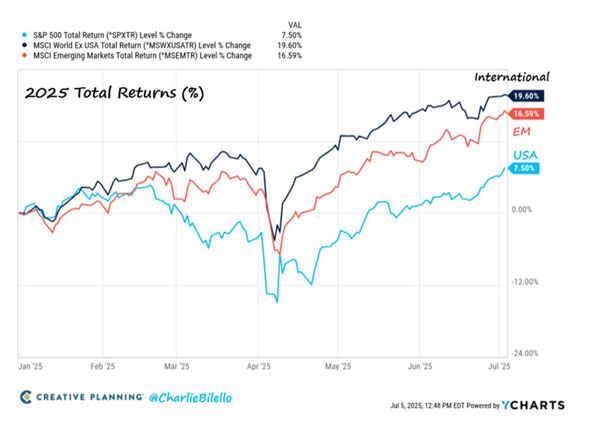
I think the situation could reverse in 2025. In other words, Aussie shares might outperform US stocks!
This is not crazy. Already in 2025 international shares are beating the US…
| |
Why might the ASX outmuscle the US for once?
One reason is that Trump’s erratic tariff policy doesn’t help US businesses. It hurts them.
That said, the odds of a recession in the US are dropping. It’s keeping inflation up. And, as above, the Fed will be reluctant to cut rates in this dynamic.
Over here, Australian consumers are coming out of a difficult, high rate environment into a rate cutting cycle and a strong labour market.
Suddenly, there’s cash to splash. Now the housing market is responding to this stimulus.
We have the “wealth effect” in play, and all that implies for household formation and spending.
The Australian Financial Review cited some CBA data yesterday that most mortgage holders are not spending the extra cash they now have thanks to the rate cuts.
The article implied it as a bad thing for retail sales. I take it as a sign of strength.
It tells me most households are not, and never were, on the edge of loan defaults. That cash will come out at some point.
For Australia, we now have the critical mineral conversation going around the world, and a secure, Tier 1 jurisdiction like Australia can benefit enormously.
There are big investments brewing in grid upgrades, gas supply, new gold mines and new businesses.
It’s a different dynamic to 2023.
These are all cues for investors to go “risk on”. That’s when small caps as sector really shine.
As an investor, this is when you should be getting interested. Why?
Michael Carmody over at Centennial Asset Management runs a fund that can go up and down the ASX, in terms of size.
This is called an “all cap” approach…so that the fund is not limited to one sector.
It can buy CBA at the top or a small cap toward the bottom…wherever the team see opportunity.
Michael made the point recently that most of the firm’s “alpha” throughout its history has come from the small cap sector.
Why could this be?
I can only guess. But I’d suggest it’s because of what I call “information asymmetry”.
There are simply more stocks, and stock ideas, outside the ASX 200 that are misunderstood, not followed or under researched.
Why is it like this?
The old broker-research model broke long ago. Nothing ever replaced it in the same way.
This gives the active investor a chance to exploit this gaping hole.
That’s what I try to do anyway. And everything I see says the next 12 months is the time to make some serious hay.
Best wishes,
 |
Callum Newman,
Editor, Small-Cap Systems and Australian Small-Cap Investigator


Comments