




I wonder whether you’ve heard of something called LAN (local area network) parties.
This involved a bunch of gaming enthusiasts gathering at one’s home, plugging their computers into a home network and playing various games.
Meals involved pizza, snack foods and soft drinks. Sleep is minimal, perhaps from 4am to 10am the next day in a sleeping bag or a couch. You can forget about brushing your teeth, showering, and all that. Leave that for later.
Anyway, I attended a few when I was in my final year of high school and in uni. The internet was too slow and the online gaming community comprised those with tens of thousands of dollars to spend on the latest hardware and an expensive cable/ADSL connection.
We played real-time strategy games including Total Annihiliation, Command & Conquer: Red Alert, and first person shooter games such as Team Fortress Classic: Counterstrike, etc. (you can guess how old I am by telling you this).
With real-time strategy games, you may have heard of something called ‘rushing’. This is a strategy in which a player seeks to overwhelm their enemies by rapidly building the cheapest and puniest attack units, sending them to disrupt and knock them their enemy’s bases in the early stage of the game.
It’s a popular strategy used by many gamers. However, when rushing fails, the player is often left at a disadvantage if their enemy builds more advanced units and launches their counterstrike.
I was never a fan of the strategy, preferring to be the ‘porcupine’. This involved building my base and fending off these rushes. The grand plan was to amass a more potent force to deliver my revenge later in the game.
Beyond the gaming table and real-time strategy, countries and businesses adopt their own strategy to get the upper hand in geopolitics and global trade.
Today I want to talk about today is the global AI and robotics race. We’re at the cusp of our next industrial revolution as governments, businesses and other institutions contemplate whether machines can replace or at least enhance human capabilities and output.
While the official narrative points to China being the undisputed leader in this race, I’m going to present an alternative perspective.
Vying for #1 in the AI and robotics race
Let me start with this. I haven’t followed the AI and robotics race as closely as my colleague, Charlie Ormond. However, he’s shared some useful insights and data to help me grasp the situation better.
To measure who’s leading the race, there are several ways to look at it. The most obvious one is about manufacturing capability and volume.
In this case, let’s look at the number of humanoid-robot shipments:
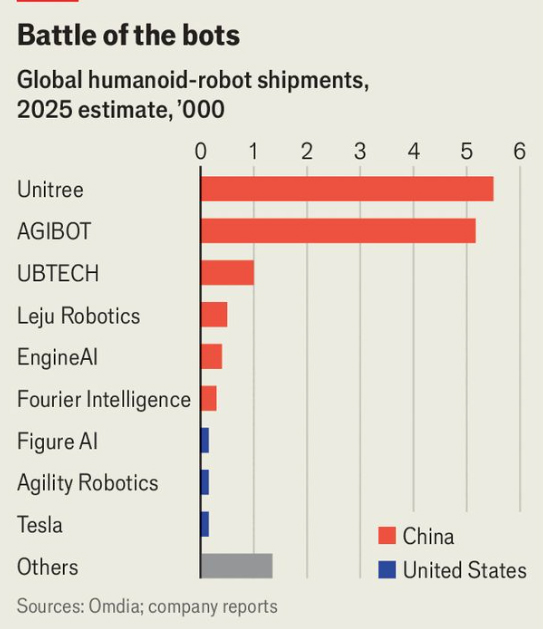
China is clearly ahead. The top six companies are based in China and the top two companies alone have built more than the others combined.
Next, let’s look at how China compares to the rest of the world on installing industrial robots:

[Click to open in a new window]
While this chart goes to 2023, it’s likely that the rest of the world hasn’t caught up to China in the last two years.
On these numbers, it’s difficult to dismiss China as a leading AI and robotics developer.
However, I want to propose an alternative angle to this.
When quantity doesn’t equal quality
Let’s go back to the start of this article where I talked about the ‘rushing’ strategy in gaming.
It might be a crude and somewhat unrelated analogy. However, there’s some relevance to what I’m about to discuss.
China’s AI and robotics development is undisputedly vast. But dig beneath the numbers, you’ll realise that what it delivers in quantity doesn’t equate to quality.
China may be the world’s manufacturing hub. Yet many would substitute a ‘Made in China’ product with a more expensive product made elsewhere if they can. Especially if the product was originally from the US, Europe, Australia or Japan. These products ended up being ‘Made in China’ because the company sought to maximise profits and reduce labour costs by offshoring production to China.
Moreover, China is notorious for its plagiarism of other countries’ technology and intellectual property. This isn’t merely a conspiracy theory or a one-off act. It’s widely known.
AI and robotics aren’t exceptions to this rule.
Recently, the world saw China showcase its robots that can dance and perform acrobatics. The official narrative was that Chinese households could use robots to care for the elderly and perform many tasks over the next five years. Moreover, the country boasted that these robots could be part of law enforcement and in complex military operations.
While, China wants the world to believe that what many deem as science fiction today will soon be its reality, these aspirations are unrealistic and likely unattainable.
Firstly, China is yet to overcome its reputation of focusing on quantity over quality. Chinese manufacturers haven’t turned a new leaf on cutting corners to earn more profit.
Secondly, China’s practice of stealing technology is more about catching up, rather than to overtake. It works the same way as copying someone in a test won’t lead to a higher score nor does it increase one’s intelligence.
Thirdly, even though China can manufacture things more cheaply than many countries, the idea of a widespread use of robotics in Chinese households is fanciful. These robots are out of reach of the budget of most Chinese households.
As for military capabilities, I can point to the latest humiliation in Iran and Venezuela, where China had previously boasted its military installations would easily deter the most advanced countries, e.g. the US.
If you’re interested in details regarding the truth behind Chinese AI and robotics, I suggest you watch this presentation by Don Xiang of Digging into China:

The ghost of The Great Leap Forward haunts
While many Western analysts talk up China’s manufacturing capabilities and technological advances based on official data, they’re missing something critical.
China doesn’t play the same game as the West. I’ve even accounted for every country manipulating its data to window dress. But China takes it to a new level.
For all the shiny exterior and self-praise, China’s economy is fragile and its living standards are dire.
Property prices have all but collapsed across the country, even in the top-tier cities. Youth unemployment is sky high, despite companies often retrenching many employees aged 35 or over.
While China boasts an immense current account surplus from the world’s demand for its manufactured goods, the government is rife with corruption. Much of what’s received may not end up in government coffers, but behind fake pillars or under the floorboards in the many mansions of officials, business leaders, and their cadre.
China knows the hottest industrial trend. You can say it sometimes sets the agenda since it manufactures them. The government centralises its planning, mobilises its state-owned enterprises, and can crank out EVs, drones, widgets, etc.
Whatever it is, China can and will be the one to make the most if it wants to. Yet, its population remains poor as the ruling party misallocates resources and distributes wealth unevenly.
If you look back to the late-1950s, Chairman Mao Zedong saw that the West was industrialised and advanced through steel production. This inspired him to make China the world’s leading steel producer.
This was the infamous ‘The Great Leap Forward’ program.
The country mobilised its people to produce steel, even those who lived in the countryside and farms.
But the steel they made was of an inferior quality. Some were useless as unscrupulous producers added other ingredients to pad out the numbers. They received the payout from the government, but they were unfit for use.
The neglect of the countryside plus unfavourable weather caused the country’s food supply to plummet within five years. A famine gripped China, claiming the lives of millions.
It was a tragedy of historical proportions.
Today, the shadow of The Great Leap Forward continues to linger in my mind. It seems like a repeat, dialled up to full blast.
While the history books record the triumphs, defeats and tragedies, it seems the ruling party hasn’t heeded the lessons. Moreover, it’s doubled down and wagered the lives of its people for the illusion of global repute that many already see through.
As I finish up today’s article, I note that the conflict in Iran may linger. It may linger or end soon: it’s anyone’s guess for now.
Some see the objective of the strike. It’s beyond Iran. The target is China.
What price will China pay in this epic arm-wrestle of the superpowers?
Regardless of the outcome, I believe that there’s one thing that will prevail. It’s gold.
In times of uncertainty, gold provides security, with over 5,000 years of history in protecting one’s purchasing power.
Oil has whipsawed, yet gold has stayed strong.
To harness the power of gold in such times, learn more about it through my recently completed book, Gold’s True Message: A Guide to Building Wealth in a Failing Monetary System.
For more information, check out my presentation here.
Join me next week as I discuss the opposing forces that have strangely helped gold hold its ground since the invasion of Iran.
Have a good week.
God Bless,

Brian Chu,
Gold Stock Pro and The Australian Gold Report




Comments