




As you know, we’re closing out the year with a special focus on investment strategies.
Today, we’ll focus on mergers and acquisitions, as this could become a key feature of the resource market next year, if commodity prices continue their upward trend.
So, why could the market see a lift in buy-out activity?
As we’ve detailed in past editions, as commodity prices rise, miners often ramp up production in a bid to maximise short-term profits.
Strengthen the balance sheet and juice up the share price.
But this tactic can have long-term consequences, like shortening the deposit mine life as reserves become hastily depleted.
It’s why investors and producers will need to pay more attention to companies owning ‘new assets.’
Whether that’s deposits still sitting in the ground, waiting for development. Or companies that have just kicked off maiden production with years of production ahead.
As commodity prices rise and depletion comes into focus, holding a healthy portfolio of future reserves becomes a key factor for investor attention.
That’s why focusing on acquisition makes sense at certain times in the mining cycle.
And I believe we could be on track to hit that in 2026.
So, what about the other side of M&A?
Mergers
If two companies come up against each other and are equally matched in size, this is when you’d see a merger deal take place.
This is not usually the focus for individual investors.
There’s far less immediate windfall for shareholders holding companies involved in these types of deals. However, it’s still worth understanding why they occur.
Like any industry, mergers in the mining sector take place to enhance operational efficiencies.
One example is the consolidation that has occurred in the Western Australian gold sector over the last two years…
An amalgamation of smaller companies joining forces and sharing one processing ‘hub.’
The hub can serve several gold deposits in the region under the one company ‘banner.’
Sometimes, though, a merge might take place so that a company can fast-track its way towards production…
Here, it will likely partner with a company that owns and operates infrastructure and processing.
Clearly, the reasons for a merger are similar to an acquisition.
But the key difference is that the two combining companies are usually of a similar market value.
So, why aren’t investors typically as excited about a merger deal?
Well, a company’s share price will be far more muted in response to this type of announcement.
On the other hand, acquisitions can deliver an instant windfall to shareholders—literally overnight—when the deal gets announced.
Here, the bigger fish must cough up a premium on the smaller company’s trading price.
That’s the carrot for shareholders when accepting a buyout offer.
So, how big does that carrot need to be?
It really depends on the quality of the company’s assets and how hot the market is running.
Under the right conditions, a premium of 100% or more is possible.
But the key element here:
Strengthening commodity prices is the spark that ignites M&A activity.
Not surprisingly, the volume of buyouts increases rapidly in line with rising commodity prices. Importantly, the premiums paid also rise.
Note the steep increase in M&A activity over the last mining boom from the early 2000s:
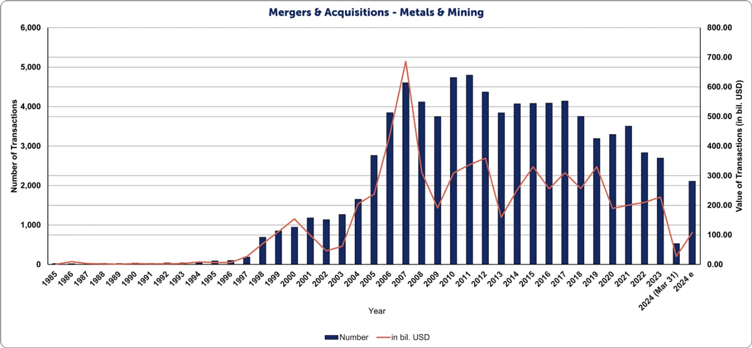
Source: Institute for Mergers, Acquisitions & Alliances
[Click to open in a new window]
Activity peaked in 2011, which coincided precisely with cyclically high prices for most commodities, including gold and copper.
Is that what we’re heading into next year?
It’s something to keep in mind.
As always, be prepared to take advantage of these speculative phases, which offer incredible windfalls and don’t come along often.
Again, that’s why I’m giving the M&A opportunity special focus as we head into 2026.
To learn more about how I apply this knowledge to identify individual investment opportunities, you can find out more here.
By the way, my colleagues and I have just recorded a special series about our individual outlooks for 2026.
No agenda… Some of us are turning bearish, while others remain bullish for the year ahead.
This is our comprehensive Fat Tail outlook for 2026, and it’s well worth your time to consider the different points of view.
You can check it out here.
Until next time.
Regards,

James Cooper,
Mining: Phase One and Diggers and Drillers




Comments