• Skip to primary navigation
  • Skip to main content
  • Skip to primary sidebar
  • Skip to footer

Fat Tail Daily

Investment Ideas From the Edge of the Bell Curve

  • Menu
    • Commodities
      • Resources and Mining
      • Copper
      • Gold
      • Iron Ore
      • Lithium
      • Silver
      • Graphite
      • Rare Earths
    • Technology
      • AI
      • Bitcoin
      • Cryptocurrency
      • Energy
      • Financial Technology
      • Bio Technology
    • Market Analysis
      • Latest ASX News
      • Dividend Shares
      • ETFs
      • Stocks and Bonds
    • Macro
      • Australian Economy
      • Central Banks
      • World Markets
    • Small Caps
    • More
      • Investment Guides
      • Premium Research
      • Editors
      • About
      • Contact Us
  • Latest
  • Fat Tail Series
  • About Us
Commodities

Why Commodities Move in Packs — And What History Says Happens Next

Like 0

By James Cooper, Wednesday, 11 March 2026

Commodities are surging across the board, and the real reason has nothing to do with the headlines you’re reading.

A fundamental question to ask: Why are commodities rising all at once?

It started with gold. Then silver. Then Platinum. Then Copper. Aluminium, Uranium, and Zinc have all followed too.

And now it’s the laggards… Oil, Gas, and Coal.

Is the global economy playing a game of commodity dominoes? Or is something else happening here?

First up, no one seems to tackle this fundamental question, or at least recognise it, and that’s probably because they’re too caught up in the ‘news of the day.’ They’ve lost any long-term lens through which to view the commodity market.

You’ve probably seen it; each price spike, for say copper, can be ‘explained’ by some geopolitical factor or a demand-and-supply factor.

But these headline explanations never get to the heart of WHY virtually ALL commodities have entered a phase of price inflation.

Instead, convenient and ‘rational’ explanations are used to justify price rises.

Let’s take gold… Much of the bullish momentum has been driven by concerns about ‘US Dollar debasement.’

Endless money printing and the dilution of the value of paper cash have been viewed as key catalysts for rising gold prices.

But I don’t buy it.

US Dollar debasement has ALWAYS been a concern for investors.

I recall back in the early 2000s, the commodity boom, gold was surging like it is today. And what was the key explanation for gold’s record surge twenty years ago?

Dollar debasement!

Excessive money creation and high government debt have slowly eroded purchasing power and currency values throughout recent history.

In other words, dollar debasement has been happening alongside surging, falling, and flat gold prices!

So, again, this ‘reason’ doesn’t go to the heart of WHY gold is in a bull market.

It’s just a recycled narrative that gets pushed out every time gold prices rise.

But to get to the core reason, we need to recognise this:

Commodities rise in packs

Commodity bull markets are characterised by broad gains across metals, minerals, energy, and food. A phase that often lasts 7-10 years.

That’s not to say they’re all rising exactly at the same time. This parallel bull market often sees certain commodities spiking at different times.

For example, gold made a major top earlier this year. Coal is making a major top now. And each top is followed by a period of price stability before it makes another move higher.

That is, until the cycle ends.

That’s how you need to look at this market.

But the biggest mystery: why do commodities rise virtually all at once, despite having very different, sometimes OPPOSING demand drivers?

Take gold: it’s traditionally associated with economic uncertainty and a hedge against market risk.

On the other hand, industrial metals like copper, zinc, and aluminium are tied to the complete opposite dynamic: surging growth!

Two opposing demand drivers, yet very similar performance outcomes.

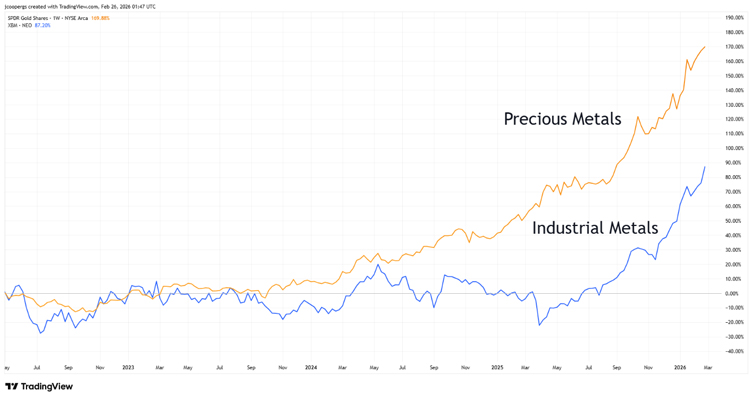
If you think I’m making this up, well, just take a look at the chart below:
Source: Trading View

[Click to open in a new window]

Precious and industrial metals are moving in lockstep. But this is not an anomaly; this is how commodity cycles operate.

So, what’s going on? And why isn’t anyone paying attention to this fundamental question?

Well, that’s what I’m going to try and tackle in our next edition.

Stay tuned.

Regards,

James Cooper,
Mining: Phase One and Diggers and Drillers
All advice is general advice and has not taken into account your personal circumstances.

Please seek independent financial advice regarding your own situation, or if in doubt about the suitability of an investment.

Comments

Subscribe
Notify of
guest
guest
0 Comments
Inline Feedbacks
View all comments
James Cooper

James Cooper has been a working geologist in mines across Australia, Canada, and Africa since the early 2000s. He’s led the operations of tiny explorers through to huge producer outfits. He’s seen booms and busts firsthand and he also understands the cyclical nature of individual commodities. For example, James was right there when Barrick Gold launched an enormous $7.5 billion takeover bid for Equinox. That was the peak of the last cycle.

With his background as a geo and finance professional, he brings a unique insight and experience to Fat Tail Investment Research. He writes the broader resource-focused investing letter Diggers and Drillers and the ultra-speculative explorer-focused trading service Mining: Phase One.

James’s Premium Subscriptions

Publication logo
Diggers and Drillers
Publication logo
Mining: Phase One

Latest Articles

  • Why Commodities Move in Packs — And What History Says Happens Next
    By James Cooper

    Commodities are surging across the board, and the real reason has nothing to do with the headlines you’re reading.

  • China’s playbook narrows, and it likely means more commodities
    By Lachlann Tierney

    China is in a tricky spot with Venezuela and Iran off the board. It will likely have to double down on metals, as it has done previously.

  • Trump is targeting China, Cuba and Russia via the shadow oil market
    By Jim Rickards

    Iran and Venezuela have a lot of oil. But who they sell it to at a discount is what got the US President’s attention. His real target is Russia, Cuba and China.

Primary Sidebar

Latest Articles

  • Why Commodities Move in Packs — And What History Says Happens Next
  • China’s playbook narrows, and it likely means more commodities
  • Trump is targeting China, Cuba and Russia via the shadow oil market
  • Bottoms up in Victoria, Market Chaos and The One Thing in Your Control
  • O&G Prediction Emerges

Footer

Fat Tail Daily Logo
YouTube
Facebook
x (formally twitter)
LinkedIn

About

Investment ideas from the edge of the bell curve.

Go beyond conventional investing strategies with unique ideas and actionable opportunities. Our expert editors deliver conviction-led insights to guide your financial journey.

Quick Links

Subscribe

About

FAQ

Terms and Conditions

Financial Services Guide

Privacy Policy

Get in Touch

Contact Us

Email: support@fattail.com.au

Phone: 1300 667 481

All advice is general in nature and has not taken into account your personal circumstances. Please seek independent financial advice regarding your own situation, or if in doubt about the suitability of an investment.

The value of any investment and the income derived from it can go down as well as up. Never invest more than you can afford to lose and keep in mind the ultimate risk is that you can lose whatever you’ve invested. While useful for detecting patterns, the past is not a guide to future performance. Some figures contained in our reports are forecasts and may not be a reliable indicator of future results. Any actual or potential gains in these reports may not include taxes, brokerage commissions, or associated fees.

Fat Tail Logo

Fat Tail Daily is brought to you by the team at Fat Tail Investment Research

Copyright © 2026 Fat Tail Daily | ACN: 117 765 009 / ABN: 33 117 765 009 / ASFL: 323 988