



If the market feels like a game of “what should I worry about?” to you…
You’re not alone.
Talking to Murray Dawes last Friday on Closing Bell, there was however, an unusual ray of hope right at the end.
Scrolling through the charts, what’s this?
Lynas Rare Earths [ASX:LYC] looks to be pulling off a little downtrend snap:
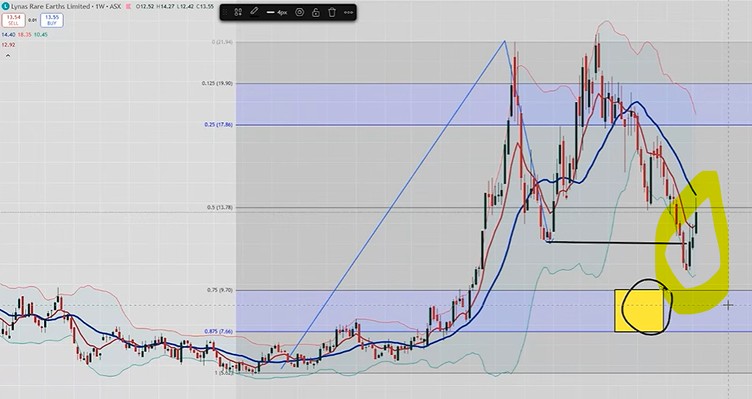
Source: MarketIndex
[Click to open in a new window]
Lynas is now transforming into a company that makes money.
This is after about a decade of trading on geopolitical tailwinds alone, without making money.
That long-term picture has now turned up in cashflows because rare earths are massive to where the world wants to go in terms of technology and defence procurement.
And every so often, an investment thesis arrives with dates attached.
This one has two.
Both in January 2027.
And they’re written into law and diplomacy.
The first is 1 January.
That’s when the US Department of War stops buying rare earth magnets touched by China:
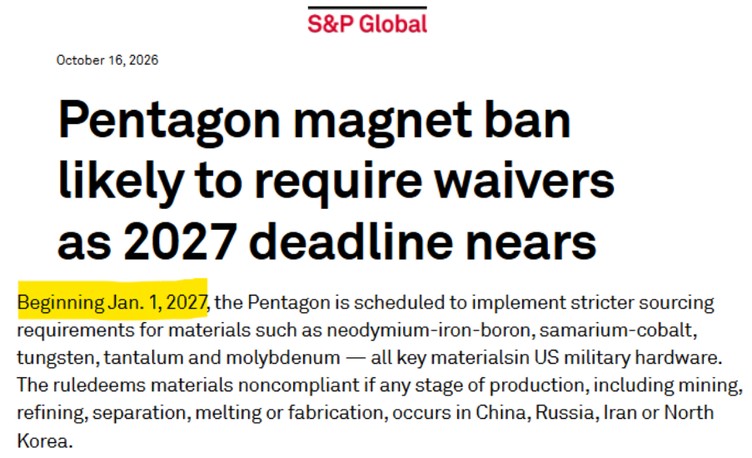
Source: S&P Global
The second is 10 January.
That’s when the truce keeping Beijing’s most aggressive export controls on ice runs out.
Between them sits a supply squeeze that, unusually for this sector, is already showing up in the price of the metals themselves…
…and a short list of ASX-listed companies are positioned to benefit.
The Pentagon’s hard stop
From 1 January, a rule with the catchy name DFARS 252.225-7052 kicks in.
It means the Pentagon can’t buy the two magnet families that power everything from F-35 actuators to missile guidance…
…if any stage of their production (mining, refining, separation or melting) happened in China, Russia, Iran or North Korea.
And the industry is nowhere near ready.
America needs an estimated 48,000 tonnes of rare earth magnets a year.
Its first domestic line, MP Materials’ Fort Worth plant, started shipping in October at roughly 1,000 tonnes.
Beijing’s clock
China’s October 2025 export controls were suspended for a year after the recent Xi–Trump summit.
These include the so-called “0.1% rule”, which claims licensing power over foreign-made magnets containing even a trace of Chinese material.
That pause was due to run out on 10 November.
The day before, Beijing extended it. By just two months.
The brevity of that extension is a big message here…
This is a negotiating chip, and Beijing’s keeping it on a short leash.
(And here’s the bit most people miss…)
The April 2025 licensing regime on seven heavy rare earths, dysprosium and terbium above all, was never suspended at all.
Every kilo leaving China still needs a Commerce Ministry licence.
That can take up to 45 working days. And if the end use is defence?
Good luck.
Point is: A CRUNCH IS COMING.
The two-price world
Outside China, dysprosium is trading at more than ten times what it fetches inside China.
Western buyers aren’t paying up for better chemistry.
They’re paying to skip Beijing’s queue.
To avoid a stalled production line.
And, from 1 January, to satisfy a rule that cares where a metal was born, not where the magnet was assembled.
Washington isn’t just encouraging this market, either.
It’s underwriting it, with a US$110-a-kilo price floor and more than US$1 billion in conditional loans.
Enter a second army
Now here’s where it gets interesting.
While the market’s been glued to Nvidia’s fallen leader, Tesla started early production of its Optimus humanoid robot at Fremont, on a line designed for a million units a year.
Elon has a name for it. A robot army.
And that army runs on the same magnets.
Musk has even admitted China’s magnet restrictions set the programme back by two to three months.
Just look at the discrepancy between China “taps on”, and China “taps off” in the NdPr market below:
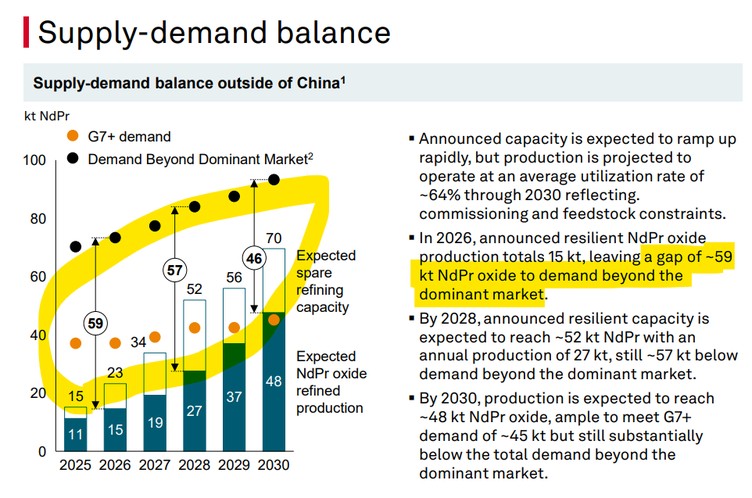
Source: S&P Global
[Click to open in a new window]
So picture January.
The Pentagon, legally barred from Chinese supply, joins the queue for non-Chinese magnet metals…
…right alongside the world’s newest army.
Two armies. One very small pool of metal.
That’s the collision at the heart of my new deep-dive investigation, Two Armies Collide.
And there’s a distinct opportunity for Aussie investors in 2027, which I outline in full here.
Now, even at full tilt, a million robots a year is small next to the magnets going into EVs, wind turbines and electronics.
And Optimus deadlines have slipped before. The first batches will work inside Tesla’s own operations, not ship to customers.
So I don’t see robots as the engine of this trade. Not yet.
The engine is defence stockpiling, and that’s already underway.
However, the robots are the spark that could get the rest of the market paying attention.
I walk you through the whole thing… and highlight four Australian companies sitting at the centre story… here: TWO ARMIES COLLIDE.
Warm regards,
Dr. Lachlann Tierney,
Australian Small-Cap Investigator and Fat Tail Microcaps





Comments