



A few weeks ago, I finished interviewing eight experts on Net Zero and the energy transition. They each came from a different perspective and provided a different angle on the energy policy that has taken the world by storm, whether voters liked it or not. But throughout those interviews, I kept trying to focus on one key factor: what does Net Zero mean for commodities?
This might seem odd to those of you who are in a state of panic about climate lockdowns, 15-minute cities and flight bans (like me). But one of the rules of newsletter writing that was drilled into me from the beginning was that I have to make myself useful, not just interesting. There has to be an investment angle, a profitable opportunity, or a threat that is avoidable. ‘The end is nigh’ just doesn’t cut it…outside of the mainstream media.
Commodities are, of course, an investable proposition. Especially to Australians. And Net Zero will have a rather stark impact on them…
You see, on the one hand, Net Zero is strangling investment into commodity projects by tightening the screws on all energy intensive business. And mining is, well, rather energy intensive. According to Appian Capital Advisory, mining consumes around 38% of global industrial energy use, 15% of global energy use and 11% of total energy use.
This might prove problematic because reaching net zero requires an extraordinary amount of mining. The wind and the sun might be renewable and free, but windmills and solar panels are not. They’re incredibly resource intensive to make, build and dispose of.
The International Energy Agency:
‘A typical electric car requires six times the mineral inputs of a conventional car and an onshore wind plant requires nine times more mineral resources than a gas-fired plant. Since 2010 the average amount of minerals needed for a new unit of power generation capacity has increased by 50% as the share of renewables in new investment has risen.
‘However, a concerted effort to reach the goals of the Paris Agreement (climate stabilisation at “well below 2°C global temperature rise”, as in the SDS) would mean a quadrupling of mineral requirements for clean energy technologies by 2040. An even faster transition, to hit net-zero globally by 2050, would require six times more mineral inputs in 2040 than today.’
We’re talking about an impossible increase in mining demand given the time it takes to find and develop deposits.
So, having established all this with my interviewees, I then asked them all one simple question: which commodities do you see as the key shortages which will undermine Net Zero?
They all came back with the same response: copper.
Former Australian mining researcher and current Finnish Geological Society associate Simon Michaux is the one who first claimed the Net Zero emperor has no clothes. In fact, he scientifically proved it. His vast body of work showed how…I’ll just let him explain it with this segment of the interview transcript:
‘The way I approached this was, work out what’s needed, right? And so, what are the metals in solar panels? What are the metals in wind turbines? What are the different units brought to market? What are the metals in different chemistries or batteries? How much of those are going to be in the market? How many were there?
‘And so you end up with a list of tasks and metals, and they’re all compressed into one column. How much metal will we need for copper? How much metal will we need for…and so we started that way.
‘What fell out the other end [of the analysis] was — I’ve got the numbers up on my screen here — in terms of production at the moment, metals that are going to be a problem are: copper, nickel, lithium, cobalt, graphite, vanadium, germanium and all the rare earth elements have serious shortfalls in a production context — we need to expand.
‘And so, all right, let’s say we were able to expand [mining] to the max, to what reserves we have at the moment. I’ve picked out ones to focus on: copper is what I’m most worried about. You can make batteries out of something else, but good luck replacing copper.
‘But if you put reserves, resources, and include the resources under the sea all together, we’ve got something like 3.2 billion tons of copper in the system we call planet Earth, but we need 4.7 billion tons [to reach net zero].’
In other words, we’re going to have to find and mine a lot more copper than we currently know about. And that’s just to reach 2018’s level of energy demand — the year Michaux tried to replicate using only green forms of energy.
But here’s the kicker:
‘Right, and that’s to make the first generation of stuff. It wears out like cars wear out after, you know, 10 years or 15 years or let’s say 20 years on average. Car batteries, current technology the way it is at the moment, all that stuff will wear out. After 20 years you’d have to do it again.’
Recent news suggests that wind and solar are struggling to reach their expected life spans.
My colleague over in the UK, Eoin Treacy, pointed out that the copper shortage is going to be such a severe constraint on Net Zero that it may short circuit the policy entirely:
‘Well, you’ve got to also think that all those experts, particularly the miners, they make a lot of money out of copper going up. So, they really have a vested interest in selling that story. And I mean, I’ve been to conferences where people are talking about that. And Robert Friedland is a great example of this. I mean, he is a fantastic salesman and stands up there and says, “Well, you know, we’re not even close to achieving the goals of net zero. We would have to double copper supply and it takes a decade to even build a mine. So that means prices for copper have to go through the roof.”
‘Well, I don’t actually agree with that. If it takes a decade to build a mine, well then, we just can’t buy the copper. You know, it’s not like people can afford to pay any price for a car.’
You might know of UK politician Nigel Farage as Mr Brexit, but before he entered politics, Nigel was a commodities trader on the London Metals Exchange and even had his own commodities futures firm. Here’s his take on whether Net Zero is viable:
‘This can’t happen. And if it was to happen, I mean, goodness knows what the price a copper would do. You know, I mean, the whole of Chile would be turned into a mine, I think.
‘So what will happen is, you won’t see a U-turn from politicians admitting they were wrong for the last couple of decades. That doesn’t happen. But you’ll start to see a slipping of a variety of deadlines.’
Your regular editor James Cooper focused on the supply side for copper: ‘If we go back to the 90s copper discovery we were making sort of 10 to 15 new major discoveries every single year. Over the last 10 years we’ve really only made two major discoveries.’ He also made the politically incorrect points about political risk in the key copper mining regions of the world…
It’s no accident that I accidentally named the file with James Cooper’s interview transcript ‘James Copper’. In coming months, I suspect the name will catch on. Because James is positioning his readers into opportunities from Net Zero while the rest of us wallow in imposed energy poverty…
But he’s not the only one. My old mentor Greg Canavan has put together an entire investment plan based on Net Zero. The boom and the bust, the bubble and the crash, what to own and what you should avoid…it’s all covered in his controversial video, ‘NOT ZERO’.
Given how all-encompassing the policy is, you can’t afford to ignore it.
It’s set to hit your inbox later this week…
Regards,
 |
Nick Hubble,
Guest contributor, Fat Tail Commodities
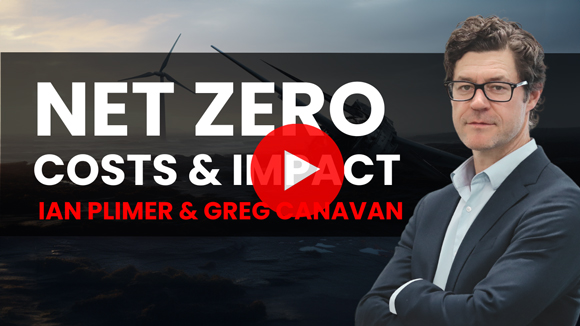
PS: Greg has similarly been interviewing a number of people on this energy transition to get a detailed picture of its implications both economically and politically.
This interview in particular ties in quite well with today’s article…
| The Irony of Net Zero…More Costly, More Energy-Intensive – Interview with Ian Plimer |
In this video, Greg interviews Professor Ian Plimer — Australia’s pre-eminent geologist who has long been a critic of climate alarmism.
Greg agrees the climate debate is so one-sided in the mainstream media. Everyone is terrified of questioning the narrative for fear of being ‘cancelled’.
Here at Fat Tail, we are simply trying to get to the truth of the matter. And you generally only get there by asking tough questions.
|
|



Comments