



This is my two-part look at BRICS. To understand the bloc as it stands today, you can read part one here.
To understand where it goes next, I want to start in 1956.
Late that year, Britain and France invaded Egypt to take back the Suez Canal.
Under President Nasser, Egypt nationalised the canal to disrupt London’s power in the region.
Britain, as a fading power, saw this invasion as its last hope of holding on to its empire. And in the beginning, it was going well. British troops were advancing at Port Said, and the Egyptian army was falling back.
But just six days later, Britain ordered a total ceasefire and sailed home.
Nothing had gone wrong on the battlefield. Everything had gone wrong with its ledger.
Egypt had sunk around 40 ships to block the canal. With the vital Suez closed, Britain was forced to buy its oil from across the Atlantic.
American oil needed American dollars.
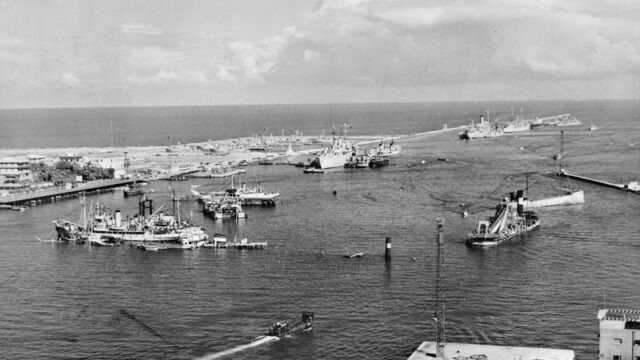
Source: National Museum of Diplomacy
Britain was already short of dollars and burning through reserves to defend the pound’s peg.
So, President Eisenhower held the whip hand. Knowing it, he let the pound slide and withheld emergency lending until British troops withdrew.
Britain had the ships but lacked the money. Sterling was no longer the reserve currency, which meant Britain’s funding sat inside systems controlled by others.
This moment was the death knell of the British Empire, crystallising a multi-decade slide. It served as a high-water mark, shattering any illusion of British economic or political power from that point forward.
Reserve currency power rarely ends on a battlefield. But its influence can determine the winners. Within 15 years, Sterling was a footnote.
Global Reserve Currency Share
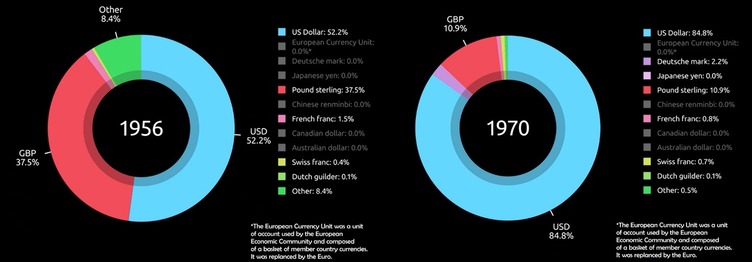
Source: EEAGLI
[Click to open in a new window]
Washington had learned how powerful its new lever had become.
The lever, used again
Washington pulled it again in late February 2022.
Days after Russia invaded Ukraine, the Biden administration and the G7 froze roughly US$300 billion of Russian central bank reserves.
That was about half of Moscow’s US$640 billion war chest taken out with the stroke of a pen.
It was the most expensive lesson Washington has ever handed its rivals. Control over reserve currencies is a power they are happy to abuse.
Only two categories of Russian reserves survived. Gold in vaults inside Russia, and reserves held in China. Every country took notice.
Central banks bought 1,136 tonnes of gold in 2022, the highest annual total on record since 1950. The average across the previous decade was 473 tonnes.
They’ve not slowed down since. I’ve marked that sanction below with line S.
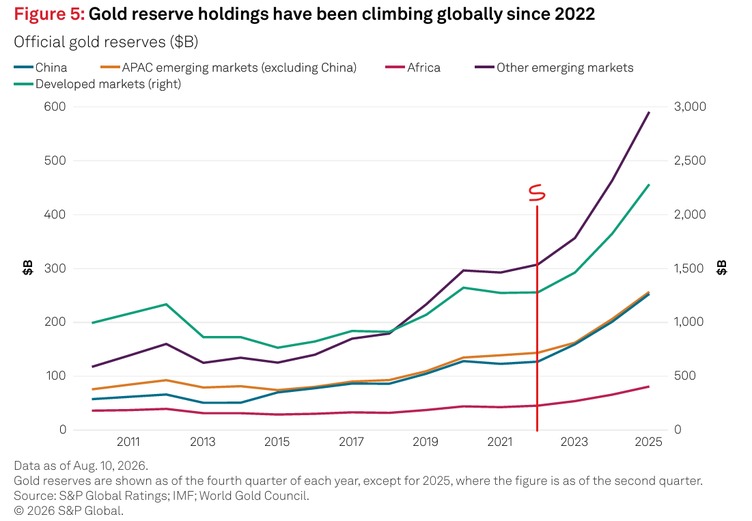
Source: S&P Global (2022 S-sanction line added)
[Click to open in a new window]
Back to BRICS
This moment marks the acceleration of gold as a hedge against US power, and why I believe it’s BRICS’ most likely path to an alternative.
Mainly because all the others have failed before it. BRICS’ efforts to promote other reserve currencies is best described as a ‘throw it against the wall’ strategy.
So far, none have been able to stick amidst internal divisions.
In 2024, the group made headlines as Russia attempted to push a multi-commodity basket as the basis for exchange.
This harks back to a concept known as Bancor, a monetary system proposed by Keynes as an alternative to the Bretton Woods system.
China all but ignored this and instead exploited Russia’s precarious financial position, due to sanctions, to buy cheap energy. So much for good allies.
Beyond this, payments are where the bloc has spent most of its recent efforts and has the least to show.
BRICS Pay is the headline project at the moment. Pencilled for 2030 completion, it has been bogged down by technical issues.
Each country is still tinkering at the pilot stage with its own digital currency.
With no central currency in these plans, cross-border payments have become a technical nightmare of complex blockchain rules governing settlement, compliance, and liquidity.
As someone who’s built on blockchains, I can tell you it’s a lot like building with carbon fibre. It looks sleek and futuristic, but it’s expensive to make, finicky to work with, and brittle under change.
At the May ministerial in Delhi, members reaffirmed their commitment to advancing it. However, countries like South Africa are dragging their feet while China powers ahead.
The Bank of Russia has directed major banks to begin offering digital-ruble services in time for the September meeting, so this could see some progress then.
But this wouldn’t be the first time an alternative payment rail has come and gone.
Which brings us back to gold
Moving out of the weeds and back to a bird’s-eye view, you can see that the trend for BRICS is clearly away from US dollar reserves.
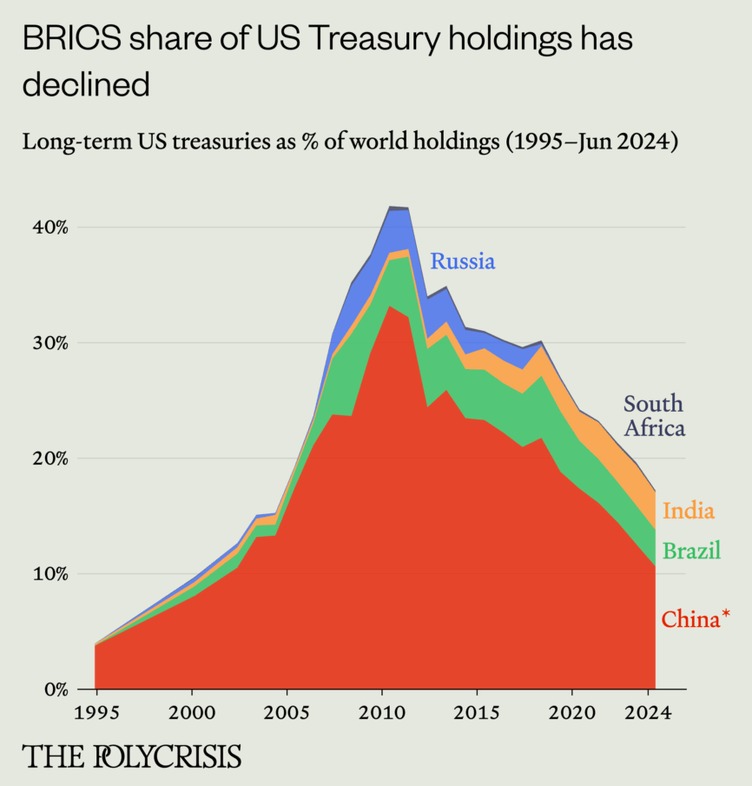
Source: Polycrisis
[Click to open in a new window]
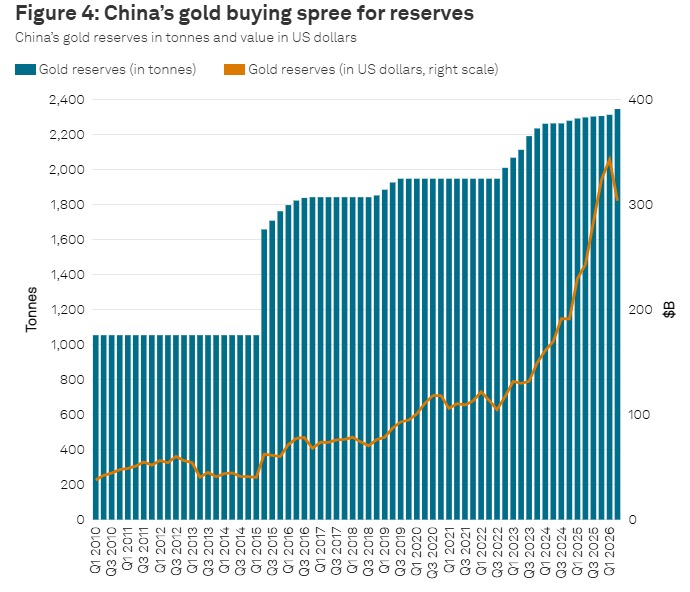
A big part of this has been led by China. Last year, nine Chinese government departments reclassified the metal. Gold moved from a financial asset to a ‘strategic mineral’ and a cornerstone of the country’s financial and industrial security.
That’s a security designation rather than a market view, and it changes what the state is willing to spend. Not that it hadn’t already had an eye for the metal.
Around the time of those 2022 sanctions, China restarted its gold buying after a three-year pause.
Source: S&P Global
[Click to open in a new window]
And with that, China’s Shanghai Gold Exchange also restarted its ‘gold road’ initiative to expand gold-based yuan settlements.
After little movement since 2019, this initiative is progressing again. Last year, China opened its first ‘offshore’ gold vault at Hong Kong airport.
Singapore, Kuala Lumpur, Dubai, Riyadh and Moscow are reportedly under review for the next sites.
The exchange listed two yuan-denominated gold contracts alongside the vault. Both settle in cash or physical metal. I believe this change is the first step in many to come.
Charles Chang, who leads greater China corporate ratings at S&P, put the logic to the South China Morning Post.
Take renminbi for a cargo, and you still need somewhere to put it. ‘But if that renminbi is convertible to gold, then that’s a potentially different picture.’
A fully gold-backed yuan is not on the table. China’s official holdings are a rounding error of its money supply, and Beijing knows it.
But I do believe this ties into the bloc’s wider gold projects. Russia confirmed in February that BRICS is building a precious metals exchange to price bullion outside London.
Alongside it sits ‘the Unit’, a settlement token backed 40% by gold and 60% by member currencies.
While this could be another option thrown at the wall, it has the best chance of sticking.
A vault network would allow a Gulf exporter or an African miner to take payment for a shipment and swap it for metal held outside American reach.
This currency does not need to be trusted for thirty years to get off the ground like the Euro. It has the backing of a commodity that has held its value for more than 4000 years.
Our resident gold expert, Brian Chu, has come to a similar conclusion in recent weeks. He thinks our Western money machine is coming to an end.
Regards,

Charlie Ormond,
ATLAS and Altucher’s Investment Network Australia




Comments