

Dear Reader,
We all desire a country built on the pillars of community, equity, and economic justice. But it’s simply not possible in a country pinned to the foundation of rising land values as a necessity to fund retirement and most other lifestyle and business needs.
The social consequence that arises from this costs Australians millions in welfare payments throughout the year.
Yet it is still advertised and promoted as the road to riches — unsurprisingly.
If I had the choice of being a rentier rather than a renter, I know which I’d rather be.
|
|
| Source: ABC News |
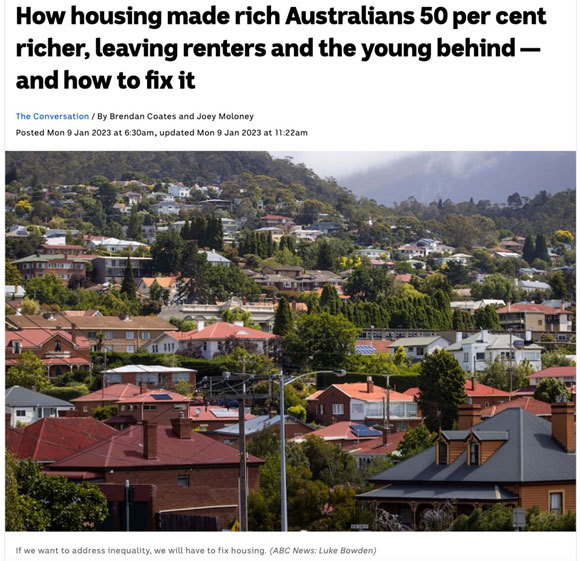
‘Rising housing costs have dramatically widened the gap between what Australians on high and low incomes can afford. Rising home prices paired with plummeting rates of home-ownership are driving up wealth inequalities.’
ABC News
Thus, we have a ‘FIRE’ (finance, insurance, and real estate) economy choreographed around the land market — disproportionally inflating land costs without due acknowledgement of the consequence.
When you read today’s headlines about the housing crisis, you may as well be reading a timeless newspaper.
Rising rents, a housing shortage, struggling first home buyers, and an increasing number of singles retiring without owning their own home. These are all consequences of the process driving the land cycle.
Unfortunately, the web of confusion surrounding the subject has put capitalist democracy — which has managed to free so many from the dominance of politically oppressive and controlling regimes — under attack.
Yet, capitalism, which, in its truest form, is simply a free market system of competing goods and services, is not quite what we have today.
It’s important, therefore, to understand what wealth and capital are exactly.
Wealth is not the paper and numbers in our bank account.
Money is simply a measurement of the resources we need to produce the goods and services we consume (capital) for both business and pleasure.
In simplest terms — a person’s wealth is made through their own enterprise, while a country’s wealth consists of its land and natural resources.
When we earn money in exchange for our skills and labour, it can’t be considered unjust or unfair.
However, when we gain a windfall through a government-legislated process of trading and monopolising land and natural resources for profit, it yields a special kind of unearned income, which classical economists termed ‘economic rent’.
Rent-seeking can take on many forms, such as patents and government licences, which cripple competition from smaller industries and produce an unfair advantage.
The Uber and Lyft revolution was one such example.
It undermined the cartel of the taxi industry’s ‘licencing’ monopoly, which gleaned economic rent from the purposeful limitation of the number of licences granted.
The most damaging of rent-seeking behaviour — and the one that yields the most gains — is trading the economic rent of land.
An increase in the market price of land is an expected result when economies are improving along with capital investment in infrastructure.
Therefore, of all rent-seeking behaviour, owning a plot of land in the path of progress yields not only the greatest windfall of passive gains but is also used as a significant source of territorial and political power.
This is not surprising when you consider all the goods we consume come from land.
Our oil, natural gas, timber, coal, and water reserves are the product of it.
We travel on it, work on it, party on it, sleep on it, and bury our dead in it.
All forms of technology need it, from wi-fi to aeroplanes. We evolved from it and progressed on it.
Try to think of an activity or item that doesn’t include land, and you’ll come up short.
However, the flow of income that comes from owning land over and above the value of building on it, when capitalised into the price, leads to a monopolist culture.
It feeds speculation, attracting a cabal of banking and finance interests and concentrating the vast proportion of a country’s wealth in the hands of a few above the very real needs of many.
Since the early Australian settler Edward Gibbon Wakefield (1796–1862) devised his grand plan of ‘systematic colonisation’ — making land just so ‘sufficiently’ unaffordable as to create a willing workforce of labourers.
Economists and politicians have done everything possible to distract public attention from what is nothing more than a modern-day game of feudalism.
They do this by allowing people to play a dangerous game of leverage, gambling on land price inflation by borrowing as much debt as possible to maximise their ‘capital gains,’ without acknowledging what is given with one hand is taken with the other — or more accurately, from another.
This, in essence, is why we have a land cycle.
The land market and the credit created against it drive the real estate cycle, which drives the economy, which ultimately drives both the stock market and property.
If you do not understand the land market, then you are blind to the risks and opportunities you are taking when you invest.
It’s this analysis that sets Land Cycle Investor and Cycles, Trends & Forecasts apart from any other newsletters you read.
By viewing the economy through the lens of the 18-year real estate cycle, you have an advantage over every other investor.
At the very heart of the real estate cycle, chasing the unearned wealth — the economic rent of land — is the motivation behind most real estate investments (i.e., speculation).
The banks love this process.
They capture the economic rent through mortgage payments — trading the interest on a multi-trillion dollar derivatives market.
It’s a parasitic system that means banks are now an enormous part of the economy — far more so than they should be.
Financiers quite simply carry a licence to mortgage the earth.
We are, in effect, all slaves to this system.
And it’s a very profitable system for those who control it.
But the boom cannot last forever!
While, theoretically, no limit to the amount of credit can be created, the real economy — the productive sectors of the economy that the rent-seeking process has eroded away — reaches a point at which the debt can no longer be afforded.
This is what brings the meltdown.
And it’s this that drives the volatility of the cycle — producing the great booms and busts that you’ll witness in most major capital cities.
This last two years of the real estate cycle is what we call the ‘Winner’s Curse’ phase.
We are approaching this phase now, between 2024 and 2026.
This is where the greatest level of speculation typically occurs and the period that sends property prices right over the top.
Buyers who purchase too close to the top risk ending up in negative equity.
Using the real estate cycle as your guide, this should not happen to you or your family.
To quote the great economist Michael Hudson:
‘The boom, alas, cannot last forever. And when the growth ceases, the market will collapse. In reality, alas, we cannot all be rentiers. In Voltaire’s phrase, the rich require an abundant supply of the poor, so too does the rentier class require an abundant supply of debtors. There is no other way.’
Best wishes,
 |
Catherine Cashmore,
Editor, Land Cycle Investor



Comments