



If a music gig starts to suck, people just drift toward the bar.
That is roughly what happened in global markets last week.
US Treasury Secretary Scott Bessent tried to talk long-term borrowing costs down, announcing the Treasury would at least double the size of some buybacks of 10 to 30-year debt.
Long yields fell for about a day.
Your average retail investor rarely cares about bonds, just what the tradable outputs are.
So here they are…
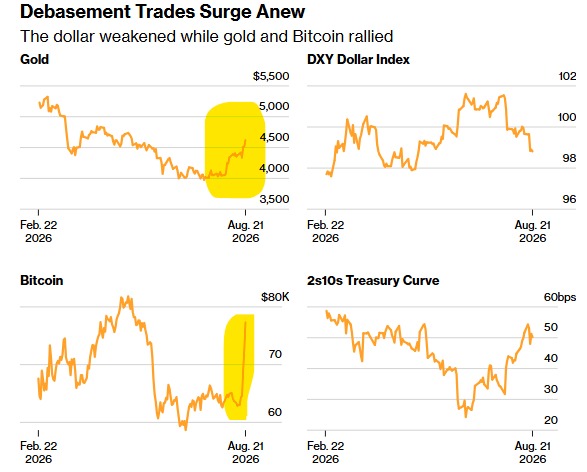
The dollar weakened, gold rallied, and Bitcoin rallied.
That’s right, just like James Brown, the debasement trade from last year appears to be back!
Ray Dalio went harder on Friday, telling investors to cut bond exposure and hold gold and some Bitcoin against the risk of a US debt crisis.
In my book, Dalio is a shill for his own investments on a global scale, so don’t be surprised if he has positioned well ahead of this pronouncement…
But the point is, the big dogs in global finance are wagging their fingers at the US Treasury.
Capital votes with its feet
Whatever the bond market does next, capital is voting with its feet.
Check out these charts… money recently wants to slide into stores of value that sit outside the fiat system:
Source: Bloomberg
[Click to open in a new window]
The US is running a deficit of close to US$2 trillion, while governments everywhere borrow more for defence, energy and social programs.
Companies are raising enormous sums at the same time for AI, data centres, chips and power.
That is a lot of hands reaching into the same pool of capital.
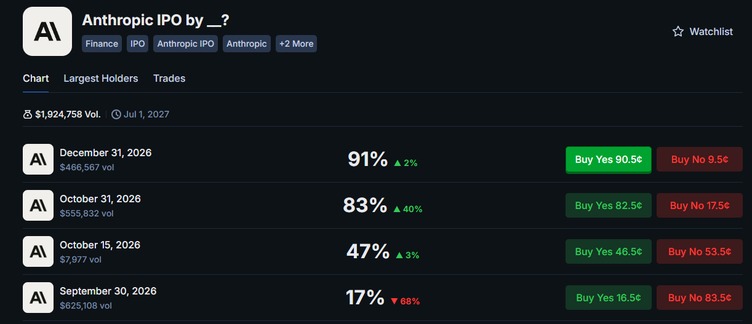
And dear me! Anthropic’s blockbuster IPO is now back on!?
Source: Polymarket
[Click to open in a new window]
When people don’t like what they see from governments and the fixed income market, this is what they usually do…
Yep, gold
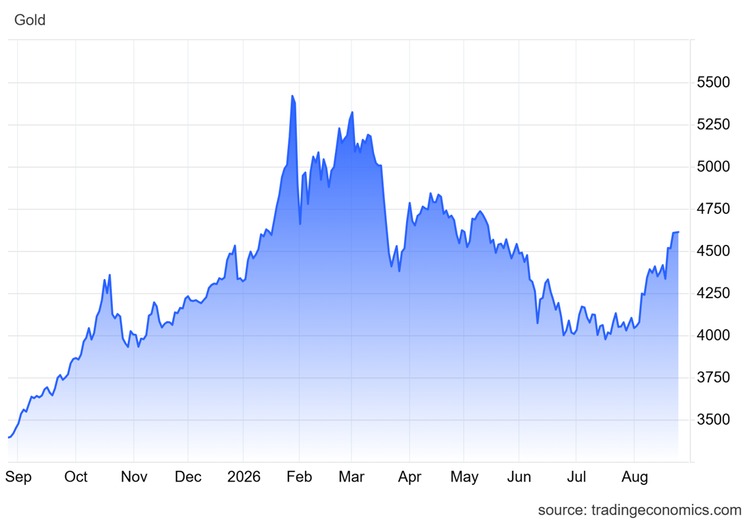
Through the first half of this year, I argued gold would have a strong second half.
I had no idea what the trigger would be.
Source: Trading Economics
[Click to open in a new window]
Gold peaked near US$5,400 in February, slid to roughly US$4,000 by July, and has clawed back to around US$4,600 over the past few weeks.
It’s nice to be right here, but I can’t claim I knew what the causal chain of economic events would be.
And my main point here is…we’re going to need a lot more physical objects to get inflation down.
So the US Fed can cut rates, and give us another sweet, sweet financial market bonanza…
The “stuff” economy keeps building its case
The wider commodity complex looks strong from here.
Prices are the signal that eventually pulls in capital expenditure, and prices across a long list of physical inputs are doing plenty of talking.
Talking that project financiers will have to listen to.
Meanwhile, if traditional energy markets stay constrained due to the Iran conflict, the obvious beneficiaries are uranium and the broader nuclear supply chain.
That’s definitely a second-order effect worth thinking about.
Those energy costs run directly into a big macro theme we’ve talked extensively about in Fat Tail Daily.
You cannot vibe code your way
to a government contract
Expensive energy is a genuine problem for an AI hyperscaler chewing through gigawatts.
It barely registers for a software business selling case management systems to a state government.
So if power costs stay elevated and investors start asking sharper questions about capital-hungry AI buildouts, a few unloved Australian software names on low multiples could get a second look.
(I’ve mentioned the SaaS rebound and tech valuations quite a bit in the past few months)
I’m thinking about the ones with defensible market share, sticky customers and contracts that take years to win.
ReadyTech Holdings [ASX:RDY] is one such example.
An overseas software acquirer lobbed an unsolicited approach at the company earlier this year, and the board knocked it back as too cheap:

Source: Australian Financial Review
*Note: not financial advice, simply an example of the tech wobbles brought on by the vibe-coding market scare attracting private equity bids*
So right now, while the back-to-the-future debasement trade makes all the headlines, there are some key points on the progression of investable sectors in the months and years ahead.
We’re going to need commodities to get prices down; the market may develop a growing taste for low-multiple tech companies where selling has gone too far. And then uranium looms as an energy pressure release valve.
As inflation comes down (praying!), that will enable the US Fed and the RBA to provide relief.
So that would mean biotech then?!
Hold on, let’s not count our chickens too early here.
For now, it’s the debasement trade: gold and Bitcoin.
Where next? Well, just look to some of the big themes in the world and how they interact with price pressures on a range of assets.
This animates my internal roadmap for types of sector exposures, which drives the recommendations I put in front of members of my paid services, Australian Small-Cap Investigator and Fat Tail Micro-Caps.
Tomorrow, I’ll share a more fleshed-out version of this roadmap after a bit more thinking time.
Have a great start to your week.
Warm regards,

Dr. Lachlann Tierney,
Australian Small-Cap Investigator and Fat Tail Microcaps





Comments