



The death knells are ringing. Market apocalypse narratives flood every financial media outlet.
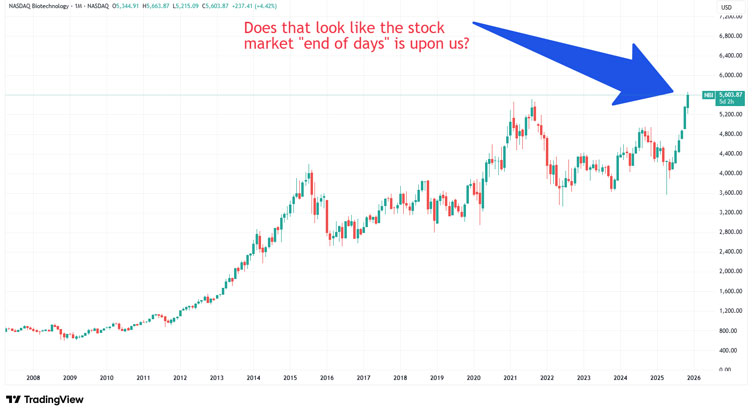
And yet here’s the Nasdaq Biotech Index going for an absolute run – up ~20% in the last three months during a “market meltdown”.
Does that look like the end of days to you?
Source: TradingView
[Click to open in a new window]
No.
What we’re witnessing right now looks far more like institutional repositioning than an actual descent into market hell.
And retail investors? They’re getting played. Again.
Let me explain how this game works.
The Profit Playbook: Step 1, Position.
Step 2, Preach, Step 3, Profit
Ray Dalio and Bridgewater are the masterclass in how big money operates.
In 2024? Dalio positioned heavily in China well before coming out publicly to say a China bounce was imminent.
Bridgewater’s funds were already loaded up, delivering over 35% returns in China during 2024 with annualized returns near 20% since inception.
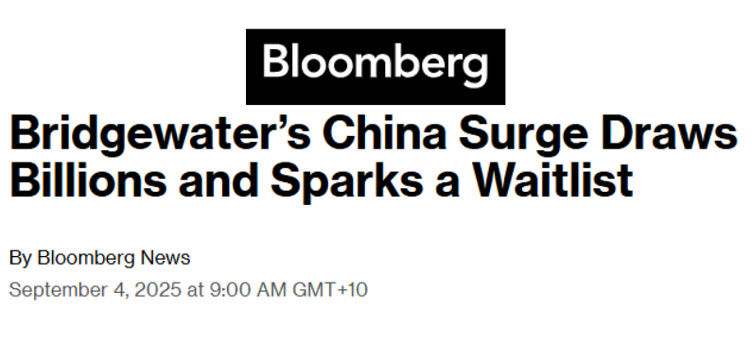
Now those funds are being gobbled up like sliced bread by Chinese investors desperate to get allocation:
Source: Bloomberg
That’s the pattern. Big funds position. Then the talking heads come out. Then retail follows the narrative straight into positions the institutions already hold.
And when it’s time to exit (this year)? The narrative shifts again.
Bridgewater completely exited all US-listed Chinese equity positions in Q2 2025, selling nearly US$1.5 billion worth:

Source: South China Morning Post
Did Dalio announce this move before it happened?
Of course not – only after the fact in mandatory filings.
So the public messaging only shifted after the repositioning was complete.
This is a conspiracy. And it’s standard operating procedure.
They legitimately are spying on
your trades…all the time
The relationship between market makers and retail brokers exposes another layer of this system.
And the money flowing through this arrangement? It’s absolutely exploding.
I’m talking about order flow – where retail investor stock market orders are packaged up and sold to the highest hedge fund bidders.
What do they get for that money? They get to see retail order flow before it executes. They get data on what retail is buying and selling. They get positioning intelligence.
Payment for order flow hit US$953M in Q2 2025, up ~64% year-on-year. In May alone, market makers paid retail brokers US$340M, up ~51.6% from May 2024.
Citadel Securities accounted for ~US$122.8m in a single month. More than a third of the monthly total.
Robinhood collected ~US$342.6M in Q2 2025, with ~US$270.5 coming from options flow alone.
Market makers paid Robinhood 56 cents per option contract in Q2, significantly higher than the 40 cents paid for major bank Charles Schwab’s flow.
What does that premium tell you? Robinhood’s retail traders are more profitable to trade against.
And this is why Robinhood trades are “free”.
It’s just a data honeypot.
Research by finance professors Thomas Boulton and Thomas Shohfi shows market makers are compensating Robinhood 4.5 times more for crypto orders compared with options. The uncoordinated daytrading flow is that valuable:

Source: SSRN
This isn’t going away. Ever.
Citadel Securities extended its dominance in order flow, raising its quarterly spend from ~US$311.2M in Q1 to ~US$340.6M in Q2. They’re not cutting back. They’re doubling down.
When retail piles into a stock, the big players already know. They can front-run, position against, or simply fade the move. Retail becomes the exit liquidity.
The SEC fined Citadel Securities $22 million in 2017 for publishing “misleading statements” about pricing. In 2020, FINRA hit them with a measly US$700,000 fine for trading ahead of customer orders.
They delayed equity orders from clients while continuing to trade the same stocks in their own account. Client orders filled second. Citadel’s orders filled first.
Despite regulatory scrutiny and multiple congressional hearings, the practice continues. And it’s more lucrative than ever.
If its in the news, it’s in the price
When institutions need to reposition, the narrative machine fires up.
We’re hearing nonstop doom about market crashes, debt crises, private credit implosions, and the end of the bull market. Every headline screams danger.
Meanwhile, the Nasdaq Biotech Index is ripping. Biotech has delivered some of the strongest sector performance in recent months. The iShares Biotechnology ETF gained ~22% in 90 days. The SPDR S&P Biotech ETF surged ~29% in the same period.
That’s while the S&P 500 gained just ~2% and the Nasdaq rose ~4% over 30 days.
Biotechs have been beaten down for years. Many are trading well below pandemic peaks despite solid fundamentals. Valuations are compressed.
The FDA approved 38 drugs in 2025 through November.
This is not a dying sector.
This is a sector being quietly accumulated while the fear narratives kept retail on the sidelines.
Smart institutional money extracted gains from commodities and precious metals, then pivoted into beaten-down growth stocks to ride the risk-on wave.
Fed to cut now…? What a surprise
And now, suddenly, the market believes the Fed will cut rates again.
Just weeks ago, the consensus was that December rate cuts were off the table. Probability sat near 40%. Now it’s back above 70%.
What changed? The US labour market data.
The Fed already cut twice in 2025, bringing rates down to 3.75-4.00%. They’ve got room to cut further if needed.
Lower interest rates make future cashflows more valuable today. Biotechs burning cash suddenly look less expensive when the discount rate drops. Small caps with high debt loads get breathing room.
Lower? Maybe. For a long time? No.
There may well be additional downside in the coming weeks. Markets could correct further.
But everything about the current environment reeks of repositioning rather than genuine systemic collapse.
Institutions are not behaving like they expect Armageddon.
They’re behaving like they expect a buying opportunity.
If you believe structural demand for critical minerals will accelerate as AI data centres multiply, then a pullback is massive opportunity.
If you think central bank gold buying and currency debasement are multi-year themes rather than three-week trades, then gold below $4,000 looks interesting.
Meanwhile, if you’re convinced this risk-on rotation has legs, and that the AI boom will broaden beyond mega-caps into smaller, nimbler players, then biotechs and small caps deserve attention.
The key is knowing which camp you’re in.
I’ve seen the abyss in markets before.
And this doesn’t feel like the edge of it.
Best Wishes,

Dr. Lachlann Tierney,
Australian Small-Cap Investigator and Fat Tail Microcaps
***
Murray’s Chart of the Day – Oil

Source: TradingView
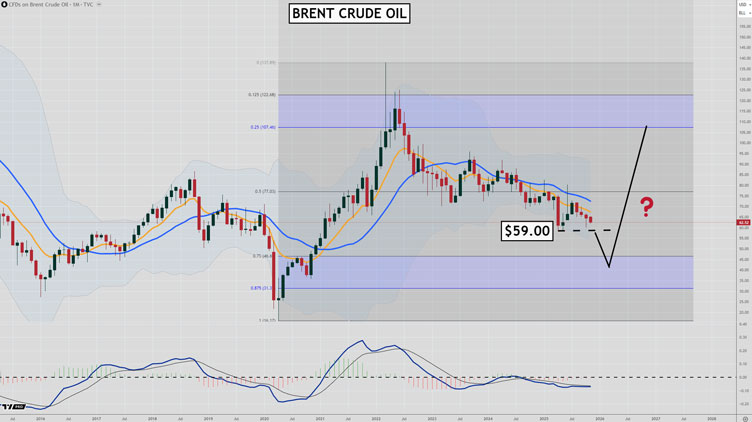
As we head towards Trumps Ukraine war ultimatum this week, oil prices have seen further selling pressure.
They remain just above the US$59.00 low of the whole bear market that started in 2022 (currently US$62.50).
There isn’t much support below US$59.00.
If the end of the war is announced and Russia is welcomed back into the international fold, we may see the oil price snap below US$59.00 and head towards US$45.00 rapidly.
That is where a major buy zone sits.
I would consider a fall of that magnitude a major buying opportunity in oil and oil stocks for the next few years as the market reassesses the long-term demand for oil and gas during the energy transition.
Recently the International Energy Agency said Global oil and gas demand could grow until 2050, departing from previous expectations of a speedy transition to cleaner fuels following U.S. criticism about its climate focus.
So perhaps one of the worst markets in 2025 is shaping up to be one of the best in 2026.
Regards,

Murray Dawes,
Retirement Trader, International Stock Trader and
Murray’s Trading Room





Comments