




Venezuela… US Military intervention in Latin America… What could possibly go wrong?
The US has danced this tune many times in the past, and each time it led to misery, bloodshed or civil war for its Southern neighbours.
The track record of US intervention isn’t good, and that’s perhaps sobering news for the Venezuelans.
Take the period throughout the 1970s.
This was a dark period in US geopolitical history; the Vietnam War was the key event. But it was also a prolific era of military interventions across South and Central America.
And, like today, much of the geopolitical chest-beating was based on securing America’s supply of critical commodities.
Like this example:
The ‘Chilenization of Copper’
If you’re not familiar, Chile is the world’s largest producer of copper, accounting for around 30 per cent of total global supplies.
It’s what makes copper a serious business in this South American nation, and it’s been that way for over 60 years.
In fact, 50 per cent of the country’s total exports come from this single commodity alone.
In a way, copper to Chile is similar to what iron ore or coal is to Australia, in terms of its essential role in the economy.
However, copper has also played a leading role in staging a dark and brutal chapter in Chile’s not-so-distant past.
It all started back in the early 1970s, when the left-wing Chilean government, led by Salvador Allende, set about the outright nationalisation of the country’s copper mines.
It was a period known as the ‘Chilenization of copper.’
Frustrated by multinationals siphoning the country’s mineral wealth mostly to the US, Allende gained widespread public appeal by bringing the country’s copper assets under state control.
In 1971, Allende’s government amended the country’s constitution, which gave the nation full ownership of all major copper mines.
With tails between their legs, the multinational mining companies were swiftly extradited from the country.
No compensation was offered….
Shareholders were left reeling.
Multi-million-dollar assets were wiped from the company’s balance sheet, effectively overnight.
In the early 1970s, copper accounted for 80 per cent of Chile’s total exports. Its why the commodity was popularised as “Chile’s salary!”
Unsurprisingly, the people adored Allende and he’s Marxist-government.
But his bold actions were creating ripples to the north….
The US government, suffering from years of chronic communist paranoia, was determined to undermine Allende and eradicate the idea of nationalism for other would-be South and Central American nations looking to repeat Chile’s playbook.
Which is precisely what the US government did.
Chile was condemned by the West and given a strong dose of international sanctions.
However, for then-US President Richard Nixon, he wasn’t satisfied with these ‘soft-tactics.’
Despite the Chilean public’s overwhelming support for the democratically elected Allende government, US officials systematically dismantled his control.
On 11 September 1973, a group of military officers led by General Augusto Pinochet seized power in a coup, ending civilian rule.
Chile called the event their very own ‘September 11.’
The military established a ‘junta’ (dictatorship) that suspended all political activity in Chile and repressed left-wing movements, especially communist and socialist parties.
Allende was killed, most likely executed by the military, while his presidential palace was attacked, as shown in the image below.
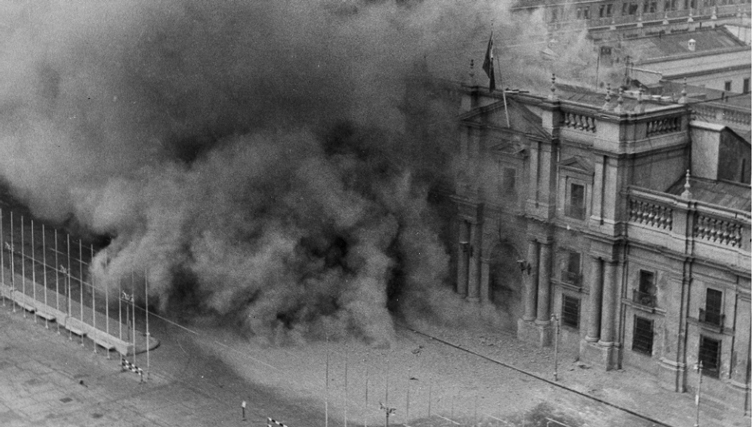
Source: People’s World
The Nixon administration, which had worked to create the conditions for the coup, promptly recognised the junta government and supported it in consolidating power.
It marked the end of Chilean democracy, which had been in place since 1932.
It also initiated one of the most violent periods in Chile’s history.
The US-supported government used political suppression, torture, and murder to destroy all remnants of the left ideology.
This persisted for years.
As the country’s most important export, copper played a critical role in sparking the darkest chapter in Chile’s history.
Is history repeating itself 54 years later in Venezuela?
The US has a poor history of military interventions in South America, sowing the seeds of chaos and often fanning civil war.
There is no doubt that the US is playing a dangerous game.
And in some of the most important regions for future oil supply. The stakes are enormous, after all, oil is the global economy’s most critical resource.
So, what could possibly go wrong?
It all boils down to this:
Keep commodities at the forefront of your portfolio right now; we could be embarking on a major new chapter in this market.
Until next time.
Regards,

James Cooper,
Mining: Phase One and Diggers and Drillers




Comments