




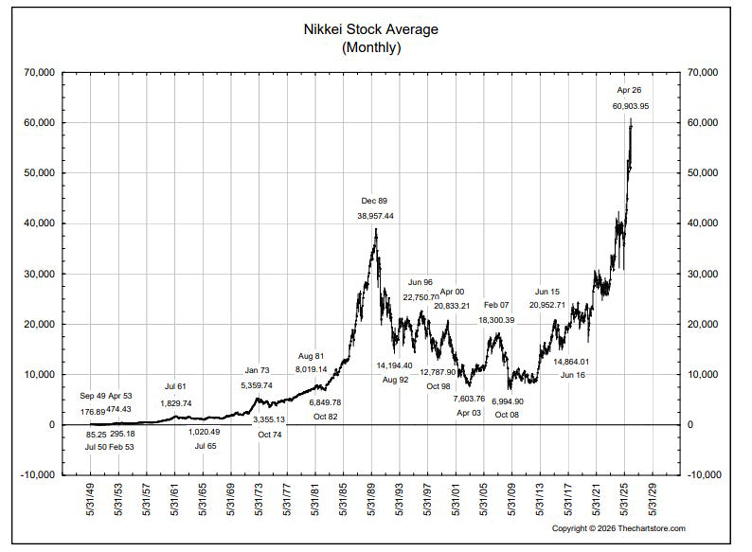
Japanese stocks took 34 years to make a new high after the 1989 crash.
[Click to open in a new window]
“Do not ever doubt President Trump and his political power.”
–Steven Cheung
Oh my. Launch the lifeboats. Send out an SOS. Get another passport. The last conservative in Congress has been booted out. By the Big Man and his Big Money backers. AP:
US Rep. Thomas Massie Loses Kentucky Primary…Another Victory For Trump
The Republic was probably doomed anyway. But who, what could possibly replace it?
The Trumpian view is that the US is on top of the world and climbing higher every day. We are smarter. Better looking. All of our children are above average…and we are so much better at kicking butt than everyone else, including the Chinese.
A more common view is that, yes, the US is slipping and China is gaining. But if we just make the right policy moves…or kick enough butt…we’ll be able to stay on top.
The third view is Spenglerian — that the US has had its day in the sun; now it’s time for China to push the old lead dog aside and take its place.
Here at Bonner Private Research, we tend to slip into the Historical Inevitability hole. There are the producers and the consumers. Everything else in economics is detail, elaboration, politics, and fakery (DEPF). As time goes by, DEPF tends to increase…at the expense of real producing and consuming.
The US has gone up for almost its entire existence. But DEPF has greatly increased. The feds are much more heavy-handed than they used to be. Our money has lost more than 95% of its value over the last 50 years …and the losing streak is now picking up speed. And Americans, arguably, have grown rich and complacent. A ‘correction’ would not be at all surprising.
But China up? The US down? That view may be far too simple. While the US is obviously in decline — relative to the rest of the world, and almost by every measure — it is not at all clear that China is ready, willing or able to take its place as global hegemon.
China is definitely a powerhouse. Dean Baker:
China’s economy is roughly one-third larger than the US economy, [based on purchasing power] and it’s growing 4-5 percent a year, compared with roughly 2.0 percent annually for the US This means both that China is 1 and its margin over the US is increasing.
But let’s look more closely. Whenever a society does well, the tendency of observers is to attribute its success to the genius of its planners. In the 1980s, for example, Japan was the envy of the world. And it had an ‘industrial plan’ and an industrial planning board known as MITI. The group’s contribution to Japan’s economic success is disputed. But whatever it did, it didn’t spare Japan from the boom/bust cycle.
By the late ‘80s, stocks in Japan were far over-valued and the economy was slowing. Then, the Bank of Japan lowered interest rates. Soon, stocks collapsed. This was not a good time to ‘buy the dip,’ however. Stock prices didn’t recover until 2025 — 35 years after the crash began.
And now, the Wall Street Journal credits China’s industrial policies for its success:
Beijing’s ‘Industrial Policy of Everything’ Leaves Rest of the World in the Dust
Xi Jinping has elevated Chinese industrial policy into something the world has never seen. It targets almost every industry and region, demand as well as supply, services as well as goods, the sophisticated and the mundane. Its goals are economic, technological, and strategic. Its tools are microeconomic and macroeconomic.
Trump has reportedly secured agreements by China to purchase soybeans, energy and aircraft, withhold military equipment from Iran, and open up more to American business. But none of this will stop China from swallowing ever more global market share. the key features of what it calls China’s “industrial policy of everything.”
Greg Ip, writing for the Wall Street Journal, highlights China’s ‘five-year plan.’ It focused on 19 different ‘priority’ sectors. Many were obvious high techy, buzzy industries. But they also paid attention to household appliances and ordinary household chemicals. The result: fast growth almost everywhere.
And no point in trying to stop China with tariffs or outright bans. It would simply shift to other markets. And then…
Chinese electric vehicles may incorporate Chinese software and artificial intelligence. As those EVs gain market share abroad, Chinese software and AI may supplant U.S. rivals as the global standard.
What’s needed, says Ip, is a “joint response by all market-based democracies to Chinese industrial policy.”
Really?
Is China’s growth really a result of intelligent government planning? Can the Chinese be beaten by even more intelligent counter planning in ‘market based’ economies…or is central planning just more DEPF?
More to come…
Regards,

Bill Bonner,
For The Daily Reckoning Australia



Comments