



Nvidia CEO Jensen Huang with a bit of poker “table talk” today…
When asked whether GPUs would feature in Thursday’s Trump-Xi trade summit: “I have no idea.”
Right.
And I have no idea whether the sun will rise tomorrow.
Huang has met with Trump repeatedly, will join him in South Korea for the summit, and his company stands to gain or lose tens (or hundreds) of billions in revenue depending on China access.
And yet he claims complete ignorance about whether his flagship product might come up.
This is a bluff. And everyone at the table knows it.
But it’s masterful table talk nonetheless. Because in this high-stakes game, sometimes saying nothing reveals everything about your hand.
Poker chips and computer chips
In poker, your chip stack determines your leverage. Run low and you’re forced to fold premium hands. Stack deep and you can pressure opponents into mistakes.
Right now, both superpowers are eyeing each other’s chip counts.
China controls a dominant share of rare earth processing. The minerals that power everything from F-35 fighter jets to data centre infrastructure. That’s a formidable stack.
But America holds the technology ace. Nvidia’s H100 and H20 chips remain the gold standard for AI development, and China’s researchers which make up half the world’s AI talent are desperate for access.
Huang has been explicit about this leverage: “Keeping US technology in front requires finesse. It requires balance. It requires long-term thinking”.
Translation: Don’t push your advantage so hard you force China to develop alternatives that eliminate your edge entirely.
A hastily arranged deal
The timeframe for this deal has been remarkably short given the lengthy build up.
October 9: China announces sweeping rare earth export restrictions.
October 10: Trump threatens 100% additional tariffs on all Chinese goods.
October 26-27: Treasury Secretary Bessent hammers out a “framework” with Chinese negotiators.
Now both sides are walking back from the brink. The 100% tariff threat is effectively off the table. China will pause rare earth restrictions for a year. And everyone’s suddenly optimistic.
Nvidia’s market share in China has gone from 95% at its peak to zero.
But here’s where Huang’s table talk matters. His carefully calibrated statements, at some points praising China’s AI ecosystem while also lobbying for US chip access, are trying to gauge China’s actual intentions.
Will Beijing genuinely allow American tech companies back in?
And the US has the best chips, for now, to offer as a carrot.
Or is this framework just temporary relief before the next round of escalation?
China is building domestic alternatives to Nvidia through Huawei.
And America’s pouring billions into friend-shoring critical minerals through Australia and Africa.
Which leads me to think this may be a dud of a deal.
The framework isn’t peace.
It’s a ceasefire that buys both sides time to fortify positions.
Think of it as both players agreeing to maintain current chip stacks while repositioning for the next big hand.
Where this leaves Aussie investors
Australia sits in the uncomfortable middle of this poker game, and that creates both risk and opportunity.
Iron ore could rally if the deal holds.
Chinese stimulus measures have already sparked volatility in iron ore futures. A genuine trade thaw would support Chinese steel demand and potentially stabilize prices around US$105-110 per tonne.
Things that don’t track the index with catalysts that can re-rate disproportionately on positive news.
Oil and gas get interesting too…the shackles could come off on global demand if energy supply is less weaponised.
Critical minerals remain the wildcard.
The US-Australia critical minerals partnership announced last week specifically targets breaking China’s rare earth dominance. Fifteen Australian juniors just secured funding commitments from Washington.
Whether Thursday’s summit succeeds or fails, America appears very committed to building non-Chinese supply chains. That structural shift doesn’t disappear with one handshake.
BHP has made big bets on copper, while RIO has invested heavily in lithium.
All up, I see the big iron ore miners, which are diversifying into energy minerals, as relatively safe if a trade deal materialises or it’s back to the same high-friction trade environment.
Today, and likely for the next 10 years…I’m in the “sell the banks, buy the miners” camp.
The commodity cycle – gets stronger by the day. If you want to learn more about why the miners could be you best bet. Read this.
Regards,

Dr. Lachlann Tierney,
Australian Small-Cap Investigator and Fat Tail Microcaps
***
Murray’s Chart of the Day – Uranium

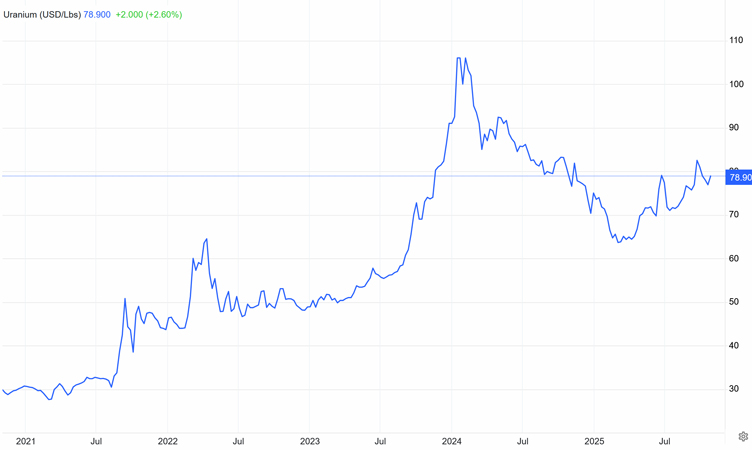
Source: Tradingview
Leading uranium company Cameco Corporation [NYSE:CCJ] announced a large deal last night.
They said:
Cameco Corporation today announced that it, along with Brookfield Asset Management (Brookfield), has entered into a binding term sheet with the United States Department of Commerce (US Government) to establish a strategic partnership, which is expected to accelerate the global deployment of Westinghouse Electric Company’s (Westinghouse) nuclear reactor technologies and reinvigorate supply chains and the nuclear power industrial base in the US and abroad.
The agreement provides for the US Government to arrange financing and facilitate the permitting and approvals for new Westinghouse nuclear reactors to be built in the US, with an aggregate investment value of at least US$80 billion, including near-term financing of long lead time items. Once constructed, the reactors are expected to generate reliable and secure power for the American grid, including powering significant data center and compute capacity to drive growth in artificial intelligence in the United States.
Uranium stocks jumped around 10% across the board on the announcement.
We have already seen steady buying in uranium stocks over the past six months as uranium prices recover from a yearlong correction.
The plot thickens when you look at the uranium price over the past five years.
Notice the steady uptrend over the past five years in the chart above, and the fact the correction in 2024 looks to have run its course.
So we are on the verge of another primary wave higher in the continuing uptrend in uranium.
It takes a long time to bring production online.
There is a new mine coming from Nextgen Energy (Canada) [ASX:NXG] and Paladin Energy [ASX:PDN] will continue ramping up their Langer Heinrich Mine over the next few years.
But if demand continues to ratchet higher over the next five years it won’t be an easy task bringing the necessary pounds into the market.
As long term contracts come up for renewal and expected future demand continues to jump higher, we could see prices rally above the 2024 high near US$110 over the next year.
That should put a rocket under the companies that have the capacity to deliver pounds over the next five years.
Regards,

Murray Dawes,
Retirement Trader, International Stock Trader and
Murray’s Trading Room





Comments