



Silver crashed ~30% in 24 hours.
Gold fell ~10% to around ~US$4,900.
Sitting at US$80 and US$4700 right now respectively.
That means ~US$7 trillion evaporated from precious metals markets in what traders are calling the most violent correction in modern history.
But here’s the bit that should grab your attention.
Despite this brutal collapse, gold is still up ~11% since the start of the year. Silver remains up ~18%.
So what just happened?
Simple profit taking after a wild run? Or something deeper?
The catalyst arrived January 30 when Trump nominated Kevin Warsh as the next Federal Reserve Chair.
Warsh is no ordinary banker. He’s a known inflation hawk who resigned from the Fed in 2011 in protest over ~US$600 billion in bond purchases he thought went too far.
The market’s interpretation was immediate. Less dovish Fed means stronger dollar. Stronger dollar means death to precious metals that offer zero yield.
But the real story is far more interesting than a simple dollar move.
Warsh these conflicting signals…
Kevin Warsh appears to want two contradictory things, and this contradiction is creating fireworks in markets.
First, he wants lower short-term interest rates. This makes sense politically. Trump wants cheap borrowing costs, and Warsh knows that AI productivity gains theoretically allow the Fed to cut rates without reigniting inflation.
His whole philosophy is captured in one phrase: “Inflation is a choice.”
But second, and this is where it gets interesting, Warsh also wants to shrink the Fed’s ~US$$6.6 trillion balance sheet.
He’s been consistent on this since 2008. He believes the Fed’s massive emergency purchases distorted markets, propped up unproductive firms, and created the conditions for today’s inflation.
His vision is to “run the printing press quieter” so the Fed can justify lower short-term rates without looking like it’s going soft on inflation.
The problem? Balance sheet shrinkage (what the Fed calls quantitative tightening) works like this: The Fed sells bonds it owns, pulling money out of the financial system.
When you sell bonds, yields rise. So while short term rates might fall, long term rates will climb.
(Unless this approach gains the Fed credibility – it’s a complex game of cat and mouse)
But as for long-term rates, right now, this move is already happening. The spread between the 30 year and 2-year Treasury widened to ~1.35 percentage points on the day of Warsh’s nomination.
That’s the biggest gap since 2021.
Translation: The yield curve is steepening. Short rates may fall, long rates should rise.
This creates what economists call “higher real rates” (interest rates above inflation), and that changes everything.
Will gold yield in the market fight?
When bonds suddenly offer real returns, gold’s opportunity cost skyrockets.
You’re holding an asset that generates nothing while you could be earning a real return in bonds.
The precious metals run had gone parabolic.
And the market looks to have taken some money off the table after a run that was just a bit too much to believe.
And in Warsh, profit takers look to have gotten the excuse they needed.
Physical v Paper: Key clues
But here’s where it gets really interesting, and it tells you something crucial about what’s happening.
In the paper market (the futures contracts and ETFs that most people trade) silver crashed to US~$73-$85 per ounce.
But in the physical market (actual metal in your hand) something very different happened.
The US Mint repriced Silver Eagles from ~US$$91 to $169 each. That’s an ~86% increase in the middle of a crash.
The Perth Mint in Australia suspended wholesale orders when silver was trading at ~US$117 before the plunge.
Right now, physical silver is trading at a 99% premium over the spot price quoted in paper markets.
The same general disconnects apply to paper gold vs physical gold.
This matters because it reveals the truth: there’s a massive disconnect between the paper precious metals market and actual physical demand.
Gold bugs would know this well.
One estimate suggests the paper gold market operates at a 100:1 ratio to physical gold. In other words, for every one ounce of actual gold, there are 100 claims on gold floating around in derivative markets.
Here’s the kicker: during the crash, ALL the selling happened during US market hours when paper futures were being liquidated.
Prices stabilised during Asian trading hours when physical buyers were active.
The data appears clear: leveraged speculators were dumping paper derivatives, but physical buyers were NOT selling.
There’s an old saying in commodity markets: “For every 100 people who think they own gold, 99 are mistaken.”
They own paper claims, not metal. When leverage unwinds, that paper gets destroyed.
But the physical? It’s hoarded.
So the gold/silver crash wasn’t necessarily a rejection of hard assets. It was a paper market liquidation event triggered by Warsh’s hawkish Fed nomination and the technical extremes of a parabolic melt up.
The physical market is sending a very different signal.
Different commodities are now in focus
I don’t think the Warsh era kills the commodity cycle.
But it should make the market more selective.
Under the old regime (2008 to 202?), the Fed’s low rates and massive stimulus meant all commodities rose together. Gold rallied. Silver rallied. Copper rallied.
It was a rising tide that lifted all boats.
Now, with higher real rates coming, the market may be forced to make a distinction: Does this commodity have “real” demand, or is it a safe haven play living off fear of debasement?
Defensive commodities like gold and silver are safe havens. They perform during uncertainty, wars, and financial shocks. They preserve wealth.
But holding them physically offers zero yield.
Productive commodities like copper, lithium, and uranium are industrial metals tied to real economic activity. They build things. They power infrastructure.
They generate returns based on a different type of demand.
And they should benefit from the Warsh regime.
Academic research backs this up. Studies show that when real interest rates are higher, capital generally flows toward productive assets and away from stores of value.
The math is simple: if bonds offer you a real return, why hoard gold?
Commodities become strategic assets in US-China competition. As critical minerals become essential to AI infrastructure, they become national security assets.
The US is friend-shoring mineral supply chains through Australia, Africa, and friendly nations precisely because they understand this.
The gold/silver correction creates a window of opportunity to rotate out of defensive, “yield-less” commodities and into productive industrial metals with genuine supply deficits and decades of structural demand ahead.
Productive assets with genuine supply deficits should thrive.
For Australian investors, this creates a specific opportunity: junior mining companies in copper, lithium, and uranium that have quality assets, clear pathways to production, and the potential to garner government backing.
These are effectively leveraged plays on the commodity-tech nexus.
Meaning the correction in defensive commodities may be an opportunity to load up on more “offensive” commodities.
That’s not to say that gold can’t still have its revenge in the second half of the year, as I suspect.
But for now, the commodity trade may have to look for new destinations for its capital flows.
Warm regards,

Dr. Lachlann Tierney,
Australian Small-Cap Investigator and Fat Tail Microcaps
***
Murray’s Chart of the Day – Bitcoin

Source: Tradingview
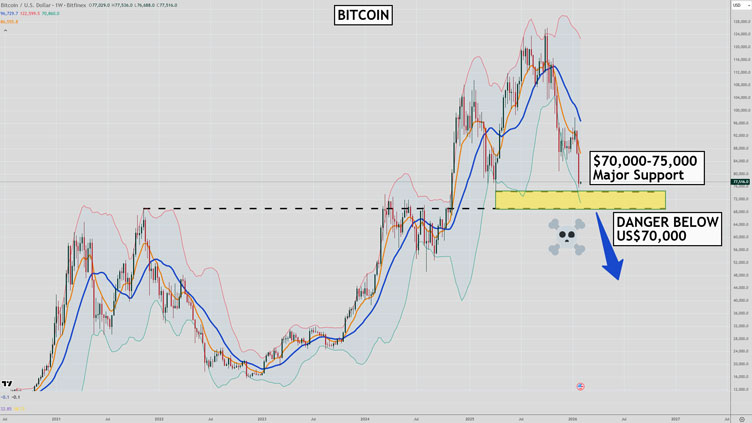
Bitcoin has remained weak over the past few months, unable to lift its head despite soaring gold and silver and the weak US Dollar Index [TVC:DXY].
It is heading towards dangerous territory and needs to hold above major support around US$70,000-75,000.
Below there we could see a cascade of selling erupt.
Michael Saylor’s Strategy Inc [NASDAQ:MSTR] owns 712,647 bitcoins with an average entry price of US$76,037 per bitcoin.
It will be interesting to see what they do with their holding if the price of bitcoin collapses below major support.
The current uptrend in bitcoin that began in November 2022 will be under threat on a fall below US$74,500. A further fall below US$69,000 will take Bitcoin below the major high hit in November 2021.
That’s why I think we need to see US$70,000-75,000 providing strong support. Because if that area doesn’t hold the chart starts to look very bearish indeed.
Regards,

Murray Dawes,
Retirement Trader, International Stock Trader and
Murray’s Trading Room





Comments