




Let’s put the budget behind us today and start looking ahead, focusing on what we CAN do to control the returns within our portfolio.
As I mentioned on Wednesday, focusing on businesses with an external (overseas) presence could be one way to separate yourself from the evolving investment risks in Australia.
There’s a smattering of ASX names across tech, financials, and industrials that have built a strong overseas presence and could de-risk them from some domestic challenges.
So, if you are concerned about the domestic policies and how they could affect your investments, there are strategies to limit that risk.
Start by building international exposure into your portfolio.
Whether that’s directly with overseas listed stocks, or indirectly with local ASX companies that generate international revenue.
But as I mentioned on Wednesday, mining companies are another great way to gain that international exposure.
That’s because commodity demand is tied to global events, not local issues. And that could reduce some of the domestic overreach we’ve seen in Australia.
The recent spike in ASX coal producers is a good example; the disruption of Liquefied Natural Gas (LNG) shipments from the Middle East prompted a surge in gas-to-coal switching in Asia.
Of course, while you’re a resident of Australia, any gains you make will still be liable for higher capital gains tax under the new budget rules.
But at least the companies themselves are able to benefit from what occurs abroad, and that should improve your bottom line, even if you do lose a larger share to tax.
So, with that in mind, let’s look at some other strategies to boost the control you can have over your investments.
Sharpening your technical insights
As you may know, I’m a geologist who’s worked in industry for several years.
I’ve worked in Australia and overseas across a variety of commodities: gold, copper, zinc, iron ore, nickel, manganese, and uranium.
All within different deposit types and styles.
But here’s the thing; 90% of what you might try to learn in geology has little relevance to the investor.
Often, geologists spend their careers formulating ideas and delving deeply into the minutest details.
And from what I’ve seen, it causes many of them to lose sight of the bigger picture.
Geologists are technical experts in the niche fields they focus on, but often they lack a practical understanding of what’s actually important for recognising an economically viable deposit.
It’s one reason why geologists often make terrible investors!
We’re all limited by the time we have, so separating the noise from what is important is one of the most important skills a geologist (or investor) can have.
That’s why I like to separate ‘academic geology’ from ‘investment-focussed geology.’
Distilling the aspects of this profession that are relevant for making gains on the stock market.
So, what are they?
First-up: Drill results are the bread and butter for junior mining stocks. Everything hinges on what comes out of the ground.
It’s obvious, but investors don’t pay enough attention to the vital stage that either makes or breaks a company.
So, your first critical step is to understand drill assay results, the critical numbers that get reported in ASX announcements. And typically follow a headline like: “Outstanding Drill Results.”
And in just a moment, I’ll get to why these results are rarely good at all.
But before we do that, let’s step back; where do these drill results come from, and what exactly are they?
Well, the whole process of getting to a drill hole announcement in an ASX release is a little bit like a production line of events.
First, the geologist decides where to drill; from there, they’ll engage a drilling company to drill test several targets.
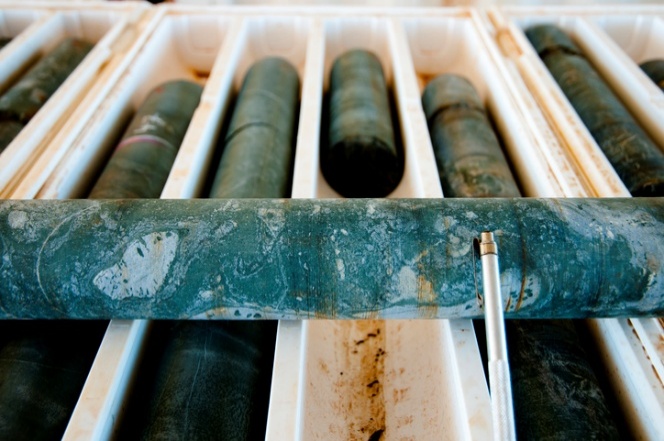
The drillers move in, and with powerful machines, they use diamond-tipped bits, barrels and winches to cut and pull that rock sample from the ground.
The net result looks like this:
Source: iStock Images
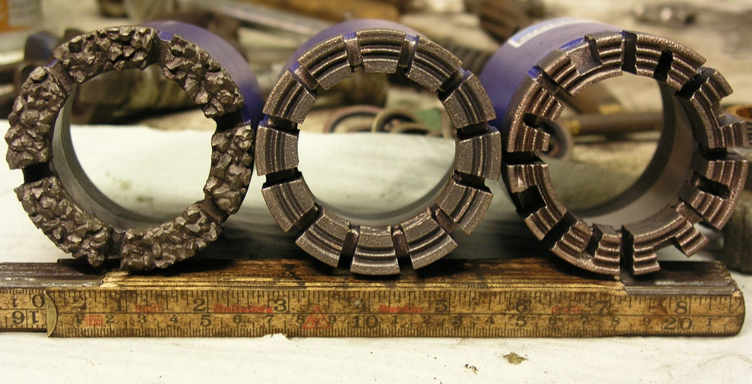
These drill bits are hollow; they sit at the end of a long string of core barrels that contain the core once it’s cut.
These core samples then get lifted through the barrel to the surface and placed in a tray. Here’s a picture of what those drill bits look like:
Source: Precision Drilling Australia
From there, the geologist inspects and logs the core. They may have some idea of what this rock contains based solely on visual inspection.
But for a metal like gold, the mineralisation is typically invisible.
After logging, the core is cut in half and sent to an independent lab for analysis. This will give the geologist the precise quantities of metals held in that rock.
At this point, geologists make sure they are the only ones who can identify where the sample came from. This information is kept strictly confidential.
Once at the lab, the core is pulverised and undergoes several processing steps to separate the metal from the rock.
You could think of it like a mini processing plant; the steps involved are quite similar to those in a full-scale mine, separating metal from waste rock.
Geologists tend to request a whole suite of metals in the analysis, particularly in the early exploration stages when there’s little understanding of what might be there.
This could include dozens of commercial metals.
The lab then reports the data back to the geologist.
In precious metals, this is expressed in grams per tonne. In industrial metals, where the grades are higher, they’re reported as a percentage, e.g., 1% copper over a set interval, usually 1 metre.
Okay, that’s the nuts and bolts of how samples are made, sent to the lab and reported back to the geologist.
Next week, I’m going to show you a tactic that allows you to really understand these results better than most.
Tips on separating the fluffy drill announcements from the potentially deposit-making results.
This is what you need to know as an investor.
Stay tuned!
Regards,

James Cooper,
Mining: Phase One and Diggers and Drillers




Comments