

I’m feeling a bit…out of sorts.
You see…there’s something you need to know about me.
I can’t explain it…but…
I just have to be doing the opposite of most people. I don’t know why I carry this curse. It’s always been this way.
Let me give you an example. Back in 2007 I started reading about sugar, and how bad it was.
Suddenly I became an anti-sugar nut.
Down with Coke! Processed food is from the devil!
If I was more entrepreneurial, I might’ve recognised this was a “fat tail” idea going mainstream.
Plenty of people and companies rode this trend for good coin indeed. I made no money from it at all.
By 2017, the sugarless trend was a mainstream idea. But you know what?
I was back to drinking Coke and having sugar in my coffee.
What was I thinking? Oh dear…
‘Stop being such wimps!’ ‘A bit of sugar never hurt anyone!’
Yes, it’s true. It’s ridiculous. But that’s me.
But my innate contrarian is darn handy in financial markets, where, to make good money, you do need to be doing something different from the herd.
That’s why I’m feeling antsy.
Two years ago, I was screaming to buy the market. I was loading my SMSF with bitcoin and stocks. I told my subscribers the same.
Now, the markets are recovered. Many are around all time highs.
Suddenly, I’m on the same side as everybody else.
This is leaving me in a tricky spot. I know that being “contrarian” just for the sake of it doesn’t work.
You can be contrarian and still be wrong. My longer term positions are in place for the long haul. They can stay that way.
But I’m an opportunist too. There’s always a way to make (and lose!) money in the short term.
However, basic logic tells us that the risk v reward of the general market is not as good as it was.
Where in the world can we see opportunity?
One idea is to embrace a new strategy.
One idea that springs to mind, for me, is options.
Let me say now that these are high risk. You can lose 100% of capital.
However, that’s “ok” if you recognise this and only put at risk a tiny portion of your total capital.
I’m talking amounts as low as $1000, as an example.
If that sounds like a lot of money to lose, take this idea and shred it. Options aren’t for you.
Why discuss it?
I’m thinking of an associate of mine. He was a pro trader for an investment bank back in the day. He’s not like most. He likes to do things different to most, like me.
One way he does that is by trading volatility.
Huh?
The idea is to not try and guess the direction of markets.
Up, down…it’s hard to tell which way the market will go at any given time.
What an options trader might do is buy both a call option and a put option.
One will go up in price, and one will go down, depending on which way the market goes.
How does our hypothetical trader make money?
If that’s all that happens, then they won’t.
But if volatility spikes, they might!
You see…options go up in price (cost) when volatility goes up.
So, if we get a big spike in volatility, one of the hypothetical options above (the call or the put) will go up so much that it will cover the cost of the option that goes to zero…with profit to spare.
That’s the general idea anyway.
This strategy would’ve worked a beauty in April, when Trump’s “Liberation Day” tanked the market and sent volatility skyrocketing.
In hindsight, I missed a trick there, because I could see the market was tentative around tariffs before the announcement. I wasn’t aggressive enough to pounce on the possibility.
As it is now, volatility is very low…
|
|
| Source: Google |
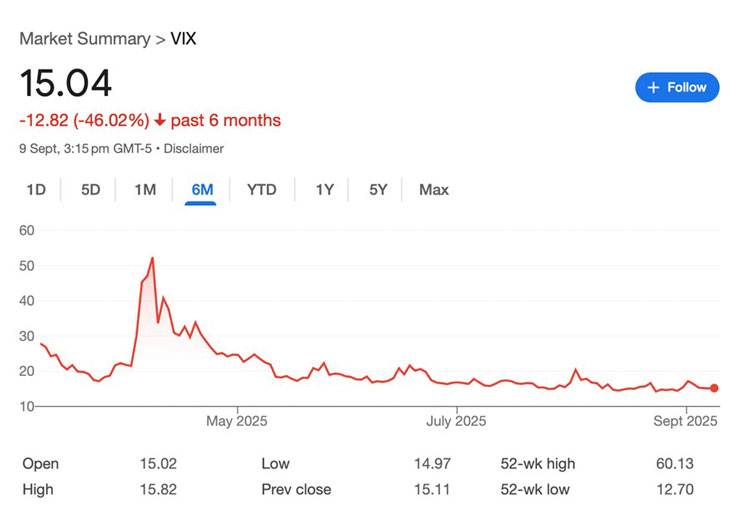
Here’s a risk warning. It could stay that way! The options strategy I just described won’t work if that happens.
Now this is where you and I have to put our heads together.
Is there something out there in the world that could send volatility up in a big way?
Your guess is as good as mine. One might be bond markets. Another could be geopolitics.
But they are always in the background. Why now? That’s the question we need to know.
Let me also say that I am no options expert. It’s a field of finance I’m still exploring.
However, we do know that markets are never so easy that we can keep doing the same thing and expect the same result.
Markets never do what everyone expects. That’s what makes them hard. It’s also what makes a profit possible.
Best Wishes,

Callum Newman,
Australian Small-Cap Investigator and Small-Cap Systems
***
Murray’s Chart of the Day –
S&P/ASX 200


Source: TradingView
[Click to open in a new window]
|
Last week saw the first sign of weakness in the incredible rally of the past five months.
The S&P/ASX 200 [ASX:XJO] confirmed a weekly sell pivot.
I have placed a circle on all the weekly sell pivots over the past four years above.
You can see during the weak trading period from mid-2021 to the start of 2024, the weekly sell pivots gave you plenty of warning that things were about to turn nasty.
Their strike rate of success during that period was very high.
But when the market started trending higher in 2024, there were a bunch of false signals.
Intuitively that makes sense.
When the market is trending up, it is the weekly buy pivots that will have a higher chance of success.
Like any indicator you have to understand the context. You must add other filters to ensure you are only taking signals which have the highest chance of success.
The way I increase the odds of success with signals is to understand where the buy and sell pivots are occurring in relation to major waves or ranges.
The ASX 200 has recently broken out to a new all-time high and has been rallying in a straight line for five months.
In other words, the possibility of a false break of the previous all-time high and a correction after five months of rallying is fairly high.
Therefore this weekly sell pivot has a fairly good chance of turning into a more substantial sell-off.
When you add in the seasonally weak months of September and October on top, it means I am now wary of what comes next.
The weekly uptrend remains in place and won’t turn down unless there is a much bigger correction.
The monthly uptrend is also solidly pointing up.
That means we could see a fairly good correction over the next month or two and still have the big picture looking bullish.
So it is a time to hold onto current positions and sit back and see what happens.
Adding more risk at this point isn’t advisable until we get the green light from the charts.
But as far as dumping positions in a panic, we are nowhere near that point yet.
Regards,

Murray Dawes,
Retirement Trader and International Stock Trader




Comments